Chassis Code Explained
| Segment | Meaning | Detail |
|---|---|---|
| D | Model series | D — DE-series FTO platform |
| E | Body type | E — FTO coupe body series |
| 3 | Engine displacement | 3 — 2.0L engine (6A12 V6) |
| A | Variant | A — high-spec GPX/GR MIVEC variant |
DE3A is the V6 MIVEC variant (GPX/GR, 200 PS); the four-cylinder variant uses the DE2A code (4G93, 125–135 PS). Both were sold in Japan only from 1994 to 2000.
Editorial notes
Key Takeaways
The FTO is a one-generation car. Production ran from October 1994 to 2000, with a single mid-cycle facelift in February 1997. The split that actually matters to a buyer isn't pre-facelift versus facelift. It's which engine the FTO has under the hood. The 4G93 1.8 four-cylinder is the easy daily driver. The non-MIVEC 6A12 V6 in the GX is the in-between car. The MIVEC V6 in the GPX and GP Version R is the FTO people actually want.
- GPX/GR MIVEC V6 manuals command the strongest premiums
- Timing belt + water pump history matters more than mileage
- INVECS-II auto is common; manuals are rarer and pricier
- Rust + crash repairs are the biggest value killers
- Parts are doable but trim/lighting can be slow to source
- Values steady; best cars rising as US eligibility expands
Variants & Trims
The FTO came in GS and GR with the 1.8 four-cylinder, GX with the non-MIVEC V6, and GPX and GP Version R with the MIVEC V6. The COTY Limited Edition GPX was a celebration trim for the 1994-95 Japan Car of the Year win. The GP Version R is the one to find. It got Recaro seats, a Momo steering wheel, a viscous LSD, twin-piston front brakes, and a strut-tower brace as standard. Most of the difference between the trims is gear and brakes, not power.
| Generation | Trim | Engine | Key Features |
|---|---|---|---|
| FTO (DE2A) pre-facelift | GS | 4G93 1.8 I4 NA | Base model, 14in wheels, ABS optional, cloth seats |
| FTO (DE2A) pre-facelift | GR | 4G93 1.8 I4 NA | Sportier suspension, 15in wheels, rear spoiler, ABS |
| FTO (DE2A) pre-facelift | GR Sports Package | 4G93 1.8 I4 NA | Aero kit, larger spoiler, sport seats, 15in wheels |
| FTO (DE2A) pre-facelift | GPX | 6A12 2.0 V6 MIVEC NA | MIVEC V6, 15in wheels, 4WS optional, sport interior |
| FTO (DE2A) pre-facelift | GPX Sports Package | 6A12 2.0 V6 MIVEC NA | Aero kit, sport seats, larger spoiler, 16in wheels |
| FTO (DE2A) pre-facelift | GP Version R | 6A12 2.0 V6 MIVEC NA | Recaro, Momo, LSD, 16in wheels, aero, firmer sus |
| FTO (DE2A) pre-facelift | GX | 6A12 2.0 V6 NA | Non-MIVEC V6, comfort trim, ABS, 15in wheels |
| FTO (DE2A) facelift | GS | 4G93 1.8 I4 NA | Updated lamps/bumper, 15in wheels (market dep.), ABS |
| FTO (DE2A) facelift | GR | 4G93 1.8 I4 NA | Sport suspension tune, 15in wheels, rear spoiler, ABS |
| FTO (DE2A) facelift | GPX | 6A12 2.0 V6 MIVEC NA | MIVEC V6, 16in wheels (market dep.), 4WS optional |
| FTO (DE2A) facelift | GP Version R | 6A12 2.0 V6 MIVEC NA | Recaro, Momo, LSD, 16in wheels, aero, uprated brakes |
Should You Buy a Mitsubishi FTO FTO?
The FTO is one of those cars where the good stuff and the bad stuff are pretty obvious once you've driven one. The MIVEC V6 is the reason to buy it. The front-wheel drive layout is the reason a lot of people skipped it back in the day. Most of what's listed below comes down to that one tradeoff.
Why You'll Love It
- MIVEC V6 character 6A12 MIVEC pulls hard up top with a distinct cam change feel; great sound for the money.
- Chassis balance (FWD done right) Light, predictable, and eager turn-in; rewarding on B-roads without big power.
- Affordable 90s JDM coupe entry Typically far cheaper than DC2/Type R, Supra, or RX-7; good value per fun.
- Usable daily ergonomics Comfortable seating and visibility; easier to live with than many low-slung rivals.
- Strong community knowledge UK/Japan owner base provides guides for MIVEC upkeep, swaps, and suspension setups.
- Distinct styling and rarity Less common than Integra/Celica; stands out at meets without supercar pricing.
Why You Might Not
- Parts scarcity for trim/lighting Mechanical parts are manageable, but OEM interior/bumper/lamp pieces can be slow or costly.
- INVECS-II auto limits appeal Many cars are automatic; it dulls engagement and can cap resale versus 5MT.
- Timing belt service is critical Neglect risks major engine damage; buyers should budget belt, pump, seals if unknown.
- Rust and prior crash repairs Imports can hide corrosion or accident history; poor repairs hurt alignment and value.
- FWD traction limits tuning Big power builds fight wheelspin and torque steer; best enjoyed near stock power.
- Insurance/valuation variability Some markets undervalue niche JDM models; agreed-value policies are recommended.
Who Should NOT Buy This
- Anyone needing reliable daily transport with no downtime
- Buyers without access to JDM parts sourcing
- People who can’t DIY or pay for specialist labor
- Drivers over 6'2" wanting helmet clearance
- Anyone needing usable rear seats for adults/kids seats
- Hot-climate owners who won’t refresh cooling system
- Rust-belt buyers without dry storage and rustproofing
- Anyone expecting modern crash safety and airbags coverage
- People who hate chasing electrical gremlins
- Automatic-only buyers unwilling to rebuild an aging auto
- Emissions-strict areas where OBD testing is required
- Owners who won’t do timing belt on schedule
- Track users who won’t budget for brakes/bushes/cooling
- Buyers expecting cheap, fast dealer parts availability
- Anyone allergic to interior rattles and 90s plastics
- People who need strong A/C without refurbishment
Common Issues & Solutions
The FTO is a reliable car if you keep up with the basics. Most of the trouble comes from age and skipped maintenance, not from the engineering. The timing belt is the single biggest one. Miss the belt interval on the 6A12 and you'll likely total the engine, since it's an interference design. After that it's the usual 25-year-old car stuff. Cooling systems get tired. ECU capacitors leak. Auto transmissions that never got an ATF service start flaring on the 2-3 shift. None of these are FTO-specific design flaws. They're just what happens when a car gets old.
| Issue | Cause | Solution | Est. Cost |
|---|---|---|---|
| Timing belt failure | Overdue belt/tensioner; unknown service history | Full kit: belt, tensioner, idlers, water pump | $700-1400 |
| Overheating in traffic | Aging radiator, stuck thermostat, weak fan relays | Replace rad/thermostat; test fans, relays, wiring | $400-1200 |
| Head gasket failure | Prior overheating; poor coolant maintenance | HG job, machine heads, new bolts, full cooling service | $1800-3500 |
| Valve stem seal smoke | Aged seals; high-vac decel pulls oil past guides | Replace valve seals; inspect guides; new plugs | $900-2000 |
| Cam cover oil leaks | Hardened gaskets; PCV restriction increases pressure | New gaskets, grommets; service PCV and breather hoses | $150-450 |
| Front cover oil leak | Sealant failure; crank seal seep during belt service | Reseal front cover; replace crank/cam seals | $600-1400 |
| MIVEC not engaging | Low oil, wrong viscosity, clogged solenoid/filter | Correct oil; clean/replace solenoid; check oil pressure | $120-600 |
| High-rpm misfire | Old plugs/leads/coils; weak alternator voltage | Ignition refresh; check charging; clean grounds | $200-800 |
| ECU capacitor leakage | Aging electrolytics leak and damage PCB traces | ECU rebuild/recap; repair traces; verify sensors | $250-900 |
| Idle hunting/stalling | Dirty IAC/throttle; vacuum leaks; aging TPS | Clean throttle/IAC; smoke test; set TPS/base idle | $150-600 |
| INVECS auto shift flare | Worn clutch packs/valve body; old ATF; heat damage | Fluid service may help; rebuild trans if persistent | $250-3500 |
| Auto delayed engagement | Internal seal wear; low line pressure; clogged filter | Pressure test; rebuild or replace transmission | $1800-4000 |
| Manual 2nd gear grind | Worn synchros; wrong oil; aggressive shifting | Try correct gear oil; rebuild gearbox if needed | $120-2500 |
| Clutch slip/shudder | Worn disc/pressure plate; oil contamination; mounts | Clutch kit; resurface flywheel; fix leaks/mounts | $700-1500 |
| CV boot failure | Age/heat cracks boots; grease loss accelerates wear | Replace boots early or swap axle if clicking | $150-450 |
| Wheel bearing noise | Age/water intrusion; impacts from potholes | Replace hub/bearing assembly; torque to spec | $250-650 |
| Rear toe bush wear | Soft bushes; age; lowered cars accelerate wear | Replace toe link/trailing arm bushes; align properly | $400-1200 |
| Steering rack knock/leak | Worn inner joints; torn boots; seal wear | Replace inner tie rods/boots; rebuild/replace rack | $350-1400 |
| Power steering pump whine | Air leaks at hoses; old fluid; pump wear | Replace suction hose clamps; flush; pump if needed | $120-650 |
| Seized caliper slide pins | Lack of lube; torn boots; corrosion | Rebuild calipers; new pins/boots; replace pads/rotors | $250-900 |
| ABS warning light | Wheel speed sensor failure; cracked tone rings/wiring | Scan codes; replace sensor; repair wiring; clean rings | $150-600 |
| Brake line corrosion | Road salt; aged coatings; trapped moisture | Replace hard lines; flush fluid; inspect flex hoses | $400-1200 |
| Heater core leak | Corrosion; old coolant; electrolysis | Replace heater core; flush system; new coolant | $700-1500 |
| A/C not cold | Leak at condenser/evap; weak compressor; bad relay | Leak test, replace failed parts, evacuate/recharge | $250-1400 |
| Window regulator failure | Cable fray; dry tracks; motor strain | Replace regulator; lube tracks; check door seals | $180-450 |
| Exterior door handle breaks | Brittle plastic/metal fatigue; misadjusted latch | Replace handle; adjust latch; lube mechanism | $120-350 |
| Water leaks into cabin | Sunroof drains/cowl drains clogged; seam sealer cracks | Clear drains; reseal; dry and treat rust immediately | $100-800 |
| Trunk/spare well flooding | Tail light seals, trunk vents, seam sealer failure | Replace seals; reseal seams; treat rust; verify drains | $150-900 |
| Rust in sills/arches | Poor factory protection; trapped mud; prior repairs | Cut/weld properly; cavity wax; avoid filler-only jobs | $800-5000 |
| Fuel economy poor | O2 sensor aging; thermostat stuck open; vacuum leaks | Scan trims; replace O2; fix leaks; thermostat | $150-700 |
| Alternator weak output | Worn brushes/diodes; heat; poor grounds | Rebuild/replace alternator; clean grounds and cables | $250-650 |
| Engine mount collapse | Age and oil saturation; aggressive driving | Replace mounts; fix oil leaks to prevent repeat | $250-900 |
Differences between JDM & USDM
The FTO was never sold in the United States. Mitsubishi did not federalise the car for the US market — it missed period side-impact and bumper-impact regulations, and the company never engineered a US-spec variant. Under the 25-year exemption, 1994 cars became eligible to import in 2019, with the final 2000 cars eligible in 2025. State-level rules vary, particularly in California, where ARB compliance can complicate registration. Outside Japan, the only export market that received the FTO through factory channels was the United Kingdom, where Mitsubishi authorised approximately 1,000 dealer-supplied cars near the end of production after years of established grey-market demand. Australia, New Zealand, Ireland, Hong Kong, Singapore, and Malaysia received cars almost entirely through private grey-market import. None of these markets received a federalised US version — every FTO in North America today is a Japanese-build right-hand-drive car imported under the 25-year rule.
Pre-Purchase Inspection Checklist
Walk through this list with the seller present. The Critical items are the ones where you walk away if there's no paperwork backing them up. The High items can usually be priced into the deal. Pay particular attention to the timing belt history on any V6 FTO. A belt that's overdue isn't a negotiation point on the price. It's a reason to keep looking.
Critical Priority
High Priority
Medium Priority
Low Priority
Generation History
FTO (DE2A/DE3A/DE4A) (1994-2000)
- FWD coupe; 4G93 I4 or 6A12 V6 options
- MIVEC V6 (GPX/GR) is the enthusiast pick
- INVECS-II auto common; 5MT rarer
- Facelift updates lights/trim; late cars best sorted
- Popular in Japan/UK; strong aftermarket support
Sales Numbers by Year
| Year | Domestic | Notes |
|---|---|---|
| 1994 | 9,232 | Launch year; partial-year production from October |
| 1995 | 19,629 | |
| 1996 | 3,811 | |
| 1997 | 1,994 | Facelift (February 1997); 5-speed Jatco F5A5 automatic replaces INVECS-II 4AT |
| 1998 | 1,138 | |
| 1999 | 690 | |
| 2000 | — | Final year; production ended ahead of new Japanese side-impact regulations. WP-sourced production table left this cell blank. |
Market Data
The FTO came in GS and GR with the 1.8 four-cylinder, GX with the non-MIVEC V6, and GPX and GP Version R with the MIVEC V6. The COTY Limited Edition GPX was a celebration trim for the 1994-95 Japan Car of the Year win. The GP Version R is the one to find. It got Recaro seats, a Momo steering wheel, a viscous LSD, twin-piston front brakes, and a strut-tower brace as standard. Most of the difference between the trims is gear and brakes, not power.
Production Numbers & Rarity
| Generation | Years | Total Built | Notes |
|---|---|---|---|
| FTO (DE2A) pre-facelift | 1994-1996 | ~estimated | Exact split not published; estimate only |
| FTO (DE2A) facelift | 1997-2000 | ~estimated | Exact split not published; estimate only |
| FTO (DE2A) total | 1994-2000 | ~36,000 (estimated) | Commonly cited total; factory figure not verified |
Rarest variant: GP Version R (5MT)
How It Compares
Against the Integra DC2 and the Celica ST202, the FTO is the rare one and the cheapest of the three. The Integra wins on aftermarket depth and pure track focus. The Celica wins on reliability baseline and parts availability. The FTO wins on character, since the MIVEC V6 sounds nothing like a four-cylinder VTEC and there's nothing else in the segment that has one.
| Feature | FTO | Honda Integra DC2 | Toyota Celica ST202 |
|---|---|---|---|
| Layout/drive | FWD | FWD | FWD |
| Engine highlight | 6A12 2.0 V6 MIVEC | B18C 1.8 I4 VTEC | 3S-GE 2.0 I4 |
| Power (JDM rating) | ≈200 hp (MIVEC V6) | ≈200 hp (Type R) | ≈170-180 hp |
| Transmission feel | 5MT rare; auto common | 5MT common; crisp | 5MT common; solid |
| Handling character | Neutral, playful FWD | Track-focused, sharp | Stable, GT-leaning |
| Weight feel | Light coupe feel | Very light, focused | Slightly heavier GT |
| Aftermarket depth | Good, niche | Excellent, huge | Good, broader |
| Reliability baseline | Good if serviced | Excellent | Very good |
| Known weak points | belt service, trim parts | rust, synchros, theft | rust, oil use (varies) |
| Cabin/comfort | Comfortable, sporty | More spartan (Type R) | More GT comfort |
| Market pricing (US) | Lower, rising slowly | Higher, strong demand | Similar to slightly lower |
| RWD alternative feel | FWD agility | RWD balance | RWD coupe torque |
| Power upgrade path | Limited w/o traction | Turbo paths common | Turbo 1JZ headroom |
Comparable Alternatives
If the FTO doesn't end up being your car, the natural alternatives depend on what drew you in. If it was the MIVEC sound, the Honda Integra DC2 Type R is the obvious comparison and the prices reflect it. If it was the FWD coupe layout, the Toyota Celica ST202 is easier to live with. If you decide you actually want rear-wheel drive, the Silvia S14 is where most FTO shoppers end up.
Mazda MX-5 NA/NB
Lightweight handling benchmark; simpler ownership
Hyundai Tiburon GK
Modern cheap coupe option; easier US parts/support
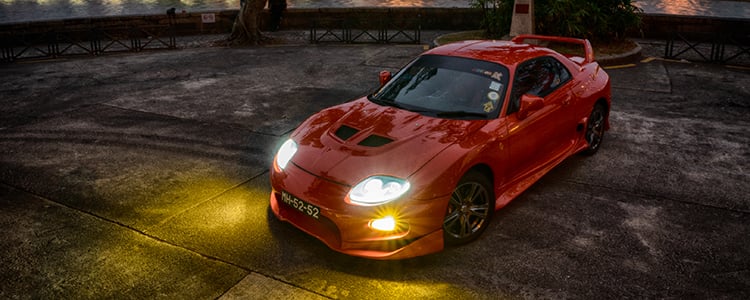
In Pictures
The Buyer's Read
The strongest starting point is a documented 1997 to 2000 facelift GPX or GP Version R with the MIVEC V6 and the 5-speed manual. That combination gives you the twin-piston front brakes, the post-facelift suspension tune, and — on the Version R — the strut-tower brace, Recaro seats, viscous LSD, and Momo wheel as standard.
Skip any V6 car where the seller cannot produce a timing belt invoice. The 6A12 is an interference engine; belt failure typically costs more than the car. If history is unclear, budget $700 to $1,400 for a full kit — belt, tensioner, idlers, and water pump — before you drive it home.
A clean GS or GR with the 4G93 1.8 four-cylinder is a reasonable bargain entry. The chassis is the same, the manual gearbox is more common in these trims, and running costs are lower. Resale will reflect the missing MIVEC top end.
The INVECS-II 4-speed automatics — especially pre-facelift cars — are the cars to price carefully. A tired INVECS gearbox flares on the 2-3 shift and a rebuild runs $1,800 to $4,000 on a car that may only be worth $10,000 to start.
Modified examples with cut springs, loud exhausts, and aftermarket wiring typically sell below stock equivalents; the FWD layout limits what power upgrades actually deliver. Current FTO listings show how condition and documentation separate the top of the range from the bottom.
Frequently Asked Questions
- Which Mitsubishi FTO trim is the one to buy?
- Look for GPX/GR with 6A12 MIVEC and 5MT. Clean, stock cars with service records bring the best resale.
- Is the FTO fast by modern standards?
- It’s quick enough for fun, not a rocket. The appeal is revvy MIVEC character and chassis balance, not big straight-line speed.
- Are automatic FTOs worth buying?
- Yes if priced right and clean, but INVECS-II auto is less desirable. Manuals are rarer and usually hold value better.
- What maintenance is non-negotiable on an FTO?
- Timing belt + water pump on schedule, plus fluids and cooling health. Budget a full baseline service if history is unclear.
- What are common problem areas to inspect?
- Check for rust, accident repairs, worn suspension bushings, cooling issues, and electrical gremlins from age or poor mods.
- How hard are parts to source in 2026?
- Most wear items are manageable, but OEM trim, lights, and interior bits can be scarce. Plan for import lead times.
- What mods help without hurting value?
- Quality suspension refresh, good tires, mild brake upgrades, and tasteful wheels. Avoid cut springs, loud exhausts, and hacked wiring.
- When is the Mitsubishi FTO US-legal?
- Under the 25-year rule, 1994 cars became legal in 2019. The newest 2000 cars become legal in 2025 (state rules vary).
Sources & References
Sources (9)
- Mitsubishi FTO — encyclopedic overview, chassis codes, production, and awards — WikipediaVerified
- Mitsubishi FTO 1994-2005 buyer's review — RACVerified
- The Mitsubishi FTO is a JDM car that you never knew existed — MotorBiscuitVerified
- 1995 Mitsubishi FTO owner reviews — CarGurusVerified
- FTO Owners Club — FTO Owners ClubVerified
- Mitsubishi 6A1 engine family — 6A12 V6 specifications and MIVEC variants — WikipediaVerified
- MIVEC variable valve system — technical overview — WikipediaVerified
- Car of the Year Japan — 1994-95 winner record — WikipediaVerified
- Mitsubishi FTO — community-maintained model overview — Automobile WikiVerified
Sources last verified: