Buyer's guide
15 min read
Mitsubishi Galant
Buyer's guide & specs
- Production
- 1969-2012
- US legal
- 2014
- 25-yr rule
- Market range
- $2K–$45K
- median ~$12K
- For sale
- 2
- active now
On this page
Quick answer
The Mitsubishi Galant spans economy sedans to rally-bred VR-4 icons, with values split between cheap daily drivers and collectible JDM performance trims. Buy condition-first: rust, timing belt history, and trim authenticity drive pricing more than mileage.
Background
Overview
The Mitsubishi Galant ran from 1969 through 2012 across nine generations, covering everything from RWD economy sedans to AWD turbo homologation specials. The car most buyers want is the E39A VR-4 — the 1987-1992 sixth-generation AWD sedan with the 4G63T that became the direct mechanical predecessor to the Lancer Evolution. JDM-only performance grades include the 500-unit Galant AMG (170 PS), the E54 Super VR-4 (6A12TT, 240 hp), and the EC5A VR-4 (6A13TT, 2.5L, 276 hp / 280 PS) — none were officially exported. The E39A VR-4 leads current collector pricing; base USDM sedans remain cheap and condition-dependent.
Galant VR-4 vs Lancer Evo — the origin question
Mitsubishi entered the sixth-generation E33/E39 Galant in Group A rally in 1987, running a 4G63T producing over 300 horsepower with AWD and four-wheel steering on homologation grades. The 5,000-unit production minimum required by Group A rules produced the JDM-market Galant VR-4 (E39A) — the same 4G63T engine, AWD drivetrain, and 5-speed manual that Mitsubishi carried directly into the Lancer Evolution I in 1992.
Stock JDM E39A output was 237-240 hp; the 1989-1990 Galant AMG special-edition raised that to 170 PS with revised cams and intake while retaining the same drivetrain. The Lancer Evolution's homologation lineage and the 4G63T's platform begin with the Galant, not the Lancer.
Today the E39A Galant VR-4 trades at prices well below equivalent Evo I-III cars despite sharing approximately 80 percent of the performance hardware. The gap reflects market recognition, not a meaningful performance difference between the two platforms.
JDM Galant AMG and the seventh-generation Super VR-4
The 1989-1990 Galant AMG was a 500-unit collaboration between Mitsubishi and AMG — the second Mitsubishi to receive AMG treatment. Output from the 4G63T rose to 170 PS versus 143 PS in the standard VR-4, and the package added a wide-body kit, wooden interior trim, and AMG-specific wheels. BaT auction results from the early 2020s placed clean examples around $8,900 — low for what it is.
The seventh-generation E54 Super VR-4 (1992-1996) replaced the 4G63T with the 6A12TT 2.0L twin-turbo V6, rated at 240 hp and limited to 240 km/h. Neither the Super VR-4 nor the eighth-generation EC5A VR-4 (1996-2002) was officially exported.
The EC5A VR-4 used the 6A13TT 2.5L twin-turbo V6 making 276 hp / 280 PS and included Active Yaw Control — the torque-vectoring rear differential later made familiar by the Evo VIII MR.
Editorial notes
Quick read
Key takeaways
- VR-4 is the value leader; rarity and originality matter most
- USDM base trims stay cheap; condition beats mileage
- Rust + neglected timing belts are the biggest deal-killers
- Manual + AWD + turbo combos command the strongest premiums
- Parts vary by gen; DSM/4G63 support helps 6G VR-4
- Import legality: 1989 models legal in 2014; 1992 in 2017
Constants
Common across all Galant generations
- Mid-size sedan body across all generations
- VR-4 performance variants combine turbocharging with all-wheel drive
- E39A and E84A VR-4 variants use the turbocharged 4G63T inline-four
- EC5A VR-4 variant uses the 6A13 twin-turbo V6
- Right-hand drive available throughout JDM production
Chassis history
Generation timeline
The Galant ran for nine generations from 1969 until 2012, which is a long time for any nameplate. The early cars were rear-wheel-drive economy sedans. The middle ones turned into the AWD turbo homologation specials that everyone actually cares about. The last few were front-wheel-drive Camry fighters built in Illinois. If you're shopping a Galant today, you're really shopping one of three or four cars wearing the same badge.
Sixth generation — E30 series, incl. VR-4 (E39A); 1987–1992
Seventh generation — E50 series, incl. VR-4 (E84A); 1992–1996
Eighth generation — EA/EC series, incl. VR-4 (EC5A); 1996–2002
Identification
Chassis-code reference
Generation names are broad families. The factory chassis codes below identify the variants represented in JDMBUYSELL's current Mitsubishi Galant guide data.
- Sixth generation — E30 series, incl. VR-4 (E39A); 1987–1992
- Chassis codes: E10, E11A, E12A, E13A, E14A, E16A, E17A, and E18A
- A50
- Chassis codes: A51, A52, A53, A54, and A55
- A100
- Chassis codes: A112, A114, and A115
- A120
- Chassis codes: A121, A122, A123, and A125
- E30
- Chassis codes: E31A, E32A, E34A, and E35A
- E50
- Chassis codes: E52A, E53A, E54A, E56A, and E74A
- EA
- Chassis codes: EA1A, EA3A, EA4A, EA5A, EA7A, EA8A, and EC5A
- DJ
- Chassis codes: DJ1A and DJ3A
Confirm the complete code on the vehicle's frame or VIN plate; drivetrain, body, and market variants can use different prefixes within one generation family.
Buyer's call
Should you buy a Mitsubishi Galant?
The Galant is cheap, practical, and on the VR-4 grades it shares most of its hardware with the Lancer Evo. That's the pull. The downside is that the Galant has been written out of the JDM canon, so parts are getting harder to find than Evo parts even though half the engine is the same. You're buying upside, but you're also buying a hunt.
Why you'll love it
- VR-4 rally-bred pedigree 6G VR-4 offers **4G63T + AWD**; real homologation-era appeal and tunability.
- Wide price spectrum From $2k beaters to $40k+ VR-4s; easy to enter, with upside in rare trims.
- Strong 4G63 aftermarket VR-4 shares ecosystem with DSM/Evo parts knowledge; supports performance builds.
- Practical sleeper packaging Sedan body, usable rear seats, and subtle looks; VR-4 is a true sleeper.
- Manuals add engagement Manual variants (esp. VR-4) are more durable-feeling and command market premiums.
- Good daily-driver value (non-VR4) Later USDM Galants are cheap transport; parts availability is generally decent.
- JDM rarity premium potential Original, unmodified VR-4s and rare specs can appreciate as 90s JDM tightens.
Why you might not
- Rust is the #1 killer Sills, arches, strut towers, and underbody corrosion can exceed car value fast.
- Timing belt service critical 4G63/4G64 belt neglect risks catastrophic damage; demand proof of service.
- VR-4 parts scarcity AWD/unique trim pieces, ECUs, and interior bits can be hard/expensive to source.
- Modded cars often abused Boosted builds may hide poor tuning, drivetrain wear, and wiring hacks.
- Auto trans wear on commuters High-mile base sedans often have tired automatics; budget for rebuild risk.
- Interior aging Dash cracks, sagging headliners, and brittle plastics common on 90s/00s cars.
- Insurance/registration friction JDM imports may face inspection hurdles; verify compliance and documentation.
Who should not buy this
- Anyone needing bulletproof automatic transmission
- Buyers without proof of timing service history
- Rust-belt shoppers unwilling to crawl underneath
- People who can't budget $1500+ surprise repairs
- Drivers who ignore maintenance intervals
- Anyone needing modern safety/ADAS features
- Those needing strong resale value
- Owners without a trusted independent mechanic
- People who require perfect A/C and electronics
- Commuters needing maximum fuel economy
- Buyers who won't do pre-purchase OBD scanning
- Anyone who can't tolerate occasional interior rattles
- Shoppers expecting easy OEM parts availability
- People who won't address small leaks immediately
- Those needing frequent towing or heavy loads
- Anyone in strict emissions areas with weak cats
Reliability
Common issues & solutions
The Galant is a tough car if it's been looked after. Most of the problems you'll see on imports come from age and neglect, not bad engineering. The 4G63T is well documented and pretty bulletproof if the timing belt has been done. The AYC pump on the AWD cars is the one expensive headache that catches people out. Rust is the other one, especially on the sills and the rear arches.
| Issue | Cause | Solution | Est. cost |
|---|---|---|---|
| Automatic trans failure | Overheated ATF, neglected service, wear | Rebuild/replace; add cooler; fluid service | $2500-4500 |
| Harsh/flare shifting | Valve body wear, solenoids, low line pressure | Valve body service/solenoids; verify pressures | $600-1600 |
| Torque converter shudder | Degraded ATF, worn lockup clutch | ATF exchange; if persists replace converter | $250-1400 |
| Timing belt overdue (4cyl) | Skipped interval; unknown history | Belt+tensioner+idler+water pump kit ASAP | $700-1400 |
| Timing chain rattle (V6) | Oil neglect; tensioner/guide wear | Chain/guides/tensioner; strict oil changes | $1200-2500 |
| Oil sludge/low oil pressure | Extended oil intervals; cheap oil; overheating | Pan clean, pickup service; may need engine | $600-4500 |
| Excessive oil consumption | Stuck rings, valve seals, PCV issues | PCV service; compression test; rebuild if bad | $80-3500 |
| Valve cover oil leaks | Hardened gaskets; PCV pressure | Replace gaskets; verify PCV; clean surfaces | $150-450 |
| Front cover/oil pump leak | Aged seals; RTV failure; crank seal wear | Reseal front cover; replace seals; inspect pump | $600-1400 |
| Overheating at idle | Fan motor/relay, clogged radiator, air pockets | Diagnose fans; replace radiator; proper bleed | $200-900 |
| Radiator plastic tank crack | Age heat-cycling; weak cap overpressure | Replace radiator and cap; flush coolant | $250-650 |
| Head gasket failure | Overheating, warped head, neglected coolant | HG job; machine head; replace thermostat/rad | $1400-2800 |
| Heater core leak | Corrosion; old coolant; electrolysis | Replace heater core; flush; new coolant | $900-1600 |
| A/C compressor failure | Wear, low oil, debris in system | Compressor+drier+flush; replace expansion valve | $900-1700 |
| EVAP leak codes | Cracked hoses, purge solenoid, gas cap, canister | Smoke test; replace failed hose/solenoid/cap | $120-600 |
| Catalyst efficiency P0420 | Aged cat, exhaust leak, upstream O2 aging | Fix leaks; verify O2; replace cat if needed | $250-1400 |
| Misfire under load | Coils, plugs, vacuum leak, injector imbalance | Tune-up; smoke test; coil/injector diagnosis | $150-900 |
| Fuel pump weak/hard start | Aging pump, clogged sock/filter, low voltage | Fuel pressure test; replace pump; check wiring | $350-900 |
| Steering rack leak | Seal wear; torn boots; contaminated fluid | Replace rack; flush system; align | $900-1600 |
| Power steering pump whine | Low fluid from leaks; worn pump vanes | Fix leaks; replace pump if noise persists | $250-700 |
| Control arm bushing wear | Age; torn rubber; pothole impacts | Replace arms/bushings; alignment | $400-900 |
| Ball joint failure risk | Boot torn; grease loss; corrosion | Replace joint/arm; do both sides if worn | $300-800 |
| Strut/shock wear | High mileage; leaking seals | Replace struts; mounts; alignment | $600-1300 |
| Wheel bearing growl | Water intrusion; age; impact damage | Replace hub/bearing assembly | $250-600 |
| CV axle clicking/vibration | Boot failure; joint wear; cheap reman axles | Replace with quality axle; new seals if leaking | $250-650 |
| Brake caliper seizure | Corroded slides; torn boots; old fluid | Replace caliper; service slides; flush fluid | $250-700 |
| Brake hard line rust | Road salt; poor undercoating; age | Replace lines; inspect all unions; bleed system | $600-1600 |
| ABS wheel speed sensor | Corrosion at tone ring; broken wiring | Replace sensor/repair harness; clean tone ring | $150-450 |
| Rear subframe rust rot | Salt exposure; trapped moisture; neglected wash | Replace subframe; rust-proof; inspect mounts | $1200-3000 |
| Rocker/floor rust perforation | Salt; clogged drains; poor prior repairs | Proper cut/weld; avoid filler-only repairs | $800-4000 |
| Water leaks into cabin | Cowl drains, door vapor barriers, sunroof drains | Clear drains; reseal barriers; dry/repair wiring | $150-900 |
| Window regulator failure | Cable fray; worn motor; dry tracks | Replace regulator; lube tracks; check switch | $200-450 |
| Door lock actuator weak | Worn motor/gears; low voltage | Replace actuator; verify grounds and battery | $180-450 |
| Cluster backlight issues | Aged bulbs/LEDs; solder cracks | Repair cluster; reflow solder; replace bulbs | $150-500 |
| SRS light on | Clock spring, seat sensor, prior crash repairs | Scan SRS; replace clock spring/sensors as needed | $200-900 |
| Engine mount collapse | Rubber separation; oil saturation | Replace mounts; avoid cheap aftermarket | $250-800 |
Market
Differences between JDM & USDM
The Mitsubishi Galant was sold in the United States continuously from 1985 through 2012, but the export car was a different vehicle from the JDM Galant. USDM Galants centered on naturally-aspirated four-cylinder and V6 engines aimed at the mid-size sedan market — competing with the Toyota Camry and Honda Accord — and the ninth-generation 2003-2012 USDM Galant was assembled in Normal, Illinois by Mitsubishi Motors North America on the PS (Project America) platform, never sold in Japan. The JDM-only VR-4 grades were the cars enthusiasts know: the E33/E39 Galant VR-4 with the 4G63T turbo and AWD (1987-1992), the seventh-generation E54 Super VR-4 with the 6A12TT twin-turbo V6 (1992-1996), and the eighth-generation EC5A Galant VR-4 with the 6A13TT 2.5L twin-turbo V6 and Active Yaw Control (1996-2002). None of these high-output VR-4 turbo grades was officially exported to North America. The Galant AMG (500 units, 1989-1990) and the Mitsubishi Legnum wagon (the AWD VR-4 wagon variant sold from 1996) were also JDM-only. For US buyers, the only path to a JDM VR-4 is the 25-year import rule: 1989 cars became legal in 2014, 1992 in 2017, and the EC5A VR-4 from 1996 in 2021.
Specs
Technical specifications
There isn't one Galant engine. Early cars ran small four-cylinders. The sixth generation brought the 4G63T turbo, which is the engine that ended up in the Evo. The seventh and eighth generation VR-4s switched to the 6A12TT and 6A13TT twin-turbo V6, which is a more complicated engine in a tighter bay. The base USDM cars used naturally aspirated fours and V6s. Match the engine you want to the chassis code before you start looking at listings.
Engine options
| Chassis | Engine | Displacement | Power | Boost | Notes |
|---|---|---|---|---|---|
| A50 | 4G30 | 1.3L | estimated | N/A | Early carb spec varies by market |
| A50 | 4G32 | 1.6L | estimated | N/A | Carb; outputs vary by year/market |
| A100 | 4G33 | 1.4L | estimated | N/A | Carb; outputs vary by market |
| A100/A120/A130/A160/A170 | 4G63 | 2.0L | estimated | N/A | Early 4G63 carb/EFI varies |
| A170 | 4G54 | 2.6L | estimated | N/A | Astron 2.6; market-dependent ratings |
| E10 | 4G37 | 1.8L | estimated | N/A | SOHC; market-dependent ratings |
| E10 | 4G63T | 2.0L | estimated | estimated | Turbo spec varies; early EFI/turbo |
| E39A (7th gen VR-4) | 4G63T | 2.0L | 237hp @ 6000rpm | estimated | JDM rating; AWD; intercooled |
| E3x (7th gen) | 4G63 DOHC | 2.0L | estimated | N/A | DOHC NA; market-dependent ratings |
| E5x/E6x (8th gen VR-4) | 4G63T | 2.0L | estimated | estimated | AWD; turbo spec varies by year |
| E5x/E6x (8th gen Super VR-4) | 6A12TT | 2.0L | estimated | estimated | Twin-turbo V6; AWD; JDM market |
| EA/EC (9th gen) | 4G93 | 1.8L | estimated | N/A | SOHC/DOHC/GDI varies by market |
| EA/EC (9th gen) | 4G64 | 2.4L | estimated | N/A | SOHC; market-dependent ratings |
| EA/EC (9th gen) | 6A12 | 2.0L | estimated | N/A | V6 NA; market-dependent ratings |
| EA/EC (9th gen) | 6A13 | 2.5L | estimated | N/A | V6 NA; market-dependent ratings |
| EC5A (9th gen VR-4) | 6A13TT | 2.5L | 276hp @ 6000rpm | estimated | JDM 280PS class; AWD; AYC |
| DJ/DM (10th gen) | 4G64 | 2.4L | 140hp @ 5500rpm | N/A | US-spec SOHC 16V (typical) |
| DJ/DM (10th gen) | 6G72 | 3.0L | 190hp @ 5500rpm | N/A | US-spec SOHC V6 (typical) |
| DJ/DM (10th gen Ralliart) | 4G63T | 2.0L | estimated | estimated | Ralliart turbo spec varies by market |
| Fortis-based | 4B11 | 2.0L | estimated | N/A | MIVEC; market-dependent ratings |
| Fortis-based | 4B12 | 2.4L | estimated | N/A | MIVEC; market-dependent ratings |
Transmission options
| Type | Ratios | Availability | Notes |
|---|---|---|---|
| 4-speed Manual | estimated | A50/A100 early trims | Early RWD manual; market-dependent |
| 5-speed Manual | estimated | Most gens (varies) | Multiple gearsets; not single global spec |
| 3-speed Automatic | estimated | Select 1970s-1980s trims | Market-dependent; early AT |
| 4-speed Automatic | estimated | E10 onward; many trims | Multiple families (INVECS, etc.) |
| 5-speed Automatic | estimated | EA/EC (some markets) | INVECS-II variants; market-dependent |
| CVT | estimated | Fortis-based (some markets) | INVECS-III CVT; market-dependent |
Lineup
Variants & trims
Most Galant trims are forgettable economy grades. The ones worth knowing are the VR-4, the Super VR-4, the Galant AMG, and on the eighth generation the EC5A VR-4 with Active Yaw Control. The Galant AMG is the rarest at 500 units. The EC5A VR-4 is the one that shares the AYC torque-vectoring rear diff with the Evo VIII.
| Generation | Trim | Engine | Key features |
|---|---|---|---|
| A50 (1st gen) | Galant A-I | 4G30 1.3L I4 | RWD, 4-door sedan, carb I4 |
| A50 (1st gen) | Galant A-II | 4G32 1.6L I4 | RWD, 4-door sedan, higher output |
| A50 (1st gen) | Galant A-III | 4G32 1.6L I4 | RWD, better trim, upgraded interior |
| A50 (1st gen) | Galant A-IV | 4G32 1.6L I4 | RWD, top trim, additional equipment |
| A50 (1st gen) | Galant GTO (coupe) | 4G32 1.6L I4 | RWD coupe, sport trim, carb |
| A100 (2nd gen) | Galant 1400 | 4G33 1.4L I4 | RWD, sedan, carb I4 |
| A100 (2nd gen) | Galant 1600 | 4G32 1.6L I4 | RWD, sedan, carb I4 |
| A100 (2nd gen) | Galant 1600 GS | 4G32 1.6L I4 | RWD, sport trim, upgraded suspension |
| A100 (2nd gen) | Galant 2000 GSR | 4G63 2.0L I4 | RWD, performance trim, twin-carb |
| A120/A130 (3rd gen) | Galant 1600 | 4G32 1.6L I4 | RWD, sedan, carb |
| A120/A130 (3rd gen) | Galant 2000 | 4G63 2.0L I4 | RWD, sedan, larger displacement |
| A120/A130 (3rd gen) | Galant GTO | 4G63 2.0L I4 | RWD coupe, sport trim, twin-carb |
| A160 (4th gen) | Galant 1600 | 4G32 1.6L I4 | RWD, sedan, carb |
| A160 (4th gen) | Galant 2000 | 4G63 2.0L I4 | RWD, sedan, carb/EFI by market |
| A160 (4th gen) | Galant Lambda (coupe) | 4G63 2.0L I4 | RWD coupe, personal luxury trim |
| A160 (4th gen) | Galant Sigma (sedan) | 4G63 2.0L I4 | RWD sedan, upscale trim |
| A170 (5th gen) | Galant 1600 | 4G32 1.6L I4 | RWD, sedan, carb |
| A170 (5th gen) | Galant 2000 | 4G63 2.0L I4 | RWD, sedan, carb/EFI by market |
| A170 (5th gen) | Galant 2600 | 4G54 2.6L I4 | RWD, torque-focused, larger I4 |
| E10 (6th gen) | Galant 1600 | 4G32 1.6L I4 | FWD, sedan, carb/EFI by market |
| E10 (6th gen) | Galant 1800 | 4G37 1.8L I4 | FWD, sedan, economy trim |
| E10 (6th gen) | Galant 2000 | 4G63 2.0L I4 | FWD, sedan, EFI by market |
| E10 (6th gen) | Galant 2000 Turbo | 4G63T 2.0L Turbo I4 | FWD, turbo, sport suspension |
| E30/E32 (7th gen) | Galant GLS | 4G63 2.0L I4 | FWD, sedan, mid trim |
| E30/E32 (7th gen) | Galant GTi-16V | 4G63 DOHC 2.0L I4 | FWD, DOHC, sport seats |
| E30/E32 (7th gen) | Galant VR-4 | 4G63T 2.0L Turbo I4 | AWD, 4WS (some), turbo, LSD |
| E30/E32 (7th gen) | Galant Wagon | 4G63 2.0L I4 | FWD/AWD by market, wagon body |
| E50/E60 (8th gen) | Galant MX | 4G93 1.8L I4 | FWD, sedan, base equipment |
| E50/E60 (8th gen) | Galant MS | 4G63 2.0L I4 | FWD, sedan, upgraded trim |
| E50/E60 (8th gen) | Galant Super VR-4 | 6A12TT 2.0L Twin-Turbo V6 | AWD, twin-turbo, 4WS (some), LSD |
| E50/E60 (8th gen) | Galant VR-4 | 4G63T 2.0L Turbo I4 | AWD, turbo, sport suspension |
| E50/E60 (8th gen) | Galant Wagon | 4G63 2.0L I4 | FWD/AWD by market, wagon body |
| EA/EC (9th gen) | Galant (base) | 4G93 1.8L I4 / 4G64 2.4L I4 | FWD, sedan, standard equipment |
| EA/EC (9th gen) | Galant Super Saloon | 6A12 2.0L V6 / 6A13 2.5L V6 | FWD, V6 option, upscale interior |
| EA/EC (9th gen) | Galant VR-4 | 6A13TT 2.5L Twin-Turbo V6 | AWD, twin-turbo, Active Yaw Control |
| EA/EC (9th gen) | Galant Legnum (wagon) | 4G93/4G64/6A13/6A13TT | Wagon, FWD/AWD, AYC on VR-4 |
| DJ/DM (10th gen) | DE | 4G64 2.4L I4 | FWD, 4AT, basic trim |
| DJ/DM (10th gen) | ES | 4G64 2.4L I4 | FWD, 4AT, power accessories |
| DJ/DM (10th gen) | LS | 4G64 2.4L I4 | FWD, 4AT, upgraded interior |
| DJ/DM (10th gen) | GTZ | 6G72 3.0L V6 | FWD, V6, sport appearance |
| DJ/DM (10th gen) | GTS | 6G72 3.0L V6 | FWD, V6, larger wheels |
| DJ/DM (10th gen) | GT | 6G72 3.0L V6 | FWD, V6, premium audio |
| DJ/DM (10th gen) | Ralliart | 4G63T 2.0L Turbo I4 | FWD, turbo, sport suspension, body kit |
| Fortis-based (11th gen, some markets) | Galant Fortis (sedan) | 4B11 2.0L I4 / 4B12 2.4L I4 | FWD/AWD by market, CVT/MT |
Pricing
Average prices & original MSRP
Galant pricing splits cleanly. Base USDM cars are depreciation specials and you can find them under $5,000. AWD VR-4 grades start above $10,000 and climb from there. The 500-unit Galant AMG has traded around $8,900 on Bring a Trailer, which is low for what it is. Clean rust-free E39A VR-4 cars are the ones that have been climbing the fastest because they're basically an Evo I at half the price.
Original MSRP: USD5,000 at launch in 2020. Editorial reference figure from WP body — typical asking price for an RWD or FWD Galant in 2020-era used market. AWD VR-4 variants started above $10,000. Original 1969 Galant or VR-4 JDM launch MSRP not cited in source material; the figures here reflect resale, not factory MSRP.
Today's market range: $2,000 to $45,000 (median ~$12,000). Source: JDMBUYSELL / USS Auction.
Base USDM Galants remain depreciation-priced, while VR-4s have firmed as 90s JDM supply tightens. Best gains are in rust-free, stock VR-4s; modified or rusty cars lag. Expect steady, selective appreciation for top examples.
Inspect
Pre-purchase inspection checklist
Walk this list with the seller present, not in the car. The Critical items are dealbreakers if there's no paperwork. The High items can be priced into the deal. On any AWD Galant the AYC pump check matters more than anything else on the list. On any 4G63T car the timing belt history is the second thing you ask about.
Critical priority
High priority
Medium priority
Low priority
Cross-shop
Comparable alternatives
If the Galant doesn't work out, the obvious step up is the Lancer Evo, which is the same engine and the same AWD layout in a smaller body. The sideways move is the Subaru Legacy GT or Legacy RS, which is the rival that beat the Galant in the export market. If you want the sedan body without the AWD, the Toyota Chaser is the cleaner Japanese sport sedan of the same era.
Mitsubishi Lancer Evo I-III
Closest 4G63 AWD lineage; pricier but sharper drive
Compare
How it compares
Among the JDM AWD turbo sedans of the 90s, the Galant VR-4 is the underpriced one, the Subaru Legacy RS is the more popular one, and the Lancer Evo is the more focused one. The Galant beats both on practicality because of the bigger body and the wagon option. It loses on parts availability because Mitsubishi has stopped supporting it the way Subaru still supports Legacy parts.
| Feature | Mitsubishi Galant | Nissan Skyline R32 GTS-t | Toyota Chaser JZX90 |
|---|---|---|---|
| Layout/Drivetrain | AWD (VR-4); FWD others | RWD | RWD |
| Engine (icon trim) | 4G63T 2.0 turbo I4 | SR20DET 2.0 turbo I4 | 1JZ-GTE 2.5 TT I6 |
| Power (stock, JDM) | VR-4 ~240-280 PS (market/yr) | ~280 PS | ~280 PS |
| Tuning headroom | High; 4G63 proven 350-500hp | High; SR20 300-450hp common | High; 1JZ 400-600hp common |
| Weight/Size feel | Mid-size sedan; heavier than coupes | Lighter coupe feel | Compact AWD sedan |
| Handling character | Stable AWD grip; sedan dynamics | RWD balance; drift-friendly | Sharp AWD; rally-biased |
| Practicality | 4-door; big trunk; sleeper | 4-door; more rear space | 2-door; less practical |
| Parts availability | Mixed; VR-4 specific parts harder | Strong global supply | Strong JZ ecosystem |
| Reliability baseline | Good if maintained; age issues | Strong; simple NA options | Good; watch cooling/rotary upkeep |
| Collector demand | High for VR-4; low for base trims | High and rising | Moderate; niche enthusiast |
| Typical buy-in (US) | $2k-$8k base; $18k-$45k VR-4 | $25k-$80k+ | $12k-$35k |
| Rust sensitivity | High on 80s/90s shells | High (older Nissans) | Moderate; varies by region |
| Transmission options | 5MT (VR-4); autos common on USDM | 5MT/6MT common | Auto common; manuals rarer |
Gallery
In pictures
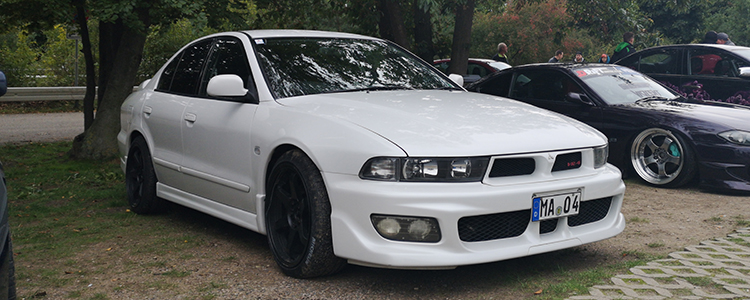
Drivetrain
Engine references
Editorial
The buyer's read
The case for the E39A Galant VR-4 is straightforward: the 4G63T turbo and AWD layout that defined the Lancer Evolution I, in a sedan built from 1989 to 1992 that still clears $20,000 only for the cleanest examples. The Evo carries the same hardware at two or three times the price. The value gap is real and tied to market recognition, not mechanical differences.
Start your search with a documented E39A from 1989 to 1992 with timing belt paperwork and a rust-free shell — those are the two variables that move price more than mileage. Inspect the sills, rear arches, strut towers, and subframe before anything else. A heavily modified E39A carries more risk than a stock one unless the build history is fully documented.
On any AWD Galant — EC5A VR-4 or Super VR-4 — the AYC pump is the first thing to verify after rust. The pump corrodes internally, jams, and the accepted fix is replacement rather than rebuild. Sellers who know the cars typically disclose AYC pump failures upfront; no recent receipt means you're likely absorbing that cost within the first year.
Avoid a 6A12TT Super VR-4 without a thick service history. The twin-turbo V6 is a complex engine in a tight bay, and maintenance is meaningfully harder than the inline-four 4G63T cars. A Super VR-4 with full paperwork is worth the premium; without records, the simpler E39A is the better buy.
FAQ
Frequently asked questions
- Which Mitsubishi Galant is the collectible one?
- The Galant VR-4 (1988-1992 JDM/other mkts) is the standout: 4G63T + AWD and rarity drive values.
- What should I check first when buying a Galant VR-4?
- Verify rust, timing belt history, AWD/drivetrain noises, and trim authenticity (VIN/plates, correct parts).
- Are non-VR-4 Galants good daily drivers?
- Yes, later USDM Galants can be solid cheap transport, but inspect automatic trans, cooling, and deferred maintenance.
- What are the biggest mechanical risks on 4G63 cars?
- Timing belt, oil leaks, tired turbos, and poor tunes. Compression/leakdown and clean wiring are key on modified cars.
- How much does originality affect VR-4 value?
- A lot: stock ECU/turbo/interior and clean body command premiums. Heavy mods can reduce value unless documented and tidy.
- Is parts availability a problem?
- For VR-4-specific AWD and trim parts, yes. For 4G63 engine wear items, support is strong via DSM/Evo ecosystem.
- What transmissions are best?
- For enthusiasts, 5MT VR-4 is preferred. High-mile autos in base trims can be a weak point—test shift quality.
- When is the Galant VR-4 legal to import to the US?
- Under the 25-year rule, 1989 models became legal in 2014, 1990 in 2015, 1992 in 2017 (by year).
Citations
Sources & references
Sources (11)
- Mitsubishi Galant — encyclopedic overview — Wikipedia Verified
- Mitsubishi Galant VR-4 — model history and homologation context — Wikipedia Verified
- Mitsubishi Lancer Evolution — 4G63T lineage — Wikipedia Verified
- Mitsubishi 4G6 engine family (4G63 / 4G63T) — Wikipedia Verified
- Active Yaw Control — system used in Galant VR-4 (EC5A) and Evo — Wikipedia Verified
- Mitsubishi 4G9 engine family (4G93 used in 8G base Galant) — Wikipedia Verified
- Mitsubishi Galant on Bring a Trailer (auction archive) — Bring a Trailer Verified
- Galant overview on Edmunds (USDM market positioning) — Edmunds Verified
- World Rally Championship — Group A regulations context — Wikipedia Verified
- Vehicle Importation Guidelines — 25-year rule — NHTSA Verified
- Mitsubishi Galant — Car and Driver model page — Car and Driver Verified
Sources last verified: