Buyer's guide

15 min read

Subaru Forester SF

Buyer's guide & specs

Production
1997-present
Market range
$2K–$45K
Engine
EJ20G
2.0L
Subaru Forester SF — JDM hero image
Subaru Forester SF. Photo: Tokumeigakarinoaoshima (CC0 1.0). Source: Wikimedia Commons.

Quick answer

The Subaru Forester is a practical AWD wagon-SUV known for safety, winter traction, and strong resale. Best buys are clean, maintained examples; watch for head gaskets (early NA), CVT care (newer), and rust in snow states.

Background

Overview

The first-generation Forester (SF, 1997–2002) was built on the Impreza platform with a tall wagon body, raised ride height, and the symmetrical AWD layout shared with every other contemporary Subaru. Japan-market base cars used the 2.0L EJ20 naturally aspirated flat-four; export base trims (including the US Forester L) ran the larger 2.5L EJ25. The standout JDM variants the US never received are the S/tb (S/Turbo) running the EJ20T from 1997, and the SF5 STi from 1998 with the EJ20K turbo, 5-speed manual, Brembo brakes, hood scoop, and a tuned chassis that shared hardware with the contemporary Impreza WRX STi.

Today's SF buyer is hunting either a cheap, honest 2.5L wagon to daily-drive (the WP guide cites the US Forester L starting around $5,000 in clean condition) or one of the JDM turbo variants now eligible for import under the 25-year rule. The pre-2000 base trims are the safety-margin liability — airbags were not standard on every base SF before 2000, ABS was added as standard from 2000, and pre-2000 cars used rear drum brakes that can be swapped to the post-2000 disc setup. The EJ25 NA head-gasket story is real for this generation; the EJ20T turbos are a different risk profile (boost-related ring/knock issues) that demands a documented service history. The interior is the weak point — mechanical door locks and windows on early base trims, plastic that rattles and cracks, fabric that tears. Buy on body and underbody condition, not on interior cosmetics.

Chassis Code Explained

SModel series
FGeneration
SegmentMeaningDetail
SModel seriesS — Subaru Forester series designation
FGenerationF — first-generation Forester (SF5/SG5; 1997–2002)

The SF5 is the turbocharged S/tb variant (EJ20T); the SG5 is the second-generation turbocharged variant. The SF generation shares its EJ platform with the contemporaneous Impreza GC.

Editorial notes

Key Takeaways

The Forester has run from 1997 to today, and the early generations are the ones that matter for JDM buyers. The SF from 1997 to 2002 is where the SF5 STi and the S/tb turbo live. The SG from 2002 to 2008 is where the JDM-only 2004 Forester STi shows up. The SH and SJ are when the Forester stopped being a wagon and started being an SUV, so they're useful as daily drivers but they're not the cars you import from Japan.

  • Best value: well-kept 2014-2018 2.5i/XT with records
  • Watch-outs: early NA head gaskets; later CVT service
  • Rust matters: rear subframe/strut towers in salt states
  • XT turbo: quickest, priciest; more upkeep than 2.5i
  • Resale strong: AWD + safety keep demand high
  • Mods/abuse: avoid tuned turbos without proof of care
From JDMBUYSELL

Find a Subaru Forester for sale

Browse listings

Technical Specifications

Every JDM Forester worth importing runs an EJ20T or EJ20K turbo flat-four. The SF5 STi uses the EJ20K with the 5-speed manual and Brembo brakes. The SG Forester STi uses the EJ255 with the 6-speed manual and DCCD. The export-market SG XT runs the same EJ255 turbo but in a softer 230 hp tune with a 4-speed automatic or 5-speed manual. The transmission you want is a manual, on any of them.

Engine Options

ChassisEngineDisplacementPower — JDMNotes
SFEJ20G2.0LestimatedTurbo; early JDM spec varies by year
SFEJ20K2.0LestimatedSTi-tuned turbo; output varies by market
SFEJ2052.0LestimatedTurbo; later SF/JDM/ROW variants
SFEJ222.2LestimatedNA; market-specific (early US/ROW)
SFEJ25D2.5LestimatedDOHC NA; early 2.5L applications

Transmission Options

TypeRatiosAvailabilityNotes
5-speed ManualestimatedSF/SG/SH (select trims/markets)AWD; final drive varies by market/year
6-speed ManualestimatedSH/SJ diesel (select mkts)Diesel applications; ratios vary by market
4-speed AutomaticestimatedSF/SG/SH (select trims/markets)4EAT; AWD; final drive varies
5-speed Automaticestimatedselect markets/years5EAT on some turbo/market applications
CVT (Lineartronic)estimatedSJ/SK/SL (most trims)Chain CVT; AWD; some with paddle steps
6-speed Manual (STi)estimatedSG Forester STi (JDM)DCCD-equipped; performance AWD tuning

Livability

Headroom
40.2"
Upright seating; pano roof trims ~0.5-1.0 in
Rear Seats
Good for adults
Legroom solid; 3-across tight; flat floor helps
Cargo
31-35 cu ft
Boxy, usable; wheel wells intrude; seats fold flat

Variants & Trims

The JDM-only Forester variants are the SF5 S/tb and S/Turbo, the SF5 STi, the SG Cross Sports, and the 2004 SG Forester STi. The US never got any of them with a factory STi badge. The closest US-market Forester is the SG XT, which is the same EJ255 turbo in a softer tune. The SF5 STi opened up for US import in 2023, and the SG Forester STi opens up in 2029.

GenerationTrimEngineKey Features
SF (1st gen, 1997-2002)Forester (Base)EJ20/EJ25 (market-dependent)AWD, 5MT/4AT, dual-range (select mkts)
SF (1st gen, 1997-2002)Forester LEJ22/EJ25 (market-dependent)AWD, 5MT/4AT, upgraded interior
SF (1st gen, 1997-2002)Forester SEJ25 (market-dependent)AWD, 5MT/4AT, sport trim, alloys
SF (1st gen, 1997-2002)Forester S/TurboEJ20G/EJ205 (market-dependent)Turbo, AWD, 5MT/4AT, hood scoop
SF (1st gen, 1997-2002)Forester S/tb (JDM)EJ20G/EJ205Turbo, AWD, 5MT/4AT, intercooler
SF (1st gen, 1997-2002)Forester STi (JDM)EJ20KSTi-tuned, turbo, AWD, 5MT, Brembo
From JDMBUYSELL

How to import a JDM car — complete guide

Read the guide

Should You Buy a Subaru Forester SF?

The Forester is the WRX you can put kayaks on. You get the same boxer-four AWD layout and the rally bones, but in a tall wagon shell that can carry mountain bikes and ski gear. The trade-off is that you're working with old Subaru cooling systems and old Subaru head gaskets, and a Forester that hasn't been looked after will eat money fast.

Why You'll Love It

  • Excellent real-world AWDSymmetrical AWD + ground clearance make it a snow-state favorite; strong traction with good tires.
  • Strong safety reputationHigh crash-test performance; EyeSight-equipped cars command premiums and sell faster.
  • Practical packagingBoxy cargo area, low load floor, good visibility; easy daily + outdoor use.
  • Resale value and liquidityHigh demand in used market; clean titles and service records bring top-of-range money.
  • Simple NA trims are durableWell-maintained 2.5i models can be long-lived; fewer turbo heat/boost-related issues.
  • Enthusiast appeal (XT)XT turbos offer strong torque; desirable to enthusiasts, especially unmodified examples.

Why You Might Not

  • Head gasket risk (older NA)Gen 1-3 EJ25 NA can develop external leaks; repair cost varies with rust and shop rates.
  • CVT maintenance sensitivityNeglected CVT fluid/overheating can shorten life; towing and big tires raise risk.
  • Oil consumption concernsSome FB25-era cars show oil use; buyers should verify level habits and service history.
  • Rust in salt climatesRear subframe, brake lines, strut towers can rust; impacts safety and repairability.
  • Turbo upkeep and abuse riskXT models often modified; poor tunes can cause ringland/knock issues and costly repairs.
  • Road noise/ride (older gens)Earlier generations can be loud and floaty; worn bushings amplify noise and vibration.

Who Should NOT Buy This

  • Anyone who won't check oil every fill-up
  • Buyers expecting Toyota-level powertrain longevity
  • Rust-belt buyers without undercoating budget
  • People who ignore tire matching and rotations
  • Towers/haulers who plan heavy towing with CVT
  • Anyone who can't afford a $6k CVT replacement
  • Short-trip drivers who skip warm-ups/maintenance
  • Buyers who won't pay for pre-purchase leakdown
  • People who need 3-across child seats regularly
  • Those who hate wind noise and economy-car NVH
  • Owners without a good Subaru-specialist shop
  • DIYers without tools for boxer engine packaging
  • Anyone wanting cheap mods without reliability hits
  • People in CARB states buying JDM swaps/engines
  • Buyers who can't tolerate occasional electronics quirks
  • Those who won't fix water leaks/mold immediately

Common Issues & Solutions

The Forester has the same issues every old Subaru has. The naturally aspirated EJ25 cars eat head gaskets if the cooling system gets neglected. The EJ20T and EJ255 turbo cars take damage when they get tuned badly or run on cheap fuel. Rust at the rear subframe and strut towers is what kills Foresters in salt states. None of these are deal breakers if you find a Forester with paperwork.

IssueCauseSolutionEst. Cost
EJ head gasket external leakOEM gasket design + heat cyclesMLS gaskets, machine heads, new bolts, reseal$1800-3500
EJ timing belt overdue failureSkipped service; idler/water pump seizeFull belt kit + pump; replace cam/crank seals$900-1600
FB oil consumptionRing pack design + long OCI + blow-byShort OCI, PCV service; engine rebuild if severe$150-6500
Cam carrier oil leak (FB)Sealant failure at cam carrier seamsReseal cam carriers; often engine-out for access$1200-2800
Valve cover gasket leaksGaskets harden; PCV pressure increases seepReplace gaskets/tube seals; service PCV$350-900
Rod bearing failureLow oil from consumption/leaks or neglectReplace engine long block; address root cause$4500-9000
Cooling system overheatRadiator cracks, air pockets, stuck thermostatReplace radiator/thermostat; proper bleed$450-1200
Radiator end tank crackPlastic tanks age/heat; common on older yearsReplace radiator cap/hoses as needed$350-850
Heater core leakCorrosion or age; coolant neglectedReplace heater core; flush system$900-1800
Catalytic converter failureOil burning contaminates cat; age/heatFix oil use; replace cat with quality unit$900-2500
CVT valve body failureSolenoid wear/contamination; heatReplace valve body; fluid service and relearn$1200-2200
CVT chain/pulley wearOverheat, dirty fluid, towing/abuseReplace CVT assembly; add cooler if used hard$4500-8500
CVT torque converter shudderLockup clutch wear; fluid breakdownFluid exchange; TC or trans replacement if bad$350-6500
Torque bind (older AT)Duty C solenoid/clutch pack wearReplace solenoid/clutches; sometimes trans swap$900-3500
Center diff bind (manual)Viscous coupling wear from tire mismatchReplace viscous coupling; match tires always$900-1800
Wheel bearing failureWater intrusion + load; common rear on some yearsReplace hub/bearing; check axle torque$450-900
Front CV axle boot tearAge/heat; aftermarket axles fail earlyReboot OEM or replace with OEM-quality axle$250-700
Rear trailing arm bushing wearAge; salt accelerates bushing separationReplace bushings/arms; align afterward$450-1200
Front LCA rear bushing tearHydraulic bushing cracks; potholesReplace LCA or bushing; align$500-1200
Steering rack leak/clunkSeal wear; inner tie rod playReplace rack/inner rods; flush fluid$900-2200
Brake caliper slide seizureSalt + lack of lube; torn bootsService slides; replace calipers if pitted$250-900
Brake line corrosion ruptureRust belt scaling; trapped moisture under clipsReplace lines; inspect all hard lines and hoses$800-2000
Rear subframe rust perforationSalt exposure; poor undercoating maintenanceReplace subframe; treat rust; avoid severe rot$1500-3500
Strut tower rust perforationSeam sealer failure + trapped moistureWeld repair; often not worth it if advanced$1200-4000
Sunroof drain leaksClogged drains; disconnected tubesClear drains; reseat tubes; dry interior fully$150-600
Hatch/spare well water leakBody vents/seals shrink; seam cracksReseal vents/seams; replace hatch seal if needed$150-700
Airbag/SRS light faultsSeat wiring, clockspring, module codesScan SRS; repair wiring/clockspring; clear codes$250-1200
EyeSight camera faultsWindshield replacement, low voltage, misalignOEM glass + calibration; fix battery/charging$400-1800
Infotainment freezing/rebootHead unit software/hardware failureUpdate firmware; replace head unit if persistent$0-1200
AC compressor failureClutch wear or internal seizure; debris in systemReplace compressor+drier; flush; evac/recharge$900-1800
Window regulator failureCable fray; plastic guides breakReplace regulator assembly$250-600
Door lock actuator failureMotor wear; cold weather worsensReplace actuator/latch assembly$200-550
TPMS sensor battery deadAge 7-10 years typical lifespanReplace sensors; program/learn IDs$200-500

Differences between JDM & USDM

The Forester nameplate split markedly between JDM and USDM through the SF and SG generations, then converged from the SH onward. JDM-only variants the US never received: SF5 S/tb turbo (1997–2002, EJ20T), SF5 STi (1998 on, EJ20K turbo, 5MT, Brembo, hood scoop), SG Cross Sports (EJ20, 4AT-only), and the SG Forester STi (2004, EJ255 turbo, 6MT with DCCD, 18-inch wheels, Brembo, aluminum hood, WRX STi seats — the SG STi is the holy-grail JDM Forester). The USDM Forester only received an STi-badged trim starting in 2014 with the SJ-era 2.0XT and aftermarket-style trims; no factory "Forester STi" badge ever shipped on a US-market car. The export markets did get the SG XT (EJ255 turbo, 230 hp, automatic or 5MT, 17-inch wheels, HID, MOMO wheel) — close to a JDM XT in spec — but not the STi. For import buyers, the SF5 STi became 25-year-rule legal in 2023; the SG STi opens up in 2029. Pre-1998 SF turbo S/tb cars are already importable. Right-hand drive throughout.

Pre-Purchase Inspection Checklist

Walk this list with the seller, not in front of them. The Critical items mean walking away if there's no paperwork backing them up. The High items can usually be priced into the deal. Pay close attention to the cooling system, the head gasket history, and any sign that a turbo Forester has been tuned badly or run hard without the right fuel.

Critical Priority

High Priority

Medium Priority

Low Priority

Generation History

SF (Gen 1) (1997-2002)

  • Impreza-based, tall wagon packaging
  • EJ25 NA; early head gasket risk
  • Some markets had turbo variants
  • Simple 4EAT/5MT; easy DIY service

SG (Gen 2) (2002-2008)

  • More rigid chassis; bigger cabin
  • XT turbo introduced; strong tuning scene
  • NA EJ25 still head gasket-prone
  • Rust and suspension wear common now

SH (Gen 3) (2008-2013)

  • Grew into compact SUV footprint
  • Timing belt EJ25; XT turbo available
  • 4EAT/5MT early; CVT later years
  • Good value; check oil consumption

SJ (Gen 4) (2014-2018)

  • FB25 + Lineartronic CVT mainstream
  • XT uses FA20DIT; quick but complex
  • EyeSight expands; safety/resale jump
  • Oil use on some FB engines; verify

SK (Gen 5) (2019-2024)

  • Subaru Global Platform; quieter, safer
  • 2.5L + CVT; strong ADAS availability
  • Thermal management improved; fewer leaks
  • High used prices; trims drive spread

SL (Gen 6) (2025-present)

  • New design; tech-forward interior
  • Market still forming; early depreciation
  • Trim/option mix affects resale
  • Warranty history matters most early on
From JDMBUYSELL

Find a verified JDM dealer near you

View dealers

Market Data

The JDM-only Forester variants are the SF5 S/tb and S/Turbo, the SF5 STi, the SG Cross Sports, and the 2004 SG Forester STi. The US never got any of them with a factory STi badge. The closest US-market Forester is the SG XT, which is the same EJ255 turbo in a softer tune. The SF5 STi opened up for US import in 2023, and the SG Forester STi opens up in 2029.

Production Numbers & Rarity

GenerationYearsTotal BuiltNotes
SF (1st gen)1997-2002estimatedGlobal total not consolidated in this dataset
SG (2nd gen)2002-2008estimatedGlobal total not consolidated in this dataset
SH (3rd gen)2008-2013estimatedGlobal total not consolidated in this dataset
SJ (4th gen)2013-2018estimatedGlobal total not consolidated in this dataset
SK (5th gen)2018-2024estimatedGlobal total not consolidated in this dataset
SL (6th gen)2025-estimatedOngoing production; totals not final

How It Compares

The Forester sits between the Impreza WRX and the small SUVs of its era. Against the Mitsubishi Lancer Evolution wagon, the Forester is more usable as a daily and easier to source parts for. Against a CR-V or a RAV4 of the same year, the Forester gives up cargo space but wins on snow, gravel, and any surface that isn't pavement. The factory STi versions of the Forester are the only ones that compete on pure performance.

FeatureSFHonda CR-V (Gen 5)Toyota RAV4 (XA50)
AWD systemFull-time Symmetrical AWDOn-demand AWDOn-demand AWD
Ground clearanceUp to ~8.7 in (varies)~8.2 in~8.4 in
Base engine2.5L flat-4 (NA)1.5T I4 (Gen 5)2.5L I4 (NA/Hybrid)
Performance trimXT turbo (older gens)2.0T option (some yrs)Turbo option (some yrs)
TransmissionCVT (most 2014+)CVT/AT (by year)8AT/Hybrid eCVT
Fuel economy focusGood; not class bestVery strong hybrid mpgStrong hybrid mpg
Off-pavement aidsX-Mode (most trims)Trail modes (trim-based)Terrain modes (trim-based)
Cabin spaceBoxy, efficientRoomy rear seatCompetitive cargo
Reliability profileGood; watch HG/CVTStrong; turbo+CVT careStrong; hybrid complexity
Winter resale demandVery high in snow statesHighHigh
Enthusiast marketXT + older 5MT nicheLimitedModerate (turbo trims)
Towing capabilityModest; trim/year variesSimilar; varies by yearOften higher in some trims

Comparable Alternatives

If the Forester doesn't end up being the right car, the natural alternatives are the Subaru Impreza WRX or WRX STi if you want the same drivetrain in a smaller body, or a Subaru Legacy GT wagon if you want something a little more grown up. The Mitsubishi Lancer Evolution wagon is the closest rival but it's much rarer and much more expensive.

Toyota RAV4 (XA50)

Hybrid mpg, strong reliability, high resale; AWD available

Honda CR-V (Gen 5)

Roomy, efficient; on-demand AWD; strong parts support

Mazda CX-5 (KF)

Best on-road feel; optional turbo; upscale interior

VW Tiguan (Mk2)

Euro driving feel, 3-row option; AWD available; watch upkeep

Subaru Outback (BS/BT)

More cargo + comfort; similar AWD ethos; often pricier

In Pictures
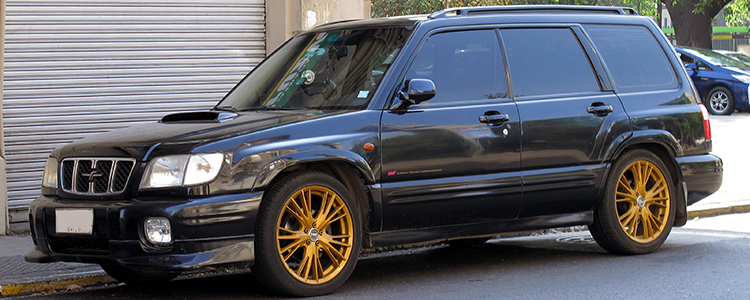
Subaru Forester STI
Subaru Forester STI
Subaru Forester — primary editorial hero image, front three-quarter view
Subaru Forester — the wagon-meets-SUV that defined Subaru's crossover identity from 1997 onward.FlickrImage by RL GNZLZ
From JDMBUYSELL

Browse JDM listings from dealers and private sellers worldwide

Browse all listings

The Buyer's Read

Start by deciding which Forester fits your situation. A clean SG XT with documented service history is the practical pick for most buyers — it carries the EJ255 turbo, parts are sourced domestically without import friction, and Bring a Trailer sold results give a reliable baseline on where clean examples are currently landing. Skip anything priced under $5,000 unless you're buying it for parts; the head gasket job alone on a neglected 2.5L EJ25 will cost more than the car did.

For import buyers, the SF5 STi became eligible under the 25-year rule in 2023. The EJ20K turbo, the 5-speed manual, Brembo brakes, and the hardware shared with the Impreza WRX STi of the same era make it a legitimate performance car in a wagon shell. The catch is supply: most clean SF5 STi cars remain in Japan, and the landed cost typically exceeds what a US-market SG XT commands.

The 2029 opening of the SG Forester STi is the longer-horizon play. EJ255 turbo, 6-speed manual with DCCD, Brembo brakes, an aluminum hood with a functional scoop, and WRX STi bucket seats — it is the rarest factory Forester variant ever built, and prices in Japan reflect that. On any turbo Forester regardless of generation, ask for paperwork covering the tune and the fuel used. A modified EJ20T or EJ255 run on a bad map or incorrect octane can carry ringland or knock damage that does not show up on a cold-start inspection or a short test drive.

Frequently Asked Questions

Which Forester years are best to buy used?
Value sweet spot is often 2014-2018 with records. For newer, 2019-2024 offers best safety/ride but higher prices.
Do Foresters have head gasket problems?
Mainly older EJ25 NA (Gen 1-3). Later FB25/FA20 are less known for HG leaks; still inspect for seepage.
How reliable is the Subaru CVT?
Generally good if maintained, but neglect hurts. Prioritize fluid service history, no shudder, and no overheating/towing abuse.
Is the Forester XT worth it?
Yes for performance, but budget for higher upkeep. Avoid heavily modified cars; seek stock tune and frequent oil changes.
What rust areas should I inspect?
Check rear subframe, brake lines, strut towers, and rocker seams. Rust can turn a cheap Forester into a write-off.
What mileage is too high for a Forester?
Condition beats miles. A well-serviced 150k+ can be fine; lack of records at 80k-120k is a bigger red flag.
What maintenance is most important?
Key items: timing belt (EJ-era), CVT fluid, coolant, diff fluids, and suspension bushings. Verify receipts, not promises.
Why are used Foresters so expensive?
Demand is boosted by AWD, safety tech, and winter-region popularity. Clean-title, rust-free examples trade at a premium.

7 sources cited below

Sources & References

Sources (7)
  1. Subaru Forester — encyclopedic overview — WikipediaVerified
  2. Subaru Forester — used-car review and common problems — Samarins (used-car research site)Verified
  3. Subaru EJ engine — family history, EJ20T, EJ20K, EJ25, EJ255 — WikipediaVerified
  4. Bring a Trailer — Subaru Forester sold results — Bring a TrailerVerified
  5. IIHS crash test ratings — Subaru Forester — Insurance Institute for Highway SafetyVerified
  6. Subaru owner resources and maintenance schedules — Subaru of AmericaVerified
  7. Subaru Forester — model overview and specs reference — CarBuzzVerified

Sources last verified:

Market & demand on JDMBUYSELL

Reported sold prices and buyer-inquiry trend for the Subaru Forester SF on the JDMBUYSELL marketplace.

Source:/api/market-data/subaru/forester/sf.json· Sold prices aggregated from listings marked sold by private-party sellers on JDMBUYSELL — seller-reported, not verified hammer prices. Inquiry counts are distinct buyer-to-seller conversations referencing at least one listing for this chassis.

Report a correction

Spotted something wrong on this page? Tell us and we'll review.