Toyota RAV4 (XA50)
Hybrid mpg, strong reliability, high resale; AWD available
Buyer's guide
15 min read
Buyer's guide & specs
Quick answer
The Subaru Forester is a practical AWD wagon-SUV known for safety, winter traction, and strong resale. Best buys are clean, maintained examples; watch for head gaskets (early NA), CVT care (newer), and rust in snow states.
Background
The Subaru Forester has run from 1997 to today across six chassis — SF, SG, SH, SJ, SK, and SL. Most serious buyers are after the SF or SG, the early wagon-SUVs built on the Impreza platform with the boxer-four AWD; Japan got the EJ20 base engine while export markets received the 2.5L EJ25, and JDM performance trims ran the EJ20T or EJ255 turbo. The SH (2008–2013), SJ (2013–2018), and SK (2018–2024) are capable AWD wagons, but they traded the turbo wagons' character for size and compliance. The SF5 STi and the 2004 SG Forester STi are the collector targets — JDM-only builds the US never received.
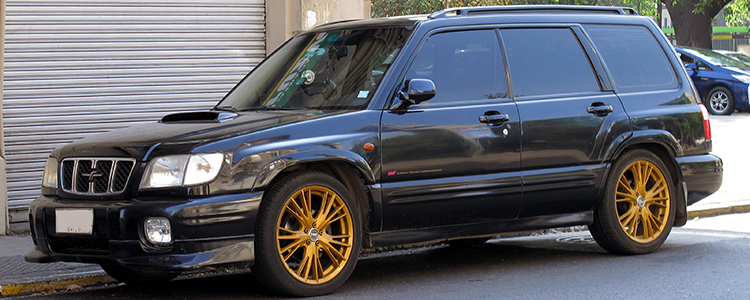
The SF5 STi arrived in 1998 as a JDM-only build on the SF chassis, carrying the EJ20K turbo flat-four — the same STi-tuned EJ20 family that powered the Impreza STi of the same era — paired to a 5-speed manual, AWD, Brembo brakes, and a hood scoop feeding the top-mount intercooler.
The body was the same tall wagon shell as any base Forester L, which obscured the performance hardware underneath. Sharing drivetrain internals with the WRX STi and running close to the same weight, the SF STi delivered Impreza-grade pace from a body that fit mountain bikes in the back.
Subaru exported the turbo SF to some markets as the S/tb and S/Turbo, but never sold the STi badge on the Forester in the United States. The SF5 STi stayed JDM-only, which is what makes it import-target material now that the 25-year rule opened early SF5 STi cars to US importation in 2023.
The 2004 SG Forester STi was a JDM-only build that the US never received: EJ255 turbo with output reported close to 300 horsepower, the 6-speed manual from the Impreza WRX STi with DCCD center differential, repositioned struts, larger anti-roll bars, sport springs, 18-inch wheels, Brembo brake calipers, a lighter aluminum hood with functional scoop, and WRX STi bucket seats.
The export market got the SG XT — the same EJ255 turbo engine, but tuned to 230 horsepower, mated to a 4-speed automatic or 5-speed manual, with 17-inch wheels, HID headlights, and a MOMO steering wheel. Subaru also offered the JDM-only Cross Sports trim: XT styling over the EJ20 at 230 horsepower, paired exclusively to a 4-speed automatic.
None of the JDM Cross Sports or SG STi cars shipped to the US when new. The SG STi remains the rarest factory Forester variant outside Japan; it becomes eligible for US importation in 2029.
Editorial notes
Quick read
Constants
Chassis history
The Forester has run from 1997 to today, and the early generations are the ones that matter for JDM buyers. The SF from 1997 to 2002 is where the SF5 STi and the S/tb turbo live. The SG from 2002 to 2008 is where the JDM-only 2004 Forester STi shows up. The SH and SJ are when the Forester stopped being a wagon and started being an SUV, so they're useful as daily drivers but they're not the cars you import from Japan.
Fourth generation — SJ (2013–2018)
Identification
Generation names are broad families. The factory chassis codes below identify the variants represented in JDMBUYSELL's current Subaru Forester guide data.
Confirm the complete code on the vehicle's frame or VIN plate; drivetrain, body, and market variants can use different prefixes within one generation family.
Buyer's call
The Forester is the WRX you can put kayaks on. You get the same boxer-four AWD layout and the rally bones, but in a tall wagon shell that can carry mountain bikes and ski gear. The trade-off is that you're working with old Subaru cooling systems and old Subaru head gaskets, and a Forester that hasn't been looked after will eat money fast.
Reliability
The Forester has the same issues every old Subaru has. The naturally aspirated EJ25 cars eat head gaskets if the cooling system gets neglected. The EJ20T and EJ255 turbo cars take damage when they get tuned badly or run on cheap fuel. Rust at the rear subframe and strut towers is what kills Foresters in salt states. None of these are deal breakers if you find a Forester with paperwork.
| Issue | Cause | Solution | Est. cost |
|---|---|---|---|
| EJ head gasket external leak | OEM gasket design + heat cycles | MLS gaskets, machine heads, new bolts, reseal | $1800-3500 |
| EJ timing belt overdue failure | Skipped service; idler/water pump seize | Full belt kit + pump; replace cam/crank seals | $900-1600 |
| FB oil consumption | Ring pack design + long OCI + blow-by | Short OCI, PCV service; engine rebuild if severe | $150-6500 |
| Cam carrier oil leak (FB) | Sealant failure at cam carrier seams | Reseal cam carriers; often engine-out for access | $1200-2800 |
| Valve cover gasket leaks | Gaskets harden; PCV pressure increases seep | Replace gaskets/tube seals; service PCV | $350-900 |
| Rod bearing failure | Low oil from consumption/leaks or neglect | Replace engine long block; address root cause | $4500-9000 |
| Cooling system overheat | Radiator cracks, air pockets, stuck thermostat | Replace radiator/thermostat; proper bleed | $450-1200 |
| Radiator end tank crack | Plastic tanks age/heat; common on older years | Replace radiator cap/hoses as needed | $350-850 |
| Heater core leak | Corrosion or age; coolant neglected | Replace heater core; flush system | $900-1800 |
| Catalytic converter failure | Oil burning contaminates cat; age/heat | Fix oil use; replace cat with quality unit | $900-2500 |
| CVT valve body failure | Solenoid wear/contamination; heat | Replace valve body; fluid service and relearn | $1200-2200 |
| CVT chain/pulley wear | Overheat, dirty fluid, towing/abuse | Replace CVT assembly; add cooler if used hard | $4500-8500 |
| CVT torque converter shudder | Lockup clutch wear; fluid breakdown | Fluid exchange; TC or trans replacement if bad | $350-6500 |
| Torque bind (older AT) | Duty C solenoid/clutch pack wear | Replace solenoid/clutches; sometimes trans swap | $900-3500 |
| Center diff bind (manual) | Viscous coupling wear from tire mismatch | Replace viscous coupling; match tires always | $900-1800 |
| Wheel bearing failure | Water intrusion + load; common rear on some years | Replace hub/bearing; check axle torque | $450-900 |
| Front CV axle boot tear | Age/heat; aftermarket axles fail early | Reboot OEM or replace with OEM-quality axle | $250-700 |
| Rear trailing arm bushing wear | Age; salt accelerates bushing separation | Replace bushings/arms; align afterward | $450-1200 |
| Front LCA rear bushing tear | Hydraulic bushing cracks; potholes | Replace LCA or bushing; align | $500-1200 |
| Steering rack leak/clunk | Seal wear; inner tie rod play | Replace rack/inner rods; flush fluid | $900-2200 |
| Brake caliper slide seizure | Salt + lack of lube; torn boots | Service slides; replace calipers if pitted | $250-900 |
| Brake line corrosion rupture | Rust belt scaling; trapped moisture under clips | Replace lines; inspect all hard lines and hoses | $800-2000 |
| Rear subframe rust perforation | Salt exposure; poor undercoating maintenance | Replace subframe; treat rust; avoid severe rot | $1500-3500 |
| Strut tower rust perforation | Seam sealer failure + trapped moisture | Weld repair; often not worth it if advanced | $1200-4000 |
| Sunroof drain leaks | Clogged drains; disconnected tubes | Clear drains; reseat tubes; dry interior fully | $150-600 |
| Hatch/spare well water leak | Body vents/seals shrink; seam cracks | Reseal vents/seams; replace hatch seal if needed | $150-700 |
| Airbag/SRS light faults | Seat wiring, clockspring, module codes | Scan SRS; repair wiring/clockspring; clear codes | $250-1200 |
| EyeSight camera faults | Windshield replacement, low voltage, misalign | OEM glass + calibration; fix battery/charging | $400-1800 |
| Infotainment freezing/reboot | Head unit software/hardware failure | Update firmware; replace head unit if persistent | $0-1200 |
| AC compressor failure | Clutch wear or internal seizure; debris in system | Replace compressor+drier; flush; evac/recharge | $900-1800 |
| Window regulator failure | Cable fray; plastic guides break | Replace regulator assembly | $250-600 |
| Door lock actuator failure | Motor wear; cold weather worsens | Replace actuator/latch assembly | $200-550 |
| TPMS sensor battery dead | Age 7-10 years typical lifespan | Replace sensors; program/learn IDs | $200-500 |
Market
The Forester nameplate split markedly between JDM and USDM through the SF and SG generations, then converged from the SH onward. JDM-only variants the US never received: SF5 S/tb turbo (1997–2002, EJ20T), SF5 STi (1998 on, EJ20K turbo, 5MT, Brembo, hood scoop), SG Cross Sports (EJ20, 4AT-only), and the SG Forester STi (2004, EJ255 turbo, 6MT with DCCD, 18-inch wheels, Brembo, aluminum hood, WRX STi seats — the SG STi is the holy-grail JDM Forester). The USDM Forester only received an STi-badged trim starting in 2014 with the SJ-era 2.0XT and aftermarket-style trims; no factory "Forester STi" badge ever shipped on a US-market car. The export markets did get the SG XT (EJ255 turbo, 230 hp, automatic or 5MT, 17-inch wheels, HID, MOMO wheel) — close to a JDM XT in spec — but not the STi. For import buyers, the SF5 STi became 25-year-rule legal in 2023; the SG STi opens up in 2029. Pre-1998 SF turbo S/tb cars are already importable. Right-hand drive throughout.
Specs
Every JDM Forester worth importing runs an EJ20T or EJ20K turbo flat-four. The SF5 STi uses the EJ20K with the 5-speed manual and Brembo brakes. The SG Forester STi uses the EJ255 with the 6-speed manual and DCCD. The export-market SG XT runs the same EJ255 turbo but in a softer 230 hp tune with a 4-speed automatic or 5-speed manual. The transmission you want is a manual, on any of them.
| Chassis | Engine | Displacement | Power | Boost | Notes |
|---|---|---|---|---|---|
| SF | EJ20G | 2.0L | estimated | estimated | Turbo; early JDM spec varies by year |
| SF | EJ20K | 2.0L | estimated | estimated | STi-tuned turbo; output varies by market |
| SF | EJ205 | 2.0L | estimated | estimated | Turbo; later SF/JDM/ROW variants |
| SF | EJ22 | 2.2L | estimated | N/A | NA; market-specific (early US/ROW) |
| SF | EJ25D | 2.5L | estimated | N/A | DOHC NA; early 2.5L applications |
| SG | EJ251 | 2.5L | estimated | N/A | SOHC NA; early SG 2.5X |
| SG | EJ253 | 2.5L | estimated | N/A | SOHC NA; i-AVLS on later years |
| SG | EJ255 | 2.5L | estimated | estimated | Turbo; XT and JDM STi variants |
| SH | EJ253 | 2.5L | estimated | N/A | NA; i-AVLS; output varies by market |
| SH | EJ255 | 2.5L | estimated | estimated | Turbo; 2.5XT; market/year dependent |
| SH/SJ/SK (select mkts) | EE20 | 2.0L | estimated | Turbo | Boxer diesel; outputs vary by calibration |
| SJ | FB25 | 2.5L | estimated | N/A | NA; chain-driven DOHC; AVCS |
| SJ | FA20DIT | 2.0L | 250hp @ 5600rpm | estimated | Turbo DI; USDM rating; torque varies |
| SK | FB25D | 2.5L | estimated | N/A | NA DI (some mkts); output varies by year |
| SK (select mkts) | FB20/FB25 + MHEV | 2.0L/2.5L | estimated | N/A | e-BOXER mild hybrid; system output varies |
| SL | FB25D (market-dependent) | 2.5L | estimated | N/A | Latest gen; final ratings vary by market |
| Type | Ratios | Availability | Notes |
|---|---|---|---|
| 5-speed Manual | estimated | SF/SG/SH (select trims/markets) | AWD; final drive varies by market/year |
| 6-speed Manual | estimated | SH/SJ diesel (select mkts) | Diesel applications; ratios vary by market |
| 4-speed Automatic | estimated | SF/SG/SH (select trims/markets) | 4EAT; AWD; final drive varies |
| 5-speed Automatic | estimated | select markets/years | 5EAT on some turbo/market applications |
| CVT (Lineartronic) | estimated | SJ/SK/SL (most trims) | Chain CVT; AWD; some with paddle steps |
| 6-speed Manual (STi) | estimated | SG Forester STi (JDM) | DCCD-equipped; performance AWD tuning |
Lineup
The JDM-only Forester variants are the SF5 S/tb and S/Turbo, the SF5 STi, the SG Cross Sports, and the 2004 SG Forester STi. The US never got any of them with a factory STi badge. The closest US-market Forester is the SG XT, which is the same EJ255 turbo in a softer tune. The SF5 STi opened up for US import in 2023, and the SG Forester STi opens up in 2029.
| Generation | Trim | Engine | Key features |
|---|---|---|---|
| SF (1st gen, 1997-2002) | Forester (Base) | EJ20/EJ25 (market-dependent) | AWD, 5MT/4AT, dual-range (select mkts) |
| SF (1st gen, 1997-2002) | Forester L | EJ22/EJ25 (market-dependent) | AWD, 5MT/4AT, upgraded interior |
| SF (1st gen, 1997-2002) | Forester S | EJ25 (market-dependent) | AWD, 5MT/4AT, sport trim, alloys |
| SF (1st gen, 1997-2002) | Forester S/Turbo | EJ20G/EJ205 (market-dependent) | Turbo, AWD, 5MT/4AT, hood scoop |
| SF (1st gen, 1997-2002) | Forester S/tb (JDM) | EJ20G/EJ205 | Turbo, AWD, 5MT/4AT, intercooler |
| SF (1st gen, 1997-2002) | Forester STi (JDM) | EJ20K | STi-tuned, turbo, AWD, 5MT, Brembo |
| SG (2nd gen, 2002-2008) | 2.5X | EJ251/EJ253 | AWD, 5MT/4AT, raised ride height |
| SG (2nd gen, 2002-2008) | 2.5XS | EJ253 | AWD, 5MT/4AT, sport suspension, alloys |
| SG (2nd gen, 2002-2008) | XT | EJ255 | Turbo, AWD, 5MT/4AT, hood scoop |
| SG (2nd gen, 2002-2008) | XT Limited | EJ255 | Turbo, AWD, leather, premium audio |
| SG (2nd gen, 2002-2008) | Cross Sports (JDM) | EJ20/EJ25 (market-dependent) | Aero kit, AWD, sport interior |
| SG (2nd gen, 2002-2008) | STi (JDM) | EJ255 | STi 6MT, Brembo, DCCD, sport chassis |
| SH (3rd gen, 2008-2013) | 2.5X | EJ253 | AWD, 5MT/4AT, new platform, larger body |
| SH (3rd gen, 2008-2013) | 2.5X Premium | EJ253 | AWD, 4AT, panoramic roof (some mkts) |
| SH (3rd gen, 2008-2013) | 2.5X Limited | EJ253 | AWD, leather, premium audio, 4AT |
| SH (3rd gen, 2008-2013) | 2.5XT | EJ255 | Turbo, AWD, 4AT, hood scoop |
| SH (3rd gen, 2008-2013) | 2.5XT Premium | EJ255 | Turbo, AWD, 4AT, upgraded interior |
| SH (3rd gen, 2008-2013) | 2.5XT Limited | EJ255 | Turbo, AWD, leather, 4AT |
| SH (3rd gen, 2008-2013) | 2.0D (select mkts) | EE20 | Boxer diesel, AWD, 6MT, high torque |
| SJ (4th gen, 2013-2018) | 2.5i | FB25 | AWD, 6MT/CVT, new FB engine |
| SJ (4th gen, 2013-2018) | 2.5i Premium | FB25 | AWD, CVT, panoramic roof (some mkts) |
| SJ (4th gen, 2013-2018) | 2.5i Limited | FB25 | AWD, CVT, leather, EyeSight (some) |
| SJ (4th gen, 2013-2018) | 2.5i Touring | FB25 | AWD, CVT, top trim, EyeSight (some) |
| SJ (4th gen, 2013-2018) | 2.0XT | FA20DIT | Turbo, AWD, CVT, direct injection |
| SJ (4th gen, 2013-2018) | 2.0XT Premium | FA20DIT | Turbo, AWD, CVT, sport features |
| SJ (4th gen, 2013-2018) | 2.0XT Touring | FA20DIT | Turbo, AWD, CVT, top trim, EyeSight |
| SJ (4th gen, 2013-2018) | 2.0D (select mkts) | EE20 | Boxer diesel, AWD, 6MT/CVT (market) |
| SK (5th gen, 2018-2024) | Base | FB25D | AWD, CVT, EyeSight (market-dependent) |
| SK (5th gen, 2018-2024) | Premium | FB25D | AWD, CVT, upgraded interior, EyeSight |
| SK (5th gen, 2018-2024) | Sport | FB25D | AWD, CVT, sport trim, SI-Drive (some) |
| SK (5th gen, 2018-2024) | Limited | FB25D | AWD, CVT, leather, EyeSight |
| SK (5th gen, 2018-2024) | Touring | FB25D | AWD, CVT, top trim, DriverFocus (some) |
| SK (5th gen, 2018-2024) | Wilderness | FB25D | AWD, CVT, lower gearing, AT tires |
| SK (5th gen, 2018-2024) | e-BOXER (select mkts) | FB20/FB25 + hybrid | MHEV, AWD, CVT, regen assist |
| SL (6th gen, 2025- ) | Base | FB25D (market-dependent) | AWD, CVT, EyeSight suite |
| SL (6th gen, 2025- ) | Premium | FB25D (market-dependent) | AWD, CVT, upgraded interior |
| SL (6th gen, 2025- ) | Sport | FB25D (market-dependent) | AWD, CVT, sport trim, larger wheels |
| SL (6th gen, 2025- ) | Limited | FB25D (market-dependent) | AWD, CVT, leather, premium audio |
| SL (6th gen, 2025- ) | Touring | FB25D (market-dependent) | AWD, CVT, top trim, driver assist |
| SL (6th gen, 2025- ) | Hybrid (select mkts) | Hybrid (market-dependent) | Hybrid, AWD, CVT, improved economy |
Pricing
Today's market range: $1,500 to $45,000 (median ~$18,500). Source: JDMBUYSELL / USS Auction.
Forester prices remain firm due to AWD demand and safety tech. 2019-2024 used values are sticky; older rust-free XTs and clean 5MTs carry niche premiums. Expect mild softening as new supply rises, but top-condition cars stay strong.
Inspect
Walk this list with the seller, not in front of them. The Critical items mean walking away if there's no paperwork backing them up. The High items can usually be priced into the deal. Pay close attention to the cooling system, the head gasket history, and any sign that a turbo Forester has been tuned badly or run hard without the right fuel.
Cross-shop
If the Forester doesn't end up being the right car, the natural alternatives are the Subaru Impreza WRX or WRX STi if you want the same drivetrain in a smaller body, or a Subaru Legacy GT wagon if you want something a little more grown up. The Mitsubishi Lancer Evolution wagon is the closest rival but it's much rarer and much more expensive.
Hybrid mpg, strong reliability, high resale; AWD available
Roomy, efficient; on-demand AWD; strong parts support
Best on-road feel; optional turbo; upscale interior
Euro driving feel, 3-row option; AWD available; watch upkeep
More cargo + comfort; similar AWD ethos; often pricier
Compare
The Forester sits between the Impreza WRX and the small SUVs of its era. Against the Mitsubishi Lancer Evolution wagon, the Forester is more usable as a daily and easier to source parts for. Against a CR-V or a RAV4 of the same year, the Forester gives up cargo space but wins on snow, gravel, and any surface that isn't pavement. The factory STi versions of the Forester are the only ones that compete on pure performance.
| Feature | Subaru Forester | Honda CR-V (Gen 5) | Toyota RAV4 (XA50) |
|---|---|---|---|
| AWD system | Full-time Symmetrical AWD | On-demand AWD | On-demand AWD |
| Ground clearance | Up to ~8.7 in (varies) | ~8.2 in | ~8.4 in |
| Base engine | 2.5L flat-4 (NA) | 1.5T I4 (Gen 5) | 2.5L I4 (NA/Hybrid) |
| Performance trim | XT turbo (older gens) | 2.0T option (some yrs) | Turbo option (some yrs) |
| Transmission | CVT (most 2014+) | CVT/AT (by year) | 8AT/Hybrid eCVT |
| Fuel economy focus | Good; not class best | Very strong hybrid mpg | Strong hybrid mpg |
| Off-pavement aids | X-Mode (most trims) | Trail modes (trim-based) | Terrain modes (trim-based) |
| Cabin space | Boxy, efficient | Roomy rear seat | Competitive cargo |
| Reliability profile | Good; watch HG/CVT | Strong; turbo+CVT care | Strong; hybrid complexity |
| Winter resale demand | Very high in snow states | High | High |
| Enthusiast market | XT + older 5MT niche | Limited | Moderate (turbo trims) |
| Towing capability | Modest; trim/year varies | Similar; varies by year | Often higher in some trims |
Gallery
Drivetrain
Editorial
Start by deciding which Forester fits your situation. A clean SG XT with documented service history is the practical pick for most buyers — it carries the EJ255 turbo, parts are sourced domestically without import friction, and Bring a Trailer sold results give a reliable baseline on where clean examples are currently landing. Skip anything priced under $5,000 unless you're buying it for parts; the head gasket job alone on a neglected 2.5L EJ25 will cost more than the car did.
For import buyers, the SF5 STi became eligible under the 25-year rule in 2023. The EJ20K turbo, the 5-speed manual, Brembo brakes, and the hardware shared with the Impreza WRX STi of the same era make it a legitimate performance car in a wagon shell. The catch is supply: most clean SF5 STi cars remain in Japan, and the landed cost typically exceeds what a US-market SG XT commands.
The 2029 opening of the SG Forester STi is the longer-horizon play. EJ255 turbo, 6-speed manual with DCCD, Brembo brakes, an aluminum hood with a functional scoop, and WRX STi bucket seats — it is the rarest factory Forester variant ever built, and prices in Japan reflect that. On any turbo Forester regardless of generation, ask for paperwork covering the tune and the fuel used. A modified EJ20T or EJ255 run on a bad map or incorrect octane can carry ringland or knock damage that does not show up on a cold-start inspection or a short test drive.
FAQ
Citations
Sources last verified: