Chassis Code Explained
| Segment | Meaning | Detail |
|---|---|---|
| J | Engine family | J — 1JZ-series inline-six engine |
| Z | Displacement | Z — 2.5L JZ displacement |
| X | Platform | X — X-chassis rear-drive sedan platform |
| 100 | Variant code | 100 — X100-series Mark II variant code (1996–2000) |
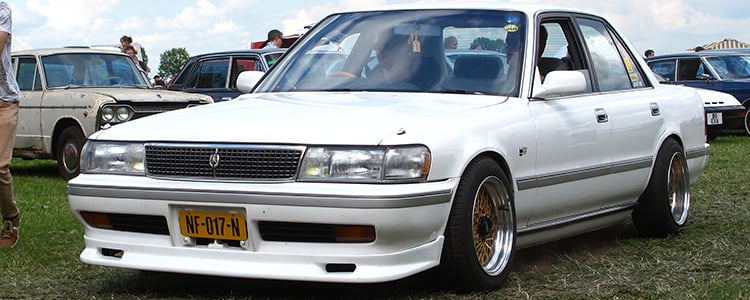
The JZX100 Tourer V with 1JZ-GTE and available 5-speed manual is the variant most commonly imported. GX100 (1G-FE) and iR-V (direct-injection 1JZ-FSE) variants are also X100-generation Mark IIs.
Key Takeaways
- Tourer V (1JZ-GTE) is the value leader
- Factory manual commands the biggest premium
- Stock, low-rust cars outperform modified
- Autos/non-turbo are best budget entries
- Chaser/Cresta share parts and pricing cues
- US legality improves demand as years roll in
Should You Buy a Toyota Mark II JZX100?
Why You'll Love It
- 1JZ/2JZ drivetrain upside Turbo trims take power reliably; NA trims swap-friendly with deep aftermarket.
- RWD dynamics and balance Long wheelbase stability with predictable breakaway; great for street or drift.
- Tourer V halo desirability Factory 1JZ-GTE + sport trim drives top demand and strongest resale.
- Huge parts interchangeability Shares components with Chaser/Cresta/Crown; easy sourcing for mechanical parts.
- Comfortable real-world sedan Four doors, usable rear seats, and quiet cruising; easier to live with than coupes.
- Strong community knowledge Well-documented swaps, wiring, and maintenance; many proven build recipes.
- Value in non-turbo trims Grande/NA cars offer same chassis look/feel for less; ideal clean daily base.
- Manual conversion viable R154/W55/W58 swaps common; many off-the-shelf mounts and pedal solutions.
Why You Might Not
- Rust and prior crash repairs Sills, rear arches, floors, and trunk wells rust; many cars have drift damage.
- Manual scarcity premium Factory 5MT Tourer V is rare; buyers overpay or settle for swapped examples.
- Modified car risk Boost creep, poor wiring, cheap coilovers, and cut harnesses hurt reliability/value.
- Aging electronics/interior Climate control, LCDs, and brittle plastics fail; OEM trim can be hard to find.
- Automatic limitations A340 autos are durable but dull; high-power builds need cooling and upgrades.
- Insurance/registration friction Import paperwork, inspections, and parts lead times vary by state and insurer.
- Fuel and cooling sensitivity Turbo cars need good fuel and cooling; neglected radiators cause overheating.
- Weight vs sport coupes Heavier than Silvia/AE86; needs suspension/brakes to feel sharp on track.
Who Should NOT Buy This
- Anyone needing modern crash safety and airbags
- Buyers who can't wrench or pay a JDM specialist
- People needing guaranteed parts next-day locally
- California residents without a clear compliance plan
- Those expecting 30+ mpg or cheap fuel costs
- Drivers wanting quiet, modern NVH and refinement
- Anyone who hates chasing oil leaks and seepage
- People who won't do timing belt on schedule
- Buyers who need OBD2 plug-in diagnostics everywhere
- Those needing perfect A/C without ongoing upkeep
- Owners without covered parking (rust and leaks worsen)
- People who want zero electrical gremlins from age
- Anyone buying a heavily modified/tuned example
- Those who can't tolerate RHD quirks in LHD traffic
- People who need strong dealer support and recalls
- Drivers in salted-road regions without rustproofing
- Anyone needing modern infotainment and phone integration
- Buyers expecting cheap insurance or easy financing
- People who won't run proper oil and cooling maintenance
- Those who need a one-car solution with no downtime
Common Issues & Solutions
| Issue | Cause | Solution | Est. Cost |
|---|---|---|---|
| Timing belt overdue | Unknown history; long intervals; age cracking | Full TB kit: belt, idlers, tensioner, WP | $700-1400 |
| Cam/crank seal oil leak | Aged seals; crank pulley wear; high mileage | Replace seals; inspect pulley; reseal front cover | $400-1200 |
| Valve cover gasket leak | Hardened gasket; overtorque; PCV restriction | Replace gasket/grommets; service PCV; clean wells | $150-450 |
| Rear main seal leak | Age; crankcase pressure; worn seal lip | Replace RMS during clutch or trans service | $700-1600 |
| Cooling system failures | Old radiator tanks; brittle hoses; weak cap | Radiator/hoses/thermostat/cap; proper bleed | $400-1100 |
| Heater core seep/leak | Corrosion; old coolant; electrolysis | Replace heater core; flush; new coolant | $900-1800 |
| Turbo oil smoke (1JZ) | Worn seals/bearings; poor oiling; high heat | Rebuild/replace turbos; check PCV and drain | $900-2500 |
| Boost creep/overboost | Exhaust mods; weak wastegate control; leaks | Fix leaks; proper boost control; tune if needed | $200-1200 |
| Detonation under load | Bad tune; low octane; heat soak; lean fuel | Compression test; fuel system check; proper tune | $300-2500 |
| Ignition coil misfire | Aged coils/boots; oil in plug wells; heat | Replace coils/boots; plugs; fix valve cover leak | $250-900 |
| Injector seal fuel leak | Hardened O-rings/insulators; ethanol exposure | Replace injector seals/insulators; inspect rail | $200-600 |
| Fuel pump weak/noisy | Age; clogged sock; low tank running | Replace pump and filter; verify pressure | $250-700 |
| A/T shift flare/slip | Worn clutches; overheated ATF; neglect | Service fluid early; rebuild/replace if slipping | $250-3500 |
| A/T delayed engagement | Valve body wear; low fluid; internal seals | Check level; service; valve body or rebuild | $250-3200 |
| M/T 2nd gear crunch | Synchro wear; wrong fluid; hard driving | Correct fluid; rebuild gearbox if persistent | $120-2500 |
| Clutch slip/chatter | Worn disc; oil contamination; weak pressure plate | Clutch kit; resurface flywheel; fix oil leaks | $700-1600 |
| Driveshaft vibration | Worn center bearing; U-joints; bent shaft | Replace bearing/U-joints; balance or replace shaft | $300-1200 |
| Diff whine/leaks | Worn bearings; low oil; pinion seal aging | Reseal; refill; rebuild diff if noisy | $200-1800 |
| Front ball joint wear | Age; torn boots; lowered suspension stress | Replace ball joints; align; inspect control arms | $250-700 |
| Control arm bushing tear | Rubber aging; oil exposure; aggressive driving | Replace bushings/arms; consider quality poly | $400-1200 |
| Rear subframe bushings | Collapsed rubber; age; torque loads | Replace bushings; check subframe rust/cracks | $600-1600 |
| Steering rack leak | Seal wear; contaminated fluid; torn boots | Rebuild/replace rack; flush PS system | $600-1600 |
| PS pump whine | Low fluid from leaks; worn pump; aeration | Fix leaks; flush; replace pump if noisy | $250-900 |
| Brake caliper sticking | Seized slide pins; torn boots; corrosion | Rebuild/replace calipers; new pads/rotors | $300-1200 |
| Warped brake rotors | Cheap rotors; overheated; stuck caliper | Quality rotors/pads; fix caliper; bed properly | $250-800 |
| ABS sensor faults | Broken wiring; dirty tone rings; sensor aging | Repair wiring; clean rings; replace sensor | $150-700 |
| Rust in rockers/sills | Poor drainage; salted roads; hidden seam rust | Cut/weld repair; treat cavities; avoid undercoat | $800-5000 |
| Trunk water intrusion | Tail light seals; trunk gasket; seam sealer cracks | Reseal lights/seams; replace gasket; dry interior | $150-800 |
| Sunroof drain leaks | Clogged drains; cracked tubes; poor prior repair | Clear/replace drains; dry and treat mold | $150-900 |
| Cluster backlight failure | Aged bulbs; solder cracks; dimmer issues | Replace bulbs/LED; reflow solder; check grounds | $80-400 |
| Speedo not working | Vehicle speed sensor; cluster fault; wiring | Test VSS; repair wiring; cluster service | $150-700 |
| Climate control faults | Blend door servo; control head aging; vacuum leaks | Diagnose actuators; repair controls; reseal ducts | $200-900 |
| A/C weak or warm | Low refrigerant; condenser leak; tired compressor | Leak test; replace O-rings; compressor if needed | $200-1500 |
| Window regulator slow | Dry tracks; weak motor; worn regulator cables | Lubricate tracks; replace regulator/motor | $150-600 |
| Door lock actuator weak | Aged actuator motor; sticky linkages | Replace actuators; clean/lube mechanisms | $150-700 |
| Power antenna failure | Stripped mast; dead motor; water intrusion | Replace mast/motor; delete if desired | $80-400 |
| Aftermarket wiring hacks | Alarm/stereo/boost controller poor installs | Trace/repair harness; restore grounds/fuses | $200-2000 |
Pre-Purchase Inspection Checklist
Critical Priority
High Priority
Medium Priority
Low Priority
Generation History
Mark II 1st (T60/T70) (1968-1972)
- Corona Mark II origins; early upscale sedan
- Carb I4/I6 options; comfort-focused
- Collector niche; limited export awareness
Mark II 2nd (X10/X20) (1972-1976)
- Larger body; more luxury positioning
- I6 availability expands; smoother cruising
- Early classic appeal, thin parts supply
Mark II 3rd (X30/X40) (1976-1980)
- Boxier styling; stronger Japan taxi presence
- I6 lineup matures; improved durability
- Low US demand; Japan classic market niche
Mark II 4th (X60) (1980-1984)
- Iconic wedge/box styling; rising classic JDM
- Twin-cam trims appear; better performance
- Rust and trim scarcity are key issues
Mark II 5th (X70) (1984-1988)
- Popular RWD platform; drift/stance interest
- 1G/7M-era engines; strong interchangeability
- Values tied to condition; mods common
Mark II 8th (X100) (1996-2000)
- Refined interior; better NVH and safety
- Tourer V remains 1JZ-GTE; strong driveline
- Most liquid market; best parts availability
Sales Numbers by Year
| Year | Exports | Notes |
|---|---|---|
| 1977 | 2,526 | First US sales as Cressida |
| 1978 | 12,484 | |
| 1979 | 11,910 | |
| 1980 | 11,627 | |
| 1981 | 29,583 | |
| 1982 | 37,448 | |
| 1983 | 39,755 | |
| 1984 | 34,456 | |
| 1985 | 45,286 | Peak US Cressida sales year |
| 1986 | 42,180 | |
| 1987 | 21,968 | |
| 1988 | 14,035 | |
| 1989 | 23,785 | |
| 1990 | 12,710 | |
| 1991 | 9,415 | |
| 1992 | 3,528 | Final US Cressida model year |
| 1993 | 322 | |
| 1994 | 5 | |
| 1995 | 10 | Cressida replaced by Avalon in North America |
Market Data
Production Numbers & Rarity
| Generation | Years | Total Built | Notes |
|---|---|---|---|
| Mark II (T60/T70, 3rd gen) | 1972-1976 | estimated | Exact global totals not consolidated; estimated |
| Mark II (X30/X40, 4th gen) | 1976-1980 | estimated | Exact totals vary by body/market; estimated |
| Mark II (X50/X60, 5th gen) | 1980-1984 | estimated | Exact totals vary by body/market; estimated |
| Mark II (X70, 6th gen) | 1984-1988 | estimated | Exact totals vary by body/market; estimated |
| Mark II (X100, 9th gen) | 1996-2000 | estimated | Exact totals not published as single figure; est. |
Comparable Alternatives
In Pictures
The Buyer's Read
The question with any Mark II purchase is which trim. A factory R154 5-speed manual JZX100 Tourer V carries the smallest supply and the highest price — expect $40,000 and up for a clean documented example. A 4-speed automatic Tourer V costs roughly half that and delivers the same 1JZ-GTE engine, reinforced body, and parts catalog; if a manual swap is planned anyway, the automatic is the more practical starting point.
If the turbo isn't required, X100 and X110 Grande and Grande G cars represent strong value. The 1JZ-GE NA is a durable engine, parts remain cheap, and a clean Grande with leather looks the part without the Tourer V premium. The X110 iR-V uses the VVT-i 1JZ-GTE at the same 280 PS rating and prices haven't yet caught up to the X100 — making it a viable alternative for buyers who don't insist on the earlier chassis.
The car to avoid is a heavily modified Tourer V without paperwork. The JZX100 was the drift platform of the late 1990s and many cars absorbed hard use before export. Cracked dashes and faded interiors are age-normal; bent subframes, replaced floors, and welded diffs are not.
Pay for a pre-purchase inspection in Japan, or buy locally from a seller who already imported and sorted the car. Auction records on Classic.com show what sorted examples actually clear. A rough Tourer V will cost more in the first year than the discount on purchase, and that difference rarely comes back at resale.
Sources & References
Sources (11)
- Toyota Mark II — encyclopedic overview — Wikipedia Verified
- Toyota Cressida — export-market overview — Wikipedia Verified
- Toyota JZ engine family (1JZ-GE, 1JZ-GTE, 1JZ-FSE, 2JZ-GE) — Wikipedia Verified
- Toyota Chaser — JZX-platform sibling reference — Wikipedia Verified
- Toyota Cresta — JZX-platform sibling reference — Wikipedia Verified
- Toyota Verossa — X110-era replacement for Chaser and Cresta — Wikipedia Verified
- Bring a Trailer auction results — Toyota Cressida (Mark II export) — Bring a Trailer Verified
- Classic.com aggregated sales — Toyota Mark II — Classic.com Verified
- Goo-net Exchange — Toyota Mark II export listings — Goo-net Verified
- Carsensor — Toyota Mark II domestic Japan listings — Carsensor (Recruit) Verified
- Toyota 75-year history — Motomachi plant overview — Toyota Motor Corporation Verified
Sources last verified: