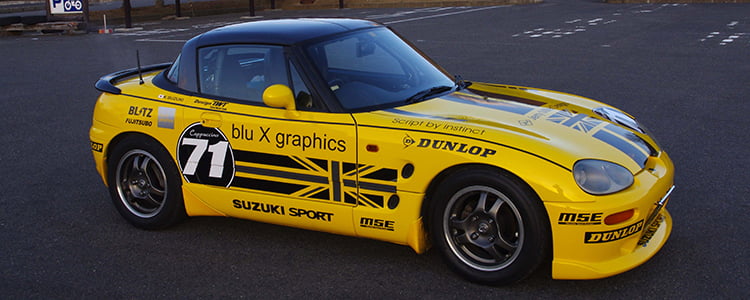
Daihatsu Mira TR-XX
Closest rival kei hot hatch; strong TR-XX/Avanzato cult
Buyer's guide
15 min read
Buyer's guide & specs
Background
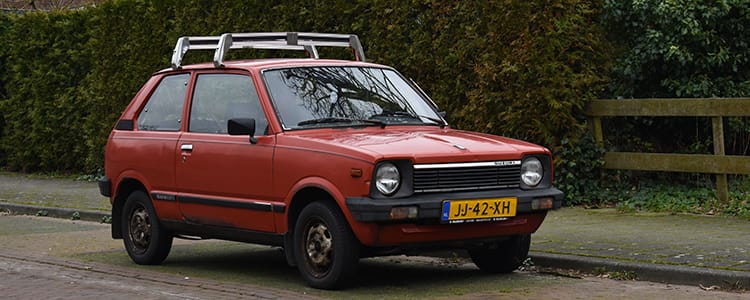
The Suzuki Alto launched in May 1979 as a commercial hatchback priced at ¥470,000 — roughly USD 1,900 — under the SS30/SS40 chassis, running a 547cc F5A three-cylinder. Ten generations followed: CA71, CM/CM11, HA11, HA12/HA23, HA24, HA25, HA36, and the current HA37/HA97. The Alto Works variants — turbocharged F6A and K6A through HA11/HA12/HA22S, then the HA36S R06A turbo reboot in 2015 — hold to the kei 64 hp ceiling with sport suspension and Recaro seats. Under the US 25-year rule, every Alto built 2001 or earlier is import-legal; cars built 2002 through 2006 reach eligibility by 2031.
Japan's 1976 kei vehicle reform lifted the displacement ceiling to 550cc and the width ceiling to 1,400mm; the May 1979 Alto was Suzuki's first clean-sheet design under those rules.
The car registered as a commercial vehicle — rear seats folded flat into a load floor — to qualify for a lower commodity tax, which explains the 'Van' or 'Alto' badge rather than a passenger-car trim hierarchy. The F5A ran 547cc water-cooled, four-stroke, three-cylinder, producing around 28 PS in early carb form through a 4-speed manual. A 2-speed automatic followed in 1980.
Suzuki could not meet domestic demand and stood up production lines in Pakistan, India, and other export markets, which eventually produced the Maruti Alto — one of the best-selling cars in the world.
The first turbocharged Alto was the 1985 Alto Juna, fitted with a turbocharged F5A. The Works name arrived in 1987 on the CA72V and carried forward through CM11/CM22 (1988–1994), HA11/HA21S (1994–1998), and HA12/HA22S (1998–2004), paired with a turbocharged 660cc engine and a 5-speed manual on RS-R, RS-X, and RS/Z trims.
The Works lineage went dormant in 2000, then returned in 2015 on the HA36S with a turbocharged R06A, Recaro seats, and a 5-speed manual or 5-speed AGS. Output across every Works trim holds at the regulated kei ceiling of 64 PS — engineering effort targets chassis tuning, suspension geometry, and weight reduction rather than peak power.
Limited-run editions ('Suzuki Sport', 'Whisper', anniversary packages) appeared periodically; documentation and original equipment matter more than raw mileage for collector valuation.
Editorial notes
Quick read
Constants
Chassis history
The Alto has been around since 1979 and every generation feels like a different car. The early SS30 and CA71 cars are tiny 550cc time capsules and pretty hard to find now. The CM and HA11 are where the Alto Works turbo lineage really lands, and the HA24 and HA36 are the modern kei Altos most buyers actually drive.
Third generation — CL11V/CN21S/CP21S (1988–1994)
Fourth generation — HA11S/HA21S (1994–1998)
Eighth generation — HA36S (Alto Works revived 2015; 2014–2021)
Buyer's call
The Alto is one of those cars where the trade-offs are obvious from the spec sheet. You're getting cheap, light, and easy to live with. What you give up is highway comfort and any kind of power. If that sounds like your kind of car you'll love it.
Reliability
The Alto is a simple car and most of what goes wrong is age, not engineering. Rust is the big one, especially on the sills and rear arches. The Works turbo cars need their oil changes done on time or the F6A turbo bearings cook themselves. Suspension bushings and exhaust hangers wear out on any Alto past 25 years old.
| Issue | Cause | Solution | Est. cost |
|---|---|---|---|
| Rust in sills/underbody | Thin paint, trapped moisture, salted roads | Inspect/repair weld patches; undercoat; avoid rot | $800-4000 |
| Strut tower rust/cracks | Corrosion + pothole loads on thin metal | Immediate repair; plate/weld; align afterwards | $1200-4500 |
| Rear wheel arch rust | Mud traps at lip; poor drainage | Cut/replace arch sections; treat cavities | $600-2500 |
| Water leaks into cabin | Cowl drains clogged; door/hatch seals aged | Clear drains; replace seals; dry carpets fully | $150-900 |
| Overheating in traffic | Fan motor/relay failure or clogged radiator | Test fan circuit; replace fan/radiator; bleed | $250-900 |
| Radiator plastic tank crack | Age heat-cycles; brittle plastic end tanks | Replace radiator/cap; refresh hoses if swollen | $200-650 |
| Thermostat stuck | Cheap coolant, corrosion, age | Replace thermostat and gasket; flush coolant | $120-350 |
| Head gasket failure | Chronic overheating or neglected coolant | Machine head, new gasket/bolts; fix root cause | $900-2200 |
| Oil consumption/smoke | Worn rings/valve seals; long oil intervals | Compression test; rebuild or engine swap | $1200-3500 |
| Timing belt overdue (some) | Unknown history; skipped interval | Replace belt, tensioner, water pump, seals | $450-1100 |
| Timing chain rattle (some) | Stretched chain/tensioner wear from dirty oil | Replace chain kit; verify oil pressure | $700-1600 |
| Rough idle/stalling | Dirty throttle body/IAC; vacuum leaks | Clean TB/IAC; smoke test; replace cracked hoses | $120-600 |
| Misfire under load | Worn plugs, coils/leads, weak fuel pressure | Tune-up; test coils; fuel pressure test/pump | $120-900 |
| O2 sensor aging | High mileage; contamination from oil burning | Replace upstream O2; check for exhaust leaks | $150-450 |
| Catalytic converter clog | Oil burning/misfire overheats cat | Fix misfire; replace cat; verify backpressure | $500-1800 |
| Manual 2nd gear grind | Synchro wear; wrong/old gear oil | Change oil; if persists rebuild gearbox | $120-1800 |
| Clutch slip/shudder | Worn disc/pressure plate; oil contamination | Replace clutch kit; resurface flywheel; fix leaks | $500-1200 |
| CVT shudder/failure | Neglected fluid; overheating; belt/pulley wear | Fluid service early; rebuild/replace if slipping | $900-3500 |
| 4AT shift flare (if auto) | Worn solenoids/clutches; old ATF | ATF service; solenoid body; rebuild if burnt | $250-2800 |
| CV joint clicking | Torn boots; grease loss; joint wear | Replace axle or reboot early; align after | $200-650 |
| Wheel bearing hum | Water intrusion; pothole impacts | Replace hub/bearing; torque to spec | $250-700 |
| Steering rack leak/clunk | Worn inner joints/seals; torn boots | Replace rack or rebuild; align; replace tie rods | $600-1600 |
| Suspension bushing wear | Age, heat, cheap rubber; rough roads | Replace control arms/bushes; alignment | $300-1200 |
| Brake line corrosion | Road salt; poor underbody coating | Replace hard lines; flush fluid; inspect all | $400-1500 |
| Caliper slide seizure | No grease service; torn boots | Service slides; replace calipers if pitted | $150-600 |
| ABS sensor faults | Broken wiring at hubs; rusted tone rings | Repair harness; replace sensor; clean tone ring | $150-650 |
| A/C weak or not cold | Condenser leak; compressor wear; O-rings | Leak test; replace parts; evac/recharge properly | $200-1200 |
| Blower resistor failure | Heat stress; debris in blower | Replace resistor; clean blower and cabin intake | $80-250 |
| Window regulator failure | Cable fray; dry tracks; motor strain | Replace regulator; lube tracks; check seals | $150-450 |
| Charging system weak | Alternator wear; bad grounds; small battery | Load test; replace alternator; clean grounds | $200-650 |
| Fuel pump weak/no start | Age; running low fuel overheats pump | Test pressure; replace pump and strainer | $250-800 |
| Exhaust leaks/rust | Thin exhaust steel; short trips condensation | Replace sections; check hangers; new gaskets | $200-900 |
| Interior rattles | Lightweight trim; broken clips | Replace clips/felt tape; tighten seat/trim bolts | $20-250 |
Market
The Suzuki Alto has never been federalised for the United States. The car sold in dozens of other markets — as the Suzuki Alto in Europe, the Maruti Alto in India (where it became one of the best-selling cars in the world), the Suzuki Mehran in Pakistan, and badge-engineered as the Holden Barina and Pontiac Firefly in Australia and Canada — but North American buyers can only access the JDM Alto under the federal 25-year rule (or, in Canada, the 15-year rule that opens the door to HA22S Works cars now). The export-market Marutis built in India share the SS80 and successor platforms but were tuned for different fuel quality, emissions and crash standards, and they are not interchangeable with JDM cars on parts. Gray-market Alto Works cars are the high-value imports; base JDM Altos are the cheap kei-novelty entry point at the $3,000–$6,000 floor.
Specs
Every Alto is a three-cylinder kei car. The early ones used the F5A 547cc, then the F6A 660cc came in with the 1990 kei rule change, and the K6A 660cc took over from 1998. The Works trim adds a turbo and roughly doubles the power. Manual gearboxes are mostly 5-speeds and the automatics are 3 or 4-speed depending on the year.
| Chassis | Engine | Displacement | Power | Boost | Notes |
|---|---|---|---|---|---|
| SS30/SS40 | F5A | 0.54L | estimated | N/A | Early kei; exact output varies by year |
| CA71 | F5A | 0.55L | estimated | N/A | Market/year dependent; confirm by submodel |
| CL11/21/22 | F5A/F5B | 0.55L | estimated | N/A | Multiple calibrations; kei limits era |
| CN11/21/22/31/32 | F6A | 0.66L | estimated | N/A | 660cc era; outputs vary by carb/EFI |
| HA11/12/21/22 | F6A | 0.66L | estimated | N/A | NA variants; exact figures vary by grade |
| HA11/12/21/22 | F6A (Turbo) | 0.66L | estimated | estimated | Alto Works; exact boost/output by year |
| HA23S/HA23V | K6A | 0.66L | estimated | N/A | NA K6A; outputs vary by tune/AT/MT |
| HA24S/HA24V | K6A | 0.66L | estimated | N/A | NA K6A; confirm by model code and year |
| HA25S/HA25V | K6A | 0.66L | estimated | N/A | NA K6A; CVT/AT tunes differ |
| HA36S/HA36V | R06A | 0.66L | 49hp @ 6500rpm (estimated) | N/A | NA R06A; exact spec varies by grade |
| HA36S | R06A (Turbo) | 0.66L | 64hp @ 6000rpm (estimated) | estimated | Turbo RS/Works; kei max output class |
| HA37S/HA97S | R06A | 0.66L | 48hp @ 6500rpm (estimated) | N/A | NA; mild-hybrid adds ISG assist |
| HA37S/HA97S | R06A + ISG (12V SHVS) | 0.66L | 48hp @ 6500rpm (estimated) | N/A | 12V mild hybrid; assist torque varies |
| Type | Ratios | Availability | Notes |
|---|---|---|---|
| 5-speed Manual | varies by gen | Most gens/trims (market dep.) | Exact ratios differ by chassis/engine |
| 3-speed Automatic | varies by gen | Older gens (market dep.) | Early AT; confirm by year/submodel |
| 4-speed Automatic | varies by gen | HA23/HA24/HA25 (market dep.) | Jatco/Aisin variants by application |
| CVT | varies by gen | HA25/HA36/HA37/HA97 (market dep.) | Pulley ratio + final drive varies |
| 5-speed AGS (Automated Manual) | varies by gen | HA36 Turbo RS/Works (market dep.) | Single-clutch automated manual |
Lineup
Alto trims are pretty simple. Base passenger cars, commercial vans with vinyl floors and fewer seats, and the Works hot-hatch with the turbo. The Mighty Boy from the SS40 era is a kei pickup truck spin-off and worth knowing about if you want something weirder. Most of the price difference between trims comes down to whether it's a Works or not.
| Generation | Trim | Engine | Key features |
|---|---|---|---|
| SS30/SS40 (1st gen, Japan) | Alto (base) | F5A 0.54L I3 NA | Kei class, 2/3-door, basic interior |
| SS30/SS40 (1st gen, Japan) | Alto (Van/Commercial) | F5A 0.54L I3 NA | Commercial van spec, simplified trim |
| CA71 (2nd gen, Japan) | Alto (base) | F5A 0.55L I3 NA | Kei hatch, improved NVH, light weight |
| CA71 (2nd gen, Japan) | Alto (Van/Commercial) | F5A 0.55L I3 NA | Commercial grade, vinyl trim, utility focus |
| CL11/21/22 (3rd gen, Japan) | Alto (base) | F5B/F5A 0.55L I3 NA | Kei hatch, updated body, basic equipment |
| CL11/21/22 (3rd gen, Japan) | Alto (Van/Commercial) | F5B/F5A 0.55L I3 NA | Commercial van spec, simplified interior |
| CN11/21/22/31/32 (4th gen, Japan) | Alto (base) | F6A 0.66L I3 NA | 660cc era, lighter chassis, improved safety |
| CN11/21/22/31/32 (4th gen, Japan) | Alto (Van/Commercial) | F6A 0.66L I3 NA | Commercial spec, utility trim, cost focused |
| HA11/12/21/22 (5th gen, Japan) | Alto (base) | F6A 0.66L I3 NA | Kei hatch, EFI, improved packaging |
| HA11/12/21/22 (5th gen, Japan) | Alto (Van/Commercial) | F6A 0.66L I3 NA | Commercial van, simplified trim, durability |
| HA11/12/21/22 (5th gen, Japan) | Alto Works | F6A 0.66L I3 Turbo | Turbo, sport suspension, Recaro (market dep.) |
| HA23S/HA23V (6th gen, Japan) | Alto (passenger) | K6A 0.66L I3 NA | Passenger spec, EFI, improved crash structure |
| HA23S/HA23V (6th gen, Japan) | Alto (Van/Commercial) | K6A 0.66L I3 NA | Commercial spec, utility trim, cost focused |
| HA24S/HA24V (7th gen, Japan) | Alto (passenger) | K6A 0.66L I3 NA | New body, improved rigidity, better fuel economy |
| HA24S/HA24V (7th gen, Japan) | Alto (Van/Commercial) | K6A 0.66L I3 NA | Commercial spec, simplified interior, utility |
| HA25S/HA25V (8th gen, Japan) | Alto F | K6A 0.66L I3 NA | Entry grade, CVT/AT avail., low rolling resistance |
| HA25S/HA25V (8th gen, Japan) | Alto G | K6A 0.66L I3 NA | Mid grade, improved audio, convenience features |
| HA25S/HA25V (8th gen, Japan) | Alto X | K6A 0.66L I3 NA | Higher grade, smart key (market dep.), styling |
| HA25S/HA25V (8th gen, Japan) | Alto (Van/Commercial) | K6A 0.66L I3 NA | Commercial spec, vinyl trim, utility focus |
| HA36S/HA36V (9th gen, Japan) | Alto F | R06A 0.66L I3 NA | Lightweight, idling stop (market dep.), safety pkg |
| HA36S/HA36V (9th gen, Japan) | Alto L | R06A 0.66L I3 NA | Value grade, keyless (market dep.), convenience |
| HA36S/HA36V (9th gen, Japan) | Alto S | R06A 0.66L I3 NA | Mid grade, safety support (market dep.), comfort |
| HA36S/HA36V (9th gen, Japan) | Alto X | R06A 0.66L I3 NA | Higher grade, alloy wheels (market dep.), styling |
| HA36S/HA36V (9th gen, Japan) | Alto Turbo RS | R06A 0.66L I3 Turbo | Turbo, 5AGS, paddle shift, sport tuning |
| HA36S/HA36V (9th gen, Japan) | Alto Works | R06A 0.66L I3 Turbo | Turbo, 5MT/5AGS, Recaro, sport suspension |
| HA36S/HA36V (9th gen, Japan) | Alto (Van/Commercial) | R06A 0.66L I3 NA | Commercial spec, simplified trim, utility focus |
| HA37S/HA97S (10th gen, Japan) | Alto A | R06A 0.66L I3 NA | Entry grade, Suzuki Safety Support (market dep.) |
| HA37S/HA97S (10th gen, Japan) | Alto L | R06A 0.66L I3 NA | Value grade, keyless (market dep.), convenience |
| HA37S/HA97S (10th gen, Japan) | Alto Hybrid S | R06A 0.66L I3 NA + ISG | 12V mild hybrid, CVT, regen, idle stop |
| HA37S/HA97S (10th gen, Japan) | Alto Hybrid X | R06A 0.66L I3 NA + ISG | 12V mild hybrid, higher equipment, safety tech |
| HA37S/HA97S (10th gen, Japan) | Alto (4WD variants) | R06A 0.66L I3 NA/Hybrid | Selectable/viscous 4WD (market dep.), CVT |
| HA37V/HA97V (10th gen, Japan) | Alto Van (Commercial) | R06A 0.66L I3 NA | Commercial van, utility trim, cargo focused |
Pricing
The first Alto launched in Japan in 1979 at ¥470,000, around $1,900 USD. That tells you where the Alto sat as a new car, cheaper than every passenger car on the Japanese market. The numbers below are what one costs today. Base Altos stay under $10,000 and Alto Works cars with the turbo and a manual are the ones that have actually appreciated.
Original MSRP: $1,900 at launch in 1979. USD equivalent of the ¥470,000 launch price for the first-generation SS30/SS40 Alto (May 1979). The WP source cites the $1,900 figure verbatim. By contrast, the contemporary Honda Civic (1979) listed at roughly $3,900 USD — the Alto undercut every competing passenger car in Japan by close to half.
Today's market range: $3,000 to $35,000 (median ~$12,000). Source: JDMBUYSELL / USS Auction.
Base Altos remain cheap, but clean JDM kei imports are firming as supply tightens. Alto Works/rare trims show the strongest appreciation, driven by nostalgia and 25-year eligibility. Expect steady gains for documented, rust-free cars; rough cars stay flat.
Inspect
Walk this list with the seller, not in front of them. The Critical items mean walking away if there's no paperwork. The High items can usually be priced into the deal. The Alto is small enough that 20 minutes with a flashlight under the car will tell you most of what you need to know.
Cross-shop
If the Alto isn't the right car, the Suzuki Cappuccino is the sportier two-seat option with the same F6A turbo. The Daihatsu Mira is the closest cross-shopped kei hatch. The Honda Beat and Mazda AZ-1 are the convertible kei sports cars and cost a lot more.
Closest rival kei hot hatch; strong TR-XX/Avanzato cult
Kei performance icon; supercharged character and AWD options
Similar kei simplicity; cheap entry; great city usability
If you want Suzuki kei fun; RWD roadster, higher collector demand
More space and comfort; similar running costs and parts ecosystem
Compare
Among the kei hatches, the Alto is the cheapest to run and the easiest to find parts for. The Daihatsu Mira is its closest rival on price and packaging. The Subaru Vivio runs a smaller four-cylinder and feels a touch more refined. The Mitsubishi Minica rounds out the segment but has the thinnest parts support.
| Feature | Suzuki Alto | Daihatsu Mira L200 | Honda Today JA4 |
|---|---|---|---|
| Class/segment | Kei car / supermini | Kei car | Kei car |
| Typical power | NA ~40-55hp; turbo 64hp | NA ~40-55hp; turbo 64hp | NA ~50-58hp |
| Performance halo | Alto Works (turbo) | Mira TR-XX Avanzato | Vivio RX-R (supercharged) |
| Engine family | F6A/K6A 0.66L I3 | JB-EL/EF 0.66L I3 | EN07 0.66L I4 |
| Drivetrain layouts | FWD; some 4WD trims | FWD; some 4WD trims | FWD; some 4WD trims |
| Transmission options | 5MT common; 3/4AT/CVT | 5MT; 3/4AT | 5MT; 3/4AT |
| Weight/feel | Very light; nimble | Light; slightly more planted | Light; revvier I4 feel |
| Tuning support | Strong for Works/RS | Strong for TR-XX | Moderate; niche parts |
| Collector demand | High for Works; base modest | High for Avanzato | Niche but rising |
| Interior space | Good for kei; upright | Similar; slightly tighter rear | Similar; boxier packaging |
| Ride comfort | Firm/short wheelbase | Slightly softer commuter tune | Varies; TR-XX is firmer |
| Reliability profile | Good if maintained; age issues | Similar; watch turbo wear | Good; supercharger upkeep |
| Rust susceptibility | Common on older imports | Similar; underbody checks | Similar; arches/sills |
Gallery
Editorial
The first decision is Works or base. A base Alto is a cheap, slow city car or a low-stakes first JDM import; an Alto Works is bought for the F6A or K6A turbo with a 5-speed manual, and prices have moved up as the kei hot-hatch market has grown.
The HA21S and HA22S (1994–1998) are the most-targeted Works entries. The F6A turbo and 5-speed manual keep the car light enough that the 64 horsepower kei ceiling doesn't feel limiting. K6A turbo cars from the HA11 generation that followed are mechanically comparable with slightly better build quality; either way, a one-owner car with its auction sheet intact commands a real premium over cheaper alternatives.
For a practical daily-driver import, the HA24 and HA36 are the sensible picks — clean examples start around $5,000 and parts availability is good. Earlier CM and HA11 base cars cost less but require more upfront work on bushings, exhaust, and brake components.
Avoid sill, rear arch, or strut tower rust: Alto sheet metal is thin and a corroded car is a parts donor, not a project. On Works cars, inspect the turbo system carefully — aftermarket intercoolers and oversized turbos on stock F6A internals are the fastest path to spending past 80 horsepower and finding the engine's limits.
SS30 and CA71 cars without paperwork are collector territory. Parts are scarce outside Japan, and most require wholesale restoration.
FAQ
Citations
Sources last verified:
New site! Spotted a bug? We're listening.