Key Takeaways
- Best value as a city runabout; ultra-low fuel/parts costs
- Alto Works/RS are the collectible trims with premiums
- Rust and neglect matter more than mileage on cheap examples
- Kei rules limit power; highway comfort is the trade-off
- Import legality: 25-year rule drives demand for JDM kei
- Auto vs manual: manuals hold value and feel less strained
Technical Specifications
Engine Options
| Chassis | Engine | Displacement | Power — JDM | Notes |
|---|---|---|---|---|
| HA36S/HA36V | R06A | 0.66L | 49hp @ 6500rpm (estimated) | NA R06A; exact spec varies by grade |
| HA36S | R06A (Turbo) | 0.66L | 64hp @ 6000rpm (estimated) | Turbo RS/Works; kei max output class |
Transmission Options
| Type | Ratios | Availability | Notes |
|---|---|---|---|
| 5-speed Manual | varies by gen | Most gens/trims (market dep.) | Exact ratios differ by chassis/engine |
| 3-speed Automatic | varies by gen | Older gens (market dep.) | Early AT; confirm by year/submodel |
| 4-speed Automatic | varies by gen | HA23/HA24/HA25 (market dep.) | Jatco/Aisin variants by application |
| CVT | varies by gen | HA25/HA36/HA37/HA97 (market dep.) | Pulley ratio + final drive varies |
| 5-speed AGS (Automated Manual) | varies by gen | HA36 Turbo RS/Works (market dep.) | Single-clutch automated manual |
Livability
- Headroom
- 38.0"
- Tall drivers fit, but upright seating feels tight
- Rear Seats
- 2 adults short trips
- Knees tight behind tall driver; best for kids
- Cargo
- 6-12 cu ft
- Small hatch; usable with seats folded, tall load lip
Variants & Trims
| Generation | Trim | Engine | Key Features |
|---|---|---|---|
| HA36S/HA36V (9th gen, Japan) | Alto F | R06A 0.66L I3 NA | Lightweight, idling stop (market dep.), safety pkg |
| HA36S/HA36V (9th gen, Japan) | Alto L | R06A 0.66L I3 NA | Value grade, keyless (market dep.), convenience |
| HA36S/HA36V (9th gen, Japan) | Alto S | R06A 0.66L I3 NA | Mid grade, safety support (market dep.), comfort |
| HA36S/HA36V (9th gen, Japan) | Alto X | R06A 0.66L I3 NA | Higher grade, alloy wheels (market dep.), styling |
| HA36S/HA36V (9th gen, Japan) | Alto Turbo RS | R06A 0.66L I3 Turbo | Turbo, 5AGS, paddle shift, sport tuning |
| HA36S/HA36V (9th gen, Japan) | Alto Works | R06A 0.66L I3 Turbo | Turbo, 5MT/5AGS, Recaro, sport suspension |
| HA36S/HA36V (9th gen, Japan) | Alto (Van/Commercial) | R06A 0.66L I3 NA | Commercial spec, simplified trim, utility focus |
Should You Buy a Suzuki Alto HA36?
Why You'll Love It
- Extremely low running costs High mpg, small tires/brakes, simple service; ideal for budget ownership.
- City-friendly size Tiny footprint, tight turning circle, easy parking; great for dense areas.
- Simple, durable kei hardware Many trims use proven small engines; basic layouts keep repairs straightforward.
- Strong JDM kei enthusiast support Aftermarket for Works/RS; community knowledge helps sourcing and maintenance.
- Surprisingly fun in turbo trims Alto Works/RS deliver lively boost in a light shell; great backroad pace.
- Import novelty with practicality Kei charm plus real usability; good conversation piece without supercar costs.
Why You Might Not
- Rust and corrosion risk Older JDM kei often rust at sills/arches/underbody; repairs can exceed value.
- Highway comfort limitations Short wheelbase, light weight, and gearing make long trips noisy and tiring.
- Safety and crash standards vary Older generations lack modern airbags/structure; buyers must accept trade-offs.
- Parts availability by generation Early gens and Works-specific bits can be scarce outside Japan; plan ahead.
- Many cars are heavily used Fleet/commuter life means worn interiors, tired suspension, deferred service.
- Automatic/CVT can feel strained Small displacement plus auto gearing reduces performance; manuals age better.
Who Should NOT Buy This
- Anyone needing highway passing power
- Drivers doing 75+ mph daily in windy areas
- People who refuse frequent maintenance
- Buyers without access to small-car specialists
- Those needing strong crash safety vs modern cars
- Anyone needing 4 adults comfortably
- Tall drivers needing lots of legroom
- People who hate cabin noise and vibration
- Owners in rust-belt without undercoating plans
- Anyone expecting cheap automatic/CVT repairs
- Buyers needing towing capability
- People needing large cargo or stroller space
- Those who can't tolerate slow A/C in extreme heat
- Anyone who won't verify import/title paperwork
- Drivers wanting modern infotainment and safety tech
- People who can't source parts or wait for shipping
- Owners who won't budget for suspension refresh
- Anyone who ignores warning lights and keeps driving
Common Issues & Solutions
| Issue | Cause | Solution | Est. Cost |
|---|---|---|---|
| Rust in sills/underbody | Thin paint, trapped moisture, salted roads | Inspect/repair weld patches; undercoat; avoid rot | $800-4000 |
| Strut tower rust/cracks | Corrosion + pothole loads on thin metal | Immediate repair; plate/weld; align afterwards | $1200-4500 |
| Rear wheel arch rust | Mud traps at lip; poor drainage | Cut/replace arch sections; treat cavities | $600-2500 |
| Water leaks into cabin | Cowl drains clogged; door/hatch seals aged | Clear drains; replace seals; dry carpets fully | $150-900 |
| Overheating in traffic | Fan motor/relay failure or clogged radiator | Test fan circuit; replace fan/radiator; bleed | $250-900 |
| Radiator plastic tank crack | Age heat-cycles; brittle plastic end tanks | Replace radiator/cap; refresh hoses if swollen | $200-650 |
| Thermostat stuck | Cheap coolant, corrosion, age | Replace thermostat and gasket; flush coolant | $120-350 |
| Head gasket failure | Chronic overheating or neglected coolant | Machine head, new gasket/bolts; fix root cause | $900-2200 |
| Oil consumption/smoke | Worn rings/valve seals; long oil intervals | Compression test; rebuild or engine swap | $1200-3500 |
| Timing belt overdue (some) | Unknown history; skipped interval | Replace belt, tensioner, water pump, seals | $450-1100 |
| Timing chain rattle (some) | Stretched chain/tensioner wear from dirty oil | Replace chain kit; verify oil pressure | $700-1600 |
| Rough idle/stalling | Dirty throttle body/IAC; vacuum leaks | Clean TB/IAC; smoke test; replace cracked hoses | $120-600 |
| Misfire under load | Worn plugs, coils/leads, weak fuel pressure | Tune-up; test coils; fuel pressure test/pump | $120-900 |
| O2 sensor aging | High mileage; contamination from oil burning | Replace upstream O2; check for exhaust leaks | $150-450 |
| Catalytic converter clog | Oil burning/misfire overheats cat | Fix misfire; replace cat; verify backpressure | $500-1800 |
| Manual 2nd gear grind | Synchro wear; wrong/old gear oil | Change oil; if persists rebuild gearbox | $120-1800 |
| Clutch slip/shudder | Worn disc/pressure plate; oil contamination | Replace clutch kit; resurface flywheel; fix leaks | $500-1200 |
| CVT shudder/failure | Neglected fluid; overheating; belt/pulley wear | Fluid service early; rebuild/replace if slipping | $900-3500 |
| 4AT shift flare (if auto) | Worn solenoids/clutches; old ATF | ATF service; solenoid body; rebuild if burnt | $250-2800 |
| CV joint clicking | Torn boots; grease loss; joint wear | Replace axle or reboot early; align after | $200-650 |
| Wheel bearing hum | Water intrusion; pothole impacts | Replace hub/bearing; torque to spec | $250-700 |
| Steering rack leak/clunk | Worn inner joints/seals; torn boots | Replace rack or rebuild; align; replace tie rods | $600-1600 |
| Suspension bushing wear | Age, heat, cheap rubber; rough roads | Replace control arms/bushes; alignment | $300-1200 |
| Brake line corrosion | Road salt; poor underbody coating | Replace hard lines; flush fluid; inspect all | $400-1500 |
| Caliper slide seizure | No grease service; torn boots | Service slides; replace calipers if pitted | $150-600 |
| ABS sensor faults | Broken wiring at hubs; rusted tone rings | Repair harness; replace sensor; clean tone ring | $150-650 |
| A/C weak or not cold | Condenser leak; compressor wear; O-rings | Leak test; replace parts; evac/recharge properly | $200-1200 |
| Blower resistor failure | Heat stress; debris in blower | Replace resistor; clean blower and cabin intake | $80-250 |
| Window regulator failure | Cable fray; dry tracks; motor strain | Replace regulator; lube tracks; check seals | $150-450 |
| Charging system weak | Alternator wear; bad grounds; small battery | Load test; replace alternator; clean grounds | $200-650 |
| Fuel pump weak/no start | Age; running low fuel overheats pump | Test pressure; replace pump and strainer | $250-800 |
| Exhaust leaks/rust | Thin exhaust steel; short trips condensation | Replace sections; check hangers; new gaskets | $200-900 |
| Interior rattles | Lightweight trim; broken clips | Replace clips/felt tape; tighten seat/trim bolts | $20-250 |
Differences between JDM & USDM
The Suzuki Alto has never been federalised for the United States. The car sold in dozens of other markets — as the Suzuki Alto in Europe, the Maruti Alto in India (where it became one of the best-selling cars in the world), the Suzuki Mehran in Pakistan, and badge-engineered as the Holden Barina and Pontiac Firefly in Australia and Canada — but North American buyers can only access the JDM Alto under the federal 25-year rule (or, in Canada, the 15-year rule that opens the door to HA22S Works cars now). The export-market Marutis built in India share the SS80 and successor platforms but were tuned for different fuel quality, emissions and crash standards, and they are not interchangeable with JDM cars on parts. Gray-market Alto Works cars are the high-value imports; base JDM Altos are the cheap kei-novelty entry point at the $3,000–$6,000 floor.
Pre-Purchase Inspection Checklist
Critical Priority
High Priority
Medium Priority
Low Priority
Generation History
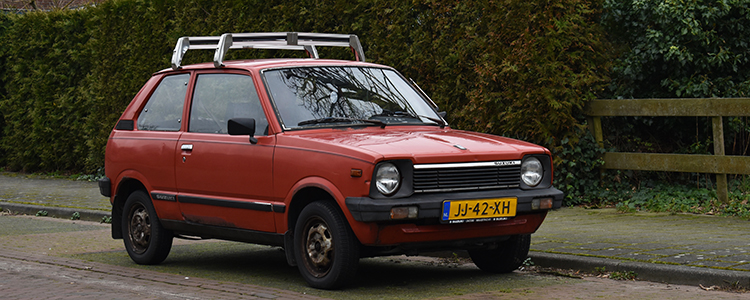
SS30/40 (1st gen) (1979-1984)
- Kei hatch; ultra-light, simple carb engines
- Early Alto identity: cheap, efficient transport
- Now niche-collectible; parts scarcity rising
HA12/23 (5th gen) (1998-2004)
- K6A engine era; better refinement and economy
- Works/RS trims vary by market; some NA sport
- Sweet spot for import: usable + still simple
HA24 (6th gen) (2004-2009)
- More safety/comfort; still light and efficient
- Great daily kei; automatics common
- Lower collector interest vs Works-era cars
HA25/35 (7th gen) (2009-2014)
- More global focus; improved NVH and safety
- CVT/auto prevalence; economy-first tuning
- Values tied to condition, not rarity
HA36 (8th gen) (2014-2021 (kei); 2014- (global))
- Modern Alto; very low running costs
- Alto Works (HA36S): modern turbo kei hot hatch
- Global Alto differs; specs vary by region
Market Data
Production Numbers & Rarity
| Generation | Years | Total Built | Notes |
|---|---|---|---|
| SS30/SS40 (1st gen) | 1979-1984 | estimated | Global totals not consolidated; Japan-heavy |
| HA23S/HA23V (6th gen) | 2004-2009 | estimated | Passenger+van; Japan totals not fully disclosed |
| HA24S/HA24V (7th gen) | 2009-2014 | estimated | Passenger+van; market-dependent production |
| HA25S/HA25V (8th gen) | 2014-2018 | estimated | Short-cycle gen; totals not consolidated |
| HA36S/HA36V (9th gen) | 2014-2021 | estimated | Includes Turbo RS/Works; rare sport variants |
| HA37S/HA97S (10th gen) | 2021-present | estimated | Ongoing production; totals not final |
How It Compares
| Feature | HA36 | Daihatsu Mira L200 | Honda Today JA4 |
|---|---|---|---|
| Class/segment | Kei car / supermini | Kei car | Kei car |
| Typical power | NA ~40-55hp; turbo 64hp | NA ~40-55hp; turbo 64hp | NA ~50-58hp |
| Performance halo | Alto Works (turbo) | Mira TR-XX Avanzato | Vivio RX-R (supercharged) |
| Engine family | F6A/K6A 0.66L I3 | JB-EL/EF 0.66L I3 | EN07 0.66L I4 |
| Drivetrain layouts | FWD; some 4WD trims | FWD; some 4WD trims | FWD; some 4WD trims |
| Transmission options | 5MT common; 3/4AT/CVT | 5MT; 3/4AT | 5MT; 3/4AT |
| Weight/feel | Very light; nimble | Light; slightly more planted | Light; revvier I4 feel |
| Tuning support | Strong for Works/RS | Strong for TR-XX | Moderate; niche parts |
| Collector demand | High for Works; base modest | High for Avanzato | Niche but rising |
| Interior space | Good for kei; upright | Similar; slightly tighter rear | Similar; boxier packaging |
| Ride comfort | Firm/short wheelbase | Slightly softer commuter tune | Varies; TR-XX is firmer |
| Reliability profile | Good if maintained; age issues | Similar; watch turbo wear | Good; supercharger upkeep |
| Rust susceptibility | Common on older imports | Similar; underbody checks | Similar; arches/sills |
Comparable Alternatives
Daihatsu Mira TR-XX
Closest rival kei hot hatch; strong TR-XX/Avanzato cult
Subaru Vivio RX-R
Kei performance icon; supercharged character and AWD options
Honda Today JA4
Similar kei simplicity; cheap entry; great city usability
Suzuki Cappuccino
If you want Suzuki kei fun; RWD roadster, higher collector demand
Suzuki Wagon R (kei)
More space and comfort; similar running costs and parts ecosystem
In Pictures
Sources & References
Sources (8)
- Suzuki Alto — encyclopedic overview — Wikipedia Verified
- Suzuki Alto Works — performance-variant history — Wikipedia Verified
- Suzuki Mighty Boy — Alto-derived kei pickup (1983-1988) — Wikipedia Verified
- Kei car — Japanese regulatory class history — Wikipedia Verified
- Maruti Alto — Indian export-market overview — Wikipedia Verified
- Suzuki Alto — current Japanese-market lineup page — Suzuki Motor Corporation (Japan) Verified
- Suzuki Alto — Japanese encyclopedic overview — Wikipedia (Japanese) Verified
- Suzuki global lineup — corporate model index — Suzuki Motor Corporation Verified
Sources last verified: