Nissan Pao PK10
Same Pike ethos; simpler NA engine; more practical hatch
Buyer's guide
15 min read
Buyer's guide & specs
Quick answer
The Nissan Figaro (1991) is a Pike Factory retro-convertible prized for design, not speed. Values are driven by condition, originality, and rust-free shells; the best cars command strong premiums. Expect rising interest as US legality expands each year.
Background
The Nissan Figaro is a 1991-only FK10 retro convertible — the fourth and final car from Nissan's Pike Factory, with 20,073 units allocated by lottery across three production batches. Built on the K10 Micra/March platform with the MA10ET 1.0-litre turbo, it offered a 1960s-styled cabin alongside a 3-speed automatic, factory air conditioning, and power soft-top. Every car left the factory in one of four colors named for Japanese seasons: Lapis Grey, Emerald Green, Pale Aqua, or Topaz Mist. The Figaro reached the United Kingdom as a gray-market import in the 1990s and became freely importable in the United States in 2016 under the 25-year rule.
The Pike Factory was a Nissan sub-brand producing low-volume, design-led models built by Aichi Kikai — the contract manufacturer better known for Nissan's commercial vans. The series ran from Be-1 (1987) through Pao (1989) and S-Cargo (1989), concluding with the Figaro, which debuted at the 1989 Tokyo Motor Show under the marketing line 'Back to the Future' and entered production in 1991.
All four models shared the K10 underpinnings and retro design language, but the Figaro was the only convertible — a fixed-profile soft-top with a rigid roof rail structure, not a true open car — and the only one fitted with the turbocharged MA10ET in place of the naturally-aspirated MA10S. Production was scheduled in three batches in 1991 to manage demand: 8,000 cars in the first run, then 6,000 each in two further batches, for a confirmed total of 20,073 units.
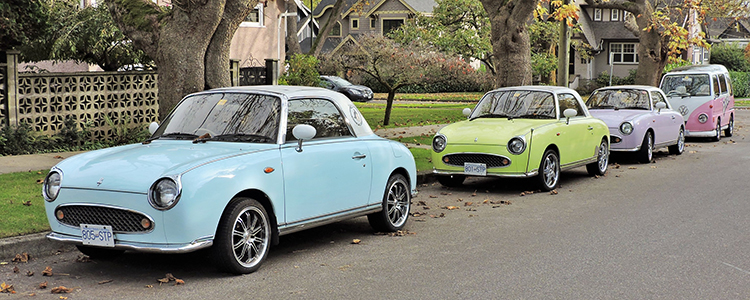
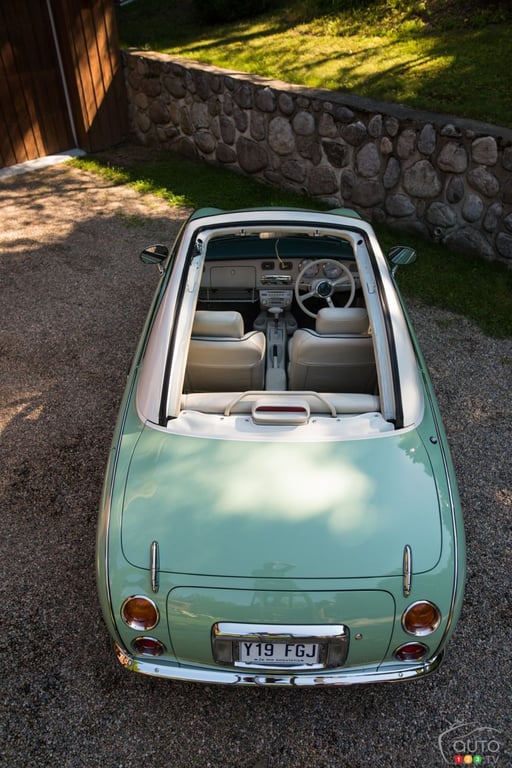
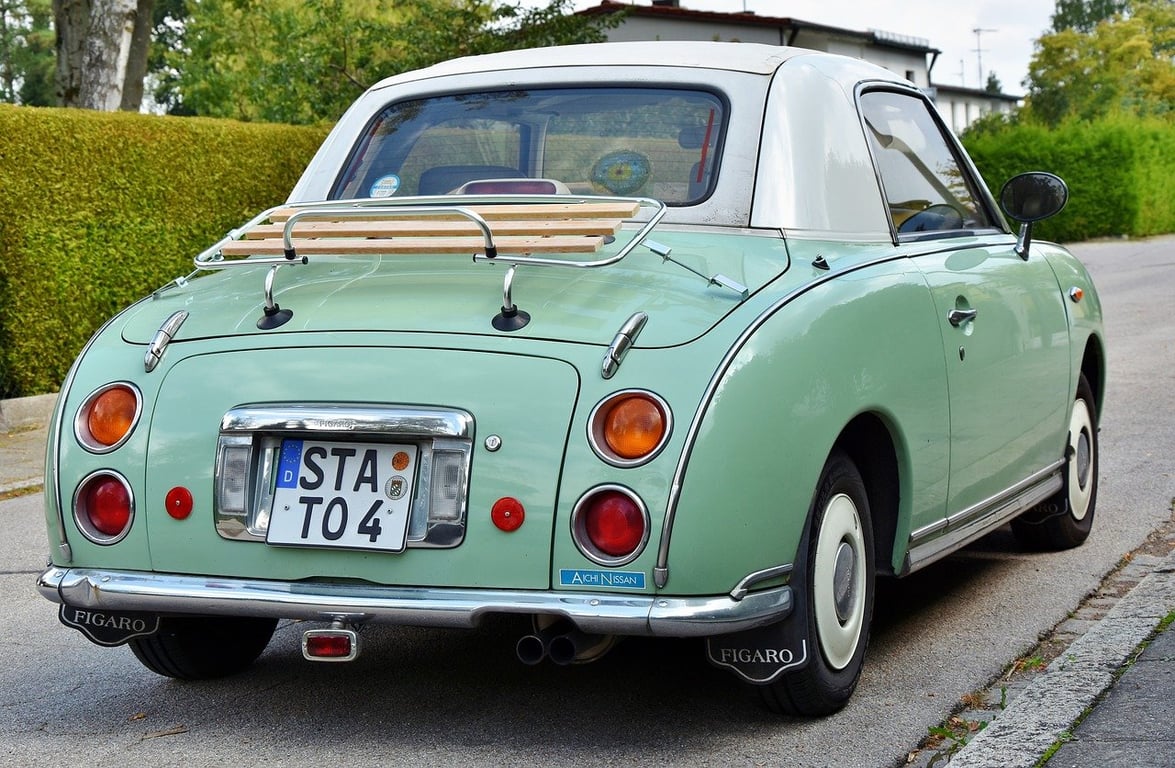
Every Figaro left the factory in one of four shades tied to a Japanese season: Lapis Grey for winter, Emerald Green for spring, Pale Aqua for summer, and Topaz Mist for autumn. There were no metallic options, no two-tones, and no special editions.
Production was split unevenly across the four colors, so some shades are rarer in the secondary market and command a premium. A resprayed Figaro in the wrong shade, or with a poor seam-to-seam color match, loses ground against documented original-paint cars at auction — historic auction results confirm that graders check soft-top fabric, factory steel wheels, and interior chrome trim alongside paint.
Editorial notes
Quick read
Constants
Chassis history
Identification
Generation names are broad families. The factory chassis codes below identify the variants represented in JDMBUYSELL's current Nissan Figaro guide data.
Confirm the complete code on the vehicle's frame or VIN plate; drivetrain, body, and market variants can use different prefixes within one generation family.
Buyer's call
The Figaro is a car you buy with your eyes, and that shapes both sides of the ledger. The good stuff is the look, the chrome, the open roof, and the fact that the K10 mechanicals underneath are simple and well understood. The trade is rust, leaks, and a 75 PS turbo that was never built to chase a freeway.
Reliability
The Figaro is mechanically a Micra with a turbo, so the engine isn't the part that breaks. Rust and water leaks are what take Figaros off the road. The soft top seals shrink, water gets in, and the sills and floors quietly rot under the carpet while the car still drives fine.
| Issue | Cause | Solution | Est. cost |
|---|---|---|---|
| Sill/rocker rust-through | Trapped moisture; blocked drains; poor repairs | Cut/replace metal; treat cavities; reopen drains | $2000-7000 |
| Floorpan corrosion | Top/windscreen leaks soaking carpets for years | Weld patches; reseal; fix leak sources first | $1500-6000 |
| Rear arch rust | Mud traps at lip; thin factory protection | Arch repair panels; rustproof inner/outer lips | $1200-4500 |
| Windscreen surround rust | Aged seal lets water sit under trim | Remove glass; repair metal; new seal; repaint | $1500-5000 |
| Spare well rot | Water ingress from seals/drains; standing water | Repair well; clear drains; reseal tail lamps | $800-3000 |
| Convertible top leaks | Shrunk seals; misaligned frame; clogged drains | Adjust frame; replace seals; clear drains; test | $400-2500 |
| Top frame binding/bent links | Forced operation; corrosion at pivots | Rebuild pivots; replace bent arms; align frame | $600-2500 |
| Rear window cloudy/cracked | Aged vinyl; folded when cold; UV damage | Replace window panel or full top skin | $300-1800 |
| Timing chain rattle | Stretched chain; worn guides/tensioner | Replace chain kit; inspect sprockets; set timing | $900-2200 |
| Turbo oil seal smoke | Worn turbo bearings; poor oiling; heat soak | Rebuild/replace turbo; clean oil feed/return | $900-2500 |
| Boost leaks/surging | Cracked vacuum/boost hoses; loose clamps | Replace all hoses; pressure test intake tract | $150-600 |
| Overheating in traffic | Clogged radiator; weak fan; old thermostat | New radiator/thermostat; verify fan circuit | $400-1200 |
| Head gasket failure | Past overheating; detonation on old fuel system | Head skim/test; gasket; fix cooling and tune | $1200-3500 |
| Oil leaks (multiple) | Aged seals: cam cover, front seal, turbo lines | Reseal; replace turbo line washers; clean PCV | $300-1500 |
| Fuel pump failure | Age; running low fuel; varnish from storage | Replace pump and sock; flush tank/lines | $300-900 |
| Injector seal leaks | Hardened O-rings; ethanol exposure | Replace injector seals; inspect rail and hoses | $200-600 |
| MAF sensor faults | Aged hot-wire; vibration; wiring corrosion | Clean connector; replace MAF; repair harness | $250-900 |
| O2 sensor lazy/rich | Old sensor; exhaust leaks upstream | Replace O2; fix leaks; verify fuel pressure | $200-600 |
| Distributor misfire | Worn cap/rotor; moisture; old leads | Tune-up: cap/rotor/leads/plugs; check coil | $150-500 |
| Auto trans shift flare | Worn clutches; old ATF; valve body wear | Service ATF/filter; rebuild if persistent | $250-3000 |
| Delayed D/R engagement | Low ATF; internal seal wear; clogged filter | Correct fluid; service; rebuild if no change | $200-3000 |
| CV boot splits | Age and heat; low ride height stress | Replace boots or complete axle assemblies | $250-900 |
| Seized brake calipers | Moisture; infrequent use; old brake fluid | Rebuild/replace calipers; flush fluid; new hoses | $400-1400 |
| Rusty brake hard lines | Road salt; neglected underbody protection | Replace lines; inspect proportioning valve | $500-1800 |
| Steering rack play/leak | Worn inner joints; torn boots; seal wear | Rebuild/replace rack; align; replace tie rods | $600-1800 |
| Suspension bushing wear | Age; oil contamination; cracked rubber | Replace control arm bushings; check ball joints | $500-2000 |
| Alternator weak output | Worn brushes/regulator; belt slip | Rebuild/replace alternator; new belt; clean grounds | $250-700 |
| Ground-related gremlins | Corroded grounds; prior alarm/immobilizer hacks | Restore grounds; remove bad splices; re-loom | $150-1200 |
| AC not cold | R12 conversions, leaks, tired compressor | Leak test; replace drier; convert properly; recharge | $400-1800 |
| Heater core leak | Corrosion; old coolant; electrolysis | Replace heater core; flush system; new coolant | $700-1800 |
| Water in cabin | Top seals, cowl drains, windscreen seal failure | Fix seals/drains; dry interior; treat rust early | $200-2500 |
| Interior trim cracking | UV and age; brittle plastics; poor storage | Source used parts; careful restoration; UV protect | $200-2000 |
Market
The Figaro was never sold outside Japan. There is no USDM, EDM, or AUDM variant — every car is a single-year JDM build with right-hand drive, JDM-spec interior, JDM odometer in kilometres, and the JDM-specification MA10ET tuned for 75–76 PS. The United Kingdom developed an early gray-market import scene in the 1990s when private importers found a regulatory work-around, which is why the UK has the largest enthusiast base outside Japan and the strongest specialist parts supply. The United States opened to general Figaro imports in 2016 under the federal 25-year rule (1991 + 25 = 2016), making it one of the earliest JDM-only retro cars to clear the import barrier. Canada had been importing them since 2006 under its 15-year rule. There is no LHD conversion programme of any note; the steering rack, dashboard, pedal box, and wiper sweep are all RHD-specific.
Specs
Every Figaro is the same car underneath. MA10ET 1.0 turbo making about 75 PS, 3-speed automatic, front-wheel drive, K10 chassis. There's no manual option and no NA version. The MA10ET is the same engine as the Nissan March Super Turbo, which is useful when you go looking for parts.
| Chassis | Engine | Displacement | Power | Boost | Notes |
|---|---|---|---|---|---|
| FK10 | MA10ET | 1.0L | 76 PS @ 6000rpm (55.9 kW) | 0.6 bar (8.7 psi) | SOHC 8V, EFI, turbo, intercooled |
| FK10 | MA10ET | 1.0L | 75 hp @ 6000rpm | 0.6 bar (8.7 psi) | Alt rating; market-dependent rounding |
| Type | Ratios | Availability | Notes |
|---|---|---|---|
| 3-speed Automatic (3AT) | 2.861/1.562/1.000 | All Figaro trims | Jatco 3AT; lock-up not fitted |
Lineup
The only factory variation is paint. Lapis Grey for winter, Emerald Green for spring, Pale Aqua for summer, and Topaz Mist for autumn. Mechanically and trim-wise every Figaro is identical, so color and originality of paint matter more on a Figaro than they do on almost any other JDM car.
| Generation | Trim | Engine | Key features |
|---|---|---|---|
| Figaro (FK10) | Figaro (Base) | MA10ET 987cc I4 Turbo | 3AT, power top, leather seats, A/C, power windows |
| Figaro (FK10) | Figaro (Emerald) | MA10ET 987cc I4 Turbo | Limited color, 3AT, power top, leather, A/C |
| Figaro (FK10) | Figaro (Pale Aqua) | MA10ET 987cc I4 Turbo | Limited color, 3AT, power top, leather, A/C |
| Figaro (FK10) | Figaro (Topaz Mist) | MA10ET 987cc I4 Turbo | Limited color, 3AT, power top, leather, A/C |
| Figaro (FK10) | Figaro (Lapis Grey) | MA10ET 987cc I4 Turbo | Limited color, 3AT, power top, leather, A/C |
Production
| Year | Domestic | Notes |
|---|---|---|
| 1991 | 20,073 | Single-model-year run; allocated by lottery in three batches (8,000 + 6,000 + 6,000). All cars JDM; no export production. |
Pricing
The Figaro launched in 1991 at around 1.87 million yen, roughly $14,000 USD at the time. Today a tired but driving Figaro is in the low teens, and a rust-free original-paint car with documented sill and top work can clear $30,000. The gap between a cheap Figaro and a sorted Figaro is mostly the cost of fixing rust, so the cheap ones rarely stay cheap.
Original MSRP: JPY1,870,000 at launch in 1991. Reported JDM list price around ¥1.87M at 1991 launch. JDMBUYSELL editorial cites an inflation- and exchange-rate-adjusted figure near US$31,500 in 2026 dollars, with a contemporary US-equivalent of roughly $14,000. Yen MSRP varies across secondary sources; the figure here is the most commonly cited JDM list price and is not corroborated by an official Nissan price sheet in the source set.
Today's market range: $12,000 to $35,000 (median ~$21,000). Source: JDMBUYSELL / USS Auction.
Demand remains design-driven with a strong premium for rust-free, correctly restored cars. Prices are steady-to-firm post-pandemic; top examples still climb, while tired imports soften due to restoration costs and rust risk.
Inspect
Walk the Figaro looking for rust and water first, mechanicals second. Pull the carpets back, look in the spare well, feel along the sills, and put a hose on the top with the doors closed. The Critical items are mostly about the shell. If the metal's gone, the rest doesn't matter.
Cross-shop
If the Figaro doesn't fit, the other Pike Factory cars are the natural next stop. The Pao is a fixed roof and simpler to own. The Be-1 is even simpler. If you want something that drives better and isn't tied to the Pike look, a Mazda MX-5 NA gives you the convertible experience with parts you can get anywhere.
Same Pike ethos; simpler NA engine; more practical hatch
Earliest Pike car; simpler ownership; similar charm
Small JDM convertible; more driver-focused; strong support
Classic convertible with better dynamics; easier parts in US
Compare
The Figaro doesn't really have direct rivals. The closest cars are its Pike Factory siblings, which share the K10 underpinnings but aren't convertibles, and the kei roadsters like the Honda Beat and Suzuki Cappuccino, which are smaller, faster, and a completely different vibe. The Figaro wins on style and presence and loses on driving feel.
| Feature | Nissan Figaro | Nissan Pao PK10 | Nissan Be-1 BK10 |
|---|---|---|---|
| Body/roof | 2dr convertible, soft top | 2dr coupe, fixed roof | 2dr hatch, fixed roof |
| Engine | 1.0L turbo I4 (MA10ET) | 1.0L NA I4 (MA10S) | 1.0L NA I4 (MA10S) |
| Power output | ≈75 hp (JDM rating) | ≈52 hp (JDM rating) | ≈52 hp (JDM rating) |
| Transmission | 3-speed automatic only | 3AT or 5MT (varies) | 3AT or 5MT (varies) |
| Drivetrain | FWD | FWD | FWD |
| Character | Retro luxury cruiser vibe | Retro utilitarian chic | Minimalist retro hatch |
| Rarity/collectibility | High; Pike halo model | High; Pike cult following | High; earliest Pike car |
| Rust sensitivity | High (convertible leaks) | High (K10-era shells) | High (K10-era shells) |
| Daily usability | Good in city; noisy at speed | Good; more cargo utility | Good; simplest to run |
| Interior vibe | Leather-look, chrome accents | Canvas/utility aesthetic | Simple, airy retro cabin |
| Open-top alternative | True convertible | T-top/convertible (varies) | Targa/convertible (varies) |
| Performance feel | Light, modest, relaxed | Revvy, sporty kei roadster | Turbo, playful kei roadster |
| Market buyer overlap | Style-first collectors | Driving-first collectors | Driving-first collectors |
| Maintenance complexity | Moderate; turbo + top | Moderate; kei parts + age | Moderate; turbo + age |
| Parts availability | Good via UK/Japan specialists | Good via kei specialists | Good via kei specialists |
| Cabin space | 2+ small; comfy for 2 | Strict 2-seater | Strict 2-seater |
| Value driver | Condition/originality story | Mileage, mods, originality | Mileage, rust, originality |
Gallery
Editorial
Buy the shell. A rust-free FK10 with original paint and a dry interior is worth paying for; a rough Figaro at half the price will cost more by the time it's sorted. Check sills, floors under the carpet, rear arches, and the metal around the windscreen — then check whether the top has been leaking, because a car that sat with wet carpets for seasons has rust you can't see from outside.
The MA10ET turbo is shared with the Nissan March Super Turbo, so mechanical parts are not the constraint. Watch for blue smoke on boost (turbo seals) and listen for timing chain rattle on cold start. The 3-speed automatic is the only transmission the Figaro came with; if it shifts cleanly and engages without delay, leave it alone.
Color matters more on a Figaro than on most cars. The four factory shades are Lapis Grey, Emerald Green, Pale Aqua, and Topaz Mist — a car resprayed in a non-original shade or with a poor color match loses real value. Check paint inside door jambs and under the bonnet.
The Figaro Owners Club and UK specialists hold most of the trim and soft-top expertise, because Figaros arrived in the UK as gray-market imports in the 1990s — well before the US 25-year rule opened in 2016. Mechanical parts are easier, since the K10 platform is common.
The car worth buying has a rust-free shell, a recently replaced top, an original interior, and a documented timing chain service. Pay for that car.
FAQ
Citations
Sources last verified: