Chassis Code Explained
| Segment | Meaning | Detail |
|---|---|---|
| N | Model series | N — Hilux N-series platform |
| 80 | Generation code | 80 — fifth-generation Hilux/Surf (1988–1997) |
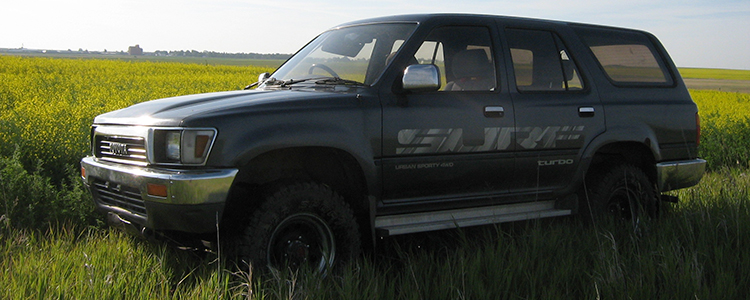
N80 covers the KZN130W (1KZ-TE diesel) and VZN130W (3VZ-E petrol) Hilux Surf; the N80 JDM diesel Surf is the most commonly imported variant for North American buyers seeking a factory RHD diesel SUV.
Key Takeaways
- 1968–present: world's longest-running mid-size pickup nameplate after Land Cruiser
- Hilux Surf is the JDM SUV body; 4Runner is the export name for the same vehicle
- N80 Surf (1989–1995) with 1KZ-TE diesel is the most-imported JDM variant
- 1KZ-TE head gasket and EGR cooler are the known weak points to budget for
- Frame rust at leaf perches and crossmembers is the deal-breaker on older cars
- JDM diesel + RHD combination is what export-market 4Runners never got
Technical Specifications
Engine Options
| Chassis | Engine | Displacement | Power — JDM | Notes |
|---|---|---|---|---|
| N80/N100 (Surf) | 1KZ-TE | 3.0L | 125 PS (estimated, JDM) | Electronic-controlled turbo-diesel I4; the iconic JDM Hilux Surf engine |
| N80/N100 (Surf) | 3VZ-E | 3.0L | 150 hp (estimated) | V6 petrol option in higher trims |
Variants & Trims
| Generation | Trim | Engine | Key Features |
|---|---|---|---|
| N80/N90/N100/N110 (1988–1997) | Hilux Surf SSR-G / SSR-X / SSR-Limited; Hilux Pickup | 22R-E 2.4L / 3RZ-FE 2.7L / 3VZ-E 3.0L V6 petrol; 2L-TE 2.4L / 1KZ-TE 3.0L turbo-diesel | Hilux Surf (LN130/KZN130/VZN130) launched May 1989; 1KZ-TE electronic-controlled turbo-diesel from 1993 |
Should You Buy a Toyota Hilux N80?
Why You'll Love It
- Legendary durability Top Gear's destruction tests — set on fire, drowned, building demolition — made the Hilux a global byword for indestructibility. Real-world ownership reflects the same pattern: simple, robust, hard to kill.
- JDM diesel + RHD combination Export-market 4Runners only got petrol engines; the JDM Hilux Surf offers turbo-diesel options (1KZ-TE, 1KD-FTV) that US buyers can't get on the equivalent Tacoma/4Runner.
- Low running costs Cheap oil, cheap filters, basic mechanicals; insurance and maintenance both come in under most pickup alternatives.
- Strong parts crossover US-market 4Runner and Tacoma share most mechanical hardware with JDM Hilux Surf; pickup-specific parts also widely available.
- Real off-road hardware Body-on-frame, solid rear axle, low-range transfer case on 4WD trims, leaf-spring rear; meant for actual trail use, not soft-roader cosplay.
- Underrated curb appeal Rare in North America (most US-market Hilux trucks were 2-door 2WDs); the imported Surf with JDM trim stands out next to ubiquitous Wranglers and Tacomas.
Why You Might Not
- Poor on-pavement ride High center of gravity, leaf-spring rear, body-on-frame; the Hilux is not a comfortable daily commuter on smooth roads — slow, noisy tires, unstable at highway speeds.
- Basic interior Spartan trim, plastic dash, minimal sound insulation, plastic creaks and rattles especially off-road; not a luxury interior.
- Body and frame rust Toyota build quality doesn't extend to corrosion resistance on body panels and frame; rocker panels, bed corners, leaf perches, and the area behind the rear bumper are common failure points.
- Automatic transmission caution Pre-2004 4-speed automatics have a reputation for early failure when neglected; manual transmissions (5-speed) are the safer buy on imports.
- Hidden ownership history risk Belief that Hiluxes are indestructible means many owners run them to actual mechanical failure rather than scheduled maintenance; auction sheets and full pre-purchase inspections matter more here than on most JDM cars.
- Diesel emissions complexity JDM diesel Surf/Hilux can hit emissions hurdles in certain US states; CARB-state buyers need a compliance plan before importing.
Who Should NOT Buy This
- Buyers wanting a smooth, quiet daily highway commuter
- Anyone in a strict diesel-emissions state without a compliance plan
- Buyers without budget for frame inspection and possible repair
- Anyone expecting modern infotainment, ADAS, or premium interior
- Owners who can't tolerate plastic creaks and tire noise off-road
- Buyers wanting an automatic — the pre-2004 4AT is the weakest drivetrain choice
- Anyone who skips scheduled fluid and timing service on diesel engines
- Buyers expecting Tacoma-level body-rust resistance
- Drivers who do mostly short city trips (turbo-diesels need to warm up)
- Anyone wanting plug-and-play parts at a US Toyota dealer (JDM-specific trim is hard to source)
Differences between JDM & USDM
The Hilux and the Hilux Surf are JDM names; the same vehicles were sold in North America as the Hilux (until 1995, after which the Tacoma replaced it) and the 4Runner (still in production today). The biggest spec divergence is powertrain: every JDM Hilux Surf could be ordered with a turbo-diesel (2L-T, 1KZ-TE, 1KD-FTV depending on generation), while every US-market 4Runner was petrol-only. JDM Surfs are right-hand drive, with JDM-only instrument clusters, headlight housings, tail lights, and audio units. Mechanical parts (engine, transmission, transfer case, axles, suspension components, brakes) cross-reference cleanly with the export 4Runner of the same generation, which keeps long-term parts support viable in the US. The Hilux pickup variant is similar: JDM-spec pickups got diesel; US-market Hilux pickups (1968–1995) were petrol-only. The Hilux nameplate left the US market in 1995, replaced by the Tacoma — a North-America-specific design that shares less with the JDM Hilux than the 4Runner does with the Surf.
Pre-Purchase Inspection Checklist
Critical Priority
High Priority
Medium Priority
Generation History
Hilux N10 (first generation) (1968–1972)
- Launched March 1968 as Toyota's commercial pickup replacement for the Briska
- Petrol-only: 1.5L, 1.6L, 1.9L, 2.0L; 4-speed manual
- Leaf-spring rear suspension established the formula for all later Hilux trucks
- Name 'Hilux' from 'high' + 'luxury' — positioned above contemporary commercial pickups
Hilux N20 (second generation) (1972–1978)
- Engine lineup rationalized to 1.6L, 2.0L, 2.2L petrol options
- First automatic option: 3-speed; 5-speed manual added alongside 4-speed
- Cabin comfort upgrades; long-wheelbase variant added
- Still petrol-only; no diesel offered this generation
Hilux N30/N40 (third generation) (1978–1983)
- First Hilux 4×4 launched 1979 with solid front axle and gear-driven transfer
- First Hilux diesel: 2.2L L-series
- Established the 4×4 reputation that led to 4Runner and Hilux Surf development
- Strong North American sales in 4×4 form
Hilux N80/N90/N100/N110 (fifth generation) (1988–1997)
- Hilux Surf (LN130/KZN130/VZN130 chassis) launched May 1989 with major redesign
- 1KZ-TE 3.0L electronic-controlled turbo-diesel introduced 1993 — the iconic JDM Surf engine
- Extended-wheelbase Xtracab with optional jump seats made it a 2+2
- 4-speed automatic, 4-speed manual, 5-speed manual transmission options
- Most-imported Hilux Surf generation under the US 25-year rule
- Compatible with both petrol (22R-E, 3VZ-E V6) and diesel (2L-TE, 1KZ-TE) powertrains
Hilux N210/AN10/AN20/AN30 (seventh generation) (2004–2015)
- First Hilux produced entirely outside Japan (Thailand primary plant)
- Japanese-market Hilux pickup discontinued during this generation
- Diesel: 2.5L 2KD-FTV, 3.0L 1KD-FTV common-rail D-4D
- Petrol: 2.0L, 2.7L four-cylinder, 4.0L 1GR-FE V6 (supercharged variant on double cabs)
- Hilux Vigo nameplate adopted in some export markets
How It Compares
| Feature | N80 | Nissan Navara/Frontier | Mitsubishi Triton/L200 |
|---|---|---|---|
| Body style | Pickup (Hilux) + SUV (Surf) | Pickup (4-door) | Pickup (4-door) |
| JDM diesel availability | 1KZ-TE, 1KD-FTV, 2KD-FTV | TD27, ZD30, YD25DDTi | 4D56, 4N15 |
| Reliability reputation | Exceptional (Top Gear durability tests) | Good — ZD30 has issues | Good — 4D56 timing belt critical |
| Off-road hardware | Body-on-frame, solid rear axle, low-range | Body-on-frame, solid rear axle, low-range | Body-on-frame, solid rear axle, low-range |
| Parts availability (US) | Strong via 4Runner/Tacoma crossover | Moderate via Frontier crossover | Limited — most parts JDM-only |
| Import popularity | Very high (most-imported pickup) | Moderate | Low |
| Typical price (good condition) | $8,000–$25,000 | $6,000–$18,000 | $5,000–$15,000 |
| Ford Ranger comparison (export) | Smaller, more compact than current Ranger T6 | — | Hilux is the global benchmark T6 targets |
Comparable Alternatives
Toyota Land Cruiser Prado
Same body-on-frame durability with more luxury and refinement; better daily driver
Toyota Land Cruiser
Bigger brother to the Hilux Surf; more capable, more expensive to import
Nissan Safari (Patrol)
Larger SUV alternative with similar diesel options and JDM RHD
Nissan Terrano
Direct Nissan competitor to the Hilux Surf in the JDM market
Mitsubishi Pajero
JDM 4×4 SUV with diesel options; different ride character (semi-monocoque later gens)
In Pictures
Sources & References
Sources (8)
- Toyota Global — Hilux vehicle lineage (75 years of Toyota) — Toyota Motor Corporation Verified
- Full Model Change for Hilux Surf (May 1989) — Toyota corporate milestone PDF — Toyota Motor Corporation Verified
- Toyota Hilux — encyclopedic overview — Wikipedia Verified
- Toyota 4Runner — encyclopedic overview (export name for Hilux Surf) — Wikipedia Verified
- Toyota 1KZ-TE engine reference — MotorReviewer Verified
- Toyota Hilux Surf / 4Runner — capable SUV import overview — BE FORWARD Verified
- Card-dealing-Page Hilux Surf column — CarDealPage Verified
- Toyota recall notice on Hilux Surf SUVs — Stars and Stripes Verified
Sources last verified: