Buyer's guide
15 min read
Nissan Pulsar GTI-R
Buyer's guide & specs
- Production
- 1990-1994
- US legal
- 2015
- 25-yr rule
- Market range
- $22K–$75K
- median ~$42K
- For sale
- 3
- active now
On this page
Quick answer
The Nissan Pulsar GTI-R (RNN14) is a rare Group A homologation hot hatch with SR20DET turbo power and ATTESA AWD. Values have risen with 1990s JDM icons, with top, original cars commanding strong premiums. Buy on condition, rust, and drivetrain health—repairs aren’t cheap.
Background
Overview
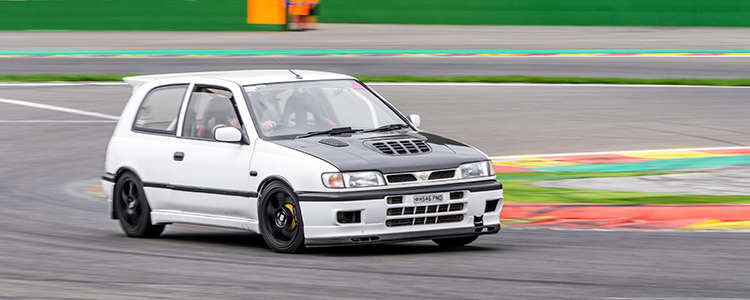
The Nissan Pulsar GTI-R (RNN14) is a Group A rally homologation hatch built from 1990 to 1994 on the N14 platform — Nissan needed at least 5,000 road cars to qualify the chassis for the World Rally Championship, and demand carried production to roughly 14,613 units by the time the line closed. The engine is the SR20DET — 2.0L turbo, 227 hp, 210 lb-ft — fed through a 5-speed manual and the same ATTESA AWD system used in the R32 Skyline GT-R, all in a shell weighing roughly 2,400 lb (1,090 kg). Period reviewers clocked 0-60 mph at about 5.4 seconds and called it the 'mini GT-R'; the WRC program itself never converted that pace into results, outpaced early by the Lancia Delta Integrale. The GTI-R was never sold in North America, and a small run reached the UK badged as the Sunny GTI-R — buy on condition, rust, and driveline health.
Group A homologation — built for a rally program that underdelivered
Group A regulations required a minimum production run of 5,000 road cars before a chassis could enter the World Rally Championship — that requirement is the reason the GTI-R exists. Nissan took the N14 platform, widened the body, fitted the SR20DET and ATTESA AWD, and cleared homologation in 1990.
Production ran through 1994, reaching roughly 14,613 cars by one widely cited breakdown: 13,131 Pulsar GTI-RA, 701 GTI-RB, 668 Sunny GTI-R LHD for Europe, 103 Sunny GTI-R RHD for the UK, and a handful of unclassified units. The WRC program never converted that effort into results; the car was outpaced by the Lancia Delta Integrale and the early Subaru Impreza 555, and Nissan exited rally competition before the platform was fully developed.
Today the homologation pedigree is the value driver. Period rally results are not.
SR20DET in a hot hatch — and what AWD bought you
Fitting the SR20DET into a 3-door hatch produced something unusual for the early 1990s: a compact AWD car with 227 hp and 210 lb-ft in a 2,400 lb shell. The factory-rated 0-60 mph time of about 5.4 seconds matched the contemporary Porsche 911 Carrera 2 (964), which is what earned the 'mini GT-R' label from period reviewers.
ATTESA sent torque to all four corners via a viscous center coupling — the same AWD lineage used on the R32 Skyline GT-R — with a viscous LSD at the rear. The packaging tradeoff was a top-mount intercooler with a functional hood scoop and a notably nose-heavy weight distribution, which contributed to the rally team's handling problems and still affects fast-road driving impressions today.
Editorial notes
Quick read
Key takeaways
- Homologation rarity drives premiums for clean, original cars
- SR20DET + AWD delivers huge grip; mods can hurt value
- Rust + drivetrain wear are the biggest ownership risks
- Sunny vs Pulsar naming varies; verify VIN/spec carefully
- Top money goes to low-mile, uncut, OEM-bodied examples
- Parts scarcity (trim/ATTESA bits) impacts total ownership
Constants
Common across all Pulsar GTI-R generations
- Homologation special built for Group A World Rally Championship eligibility
- Single notable generation — RNN14 chassis, 1990–1994
- Front-engine, all-wheel-drive layout with the ATTESA AWD system
- SR20DET turbocharged 2.0L four-cylinder in AWD-specific configuration; 230 PS JDM
- JDM-market model; right-hand drive throughout production
Chassis history
Generation timeline
Identification
Chassis-code reference
Generation names are broad families. The factory chassis codes below identify the variants represented in JDMBUYSELL's current Nissan Pulsar GTI-R guide data.
- RNN14 (Pulsar GTI-R; 1990–1994)
- Chassis code: RNN14
Confirm the complete code on the vehicle's frame or VIN plate; drivetrain, body, and market variants can use different prefixes within one generation family.
Buyer's call
Should you buy a Nissan Pulsar GTI-R?
The GTI-R is one of those cars where what you give up is just as obvious as what you get. Nissan built it to qualify a rally car, not to be polished, so the strong points and weak points have stayed the same across the whole RNN14 run.
Why you'll love it
- True homologation pedigree Built for Group A; rarity and story support long-term collectability.
- SR20DET tuning headroom Strong aftermarket; safe gains possible with fueling, cooling, and ECU done right.
- ATTESA AWD traction Excellent real-world pace in poor weather; puts power down better than FWD rivals.
- Compact, usable performance Hatch practicality with rally stance; easy to place on tight roads.
- Iconic 90s JDM styling Widebody, roof scoop, and wing are instantly recognizable; strong enthusiast demand.
- Strong enthusiast liquidity Well-known niche icon; good cars sell quickly when correctly presented.
Why you might not
- Rust and accident history Sills, arches, floors, and strut areas rust; many were crashed or repaired poorly.
- AWD driveline complexity ATTESA components, viscous couplings, and diffs add cost vs simpler FWD/FR cars.
- Heat management issues Turbo heat can cook bay components; cooling upgrades common but must be tidy.
- Parts scarcity (trim/body) Widebody panels, interior trim, and OEM aero can be hard/expensive to source.
- Modified cars dominate supply Hard-driven builds are common; value favors OEM, documented, uncut examples.
- Age-related electrics/hoses Vac lines, sensors, and wiring gremlins appear; budget for refresh work.
Who should not buy this
- Anyone needing reliable daily transport
- Buyers without a JDM/AWD specialist nearby
- People who can't afford surprise $3k driveline bills
- Owners who won't run premium fuel consistently
- Anyone planning big power on a stock tune
- Drivers who ignore warm-up and cool-down routines
- People in rust-belt climates without garage storage
- Buyers who can't source rare GTI-R-specific parts
- Anyone who hates chasing vacuum/boost leaks
- People who expect modern crash safety
- Drivers over 6'2" wanting helmet track days
- Anyone who needs quiet, refined highway cruising
- Owners who won't do frequent fluid changes
- People who can't tolerate 1990s interior quality
- Anyone expecting cheap insurance and easy parts
- Buyers who won't verify mods and tune quality
- People who can't wrench or pay shop labor rates
- Anyone needing strong rear-seat practicality
- Those in strict emissions states with inspections
- Buyers who want set-and-forget turbo reliability
Reliability
Common issues & solutions
The GTI-R is mostly bulletproof when it's been looked after. The trouble comes from age, abuse, and the AWD driveline being more complex than a FWD or rear-drive hatch. The transfer case is the expensive one to get wrong. Most of the rest is normal old turbo car stuff like cooling, vacuum leaks, and tired bushings.
| Issue | Cause | Solution | Est. cost |
|---|---|---|---|
| Transfer case failure | Low oil, abuse, mismatched tires, age wear | Rebuild/replace; correct tire sizes; frequent fluid | $2000-5000 |
| Gearbox 2nd/3rd synchro wear | Hard shifting, old fluid, high power torque | Rebuild with synchros/bearings; quality gear oil | $1800-4000 |
| Center viscous coupling weak | Heat cycling, age; prolonged wheelspin abuse | Replace viscous unit; avoid mismatched tires | $900-2000 |
| Rear diff whine/leaks | Worn bearings, low oil, old seals | Reseal and rebuild bearings; correct LSD oil | $800-2000 |
| Overheating in traffic | Undersized/old radiator, weak fans, air pockets | Aluminum rad, new fans, proper bleed, thermostat | $500-1200 |
| Head gasket failure | Overheating, detonation, old head bolts | MLS gasket, head skim, studs, fix cooling/tune | $1800-4000 |
| Detonation/piston damage | Bad tune, lean fuel, heat soak, poor fuel | Proper ECU tune, fuel upgrades; rebuild if damaged | $800-7000 |
| Turbo wear/smoke | Old seals, coked oil, high shaft speed, abuse | Rebuild/replace turbo; fix oil feed/return and PCV | $900-2500 |
| MAF sensor failure | Age, vibration, oil contamination, wiring hacks | Replace MAF, repair wiring, relocate filter properly | $250-700 |
| Idle hunt/stalling | Vacuum leaks, IACV carbon, bad MAF, BOV venting | Smoke test, clean/replace IACV, recirc BOV, tune | $150-900 |
| Cracked exhaust manifold | Heat cycling, thin cast/aftermarket, missing studs | Replace manifold, new studs/nuts, check engine mounts | $400-1200 |
| Broken exhaust studs | Corrosion and heat; over-tightening | Extract studs, helicoil if needed; new hardware | $300-900 |
| Timing chain rattle | Worn guides/tensioner; low oil pressure | Chain kit with guides/tensioner; verify oil pump | $700-1600 |
| Low oil pressure | Worn oil pump, bearing wear, thin oil, sludge | Oil pump/front cover service; bearings if needed | $600-4500 |
| Oil leaks (cam/front/rear) | Old seals, crankcase pressure, poor RTV jobs | Reseal properly; address PCV/breather routing | $250-1200 |
| Coolant leaks at hoses/rad | Aged hoses, clamps, radiator end tank cracks | Full hose kit, clamps, radiator/cap replacement | $300-1100 |
| Heater core leak | Corrosion and age; old coolant | Replace heater core; flush system; new coolant | $700-1500 |
| Fuel pump/injector issues | Old pump, clogged filter, injector O-rings aging | Replace pump/filter; service injectors; new seals | $300-1200 |
| Fuel cut/misfire on boost | Weak pump, bad coils, plug gap, boost leak | Pressure test; pump/coil/plugs; verify AFR and tune | $200-1500 |
| Coil/ignition breakdown | Heat and age; cracked coil boots | Replace coils/boots; fresh plugs; improve grounding | $250-900 |
| CV joint/boot failure | Age, lowered ride height, torn boots | Replace boots/axles; correct alignment and height | $250-900 |
| Driveshaft vibration | Worn carrier bearing/U-joints; imbalance | Rebuild/replace driveshaft; check mounts and angles | $500-1400 |
| Steering rack leaks | Old seals, torn boots, contaminated fluid | Rebuild/replace rack; new boots; flush PS system | $700-1600 |
| Suspension bushing wear | Age, hard driving; rubber cracks and deflects | Replace bushes/arms; align; consider quality poly | $600-2000 |
| Rear subframe mount rust | Moisture traps and road salt; poor undercoating | Rust repair/weld; treat and undercoat; inspect yearly | $1200-6000 |
| Brake line corrosion | Age and salt; lines routed along underbody | Replace hard lines; flush fluid; inspect annually | $400-1200 |
| Seized brake caliper sliders | Old grease, torn boots, corrosion | Rebuild/replace calipers; new pins/boots; proper lube | $250-900 |
| Electrical gremlins | Bad grounds, hacked alarms, brittle connectors | Ground refresh, remove bad wiring, repair harness | $200-1500 |
| Water leaks into cabin | Sunroof drains, hatch seals, firewall grommets | Clear drains; replace seals; reseal grommets | $100-800 |
Market
Differences between JDM & USDM
The Pulsar GTI-R was never officially sold in the United States. The only factory export market was Europe, where the car was badged 'Sunny GTI-R' and delivered in both LHD (mainland Europe, 668 units) and RHD (United Kingdom, 103 units). Sunny GTI-R cars used a slightly different ECU calibration to suit lower-octane European fuel and produced about 7 hp less than the JDM Pulsar GTI-R, and they received modified bumpers to accommodate larger European license plates — everything else (drivetrain, ATTESA AWD, widebody, hood scoop, rear wing) is shared with the JDM car. Every Pulsar GTI-R in North America today is a 25-year-rule import from Japan or, less commonly, a UK-market Sunny GTI-R brought across the Atlantic. Cars built in 1990 became US-legal in 2015; 1994 cars became legal in 2019.
Specs
Technical specifications
Every GTI-R runs the SR20DET 2.0 liter turbo and ATTESA AWD through a 5-speed manual. Factory output is 227 hp and 210 lb-ft at 0.7 bar of boost. The Rallye spec gets a shorter 4.363 final drive instead of the standard 4.111, and you'll feel that more in daily driving than the engine spec.
Engine options
| Chassis | Engine | Displacement | Power | Boost | Notes |
|---|---|---|---|---|---|
| RNN14 | SR20DET | 2.0L (1998cc) | 227hp (169kW) @ 6000rpm | 0.7 bar (10.2 psi) | T28 turbo, top-mount IC, 8.3:1 CR |
| RNN14 | SR20DET | 2.0L (1998cc) | 220PS (162kW) @ 6000rpm | 0.7 bar (10.2 psi) | JDM rating format; same factory output |
Transmission options
| Type | Ratios | Availability | Notes |
|---|---|---|---|
| 5-speed Manual (FS5R50A, AWD transaxle) | 3.333/1.955/1.286/0.926/0.733 | GTI-R (all) | ATTESA AWD, viscous center coupling |
| Final drive | 4.111 | GTI-R (Base) | Standard FD |
| Final drive | 4.363 | GTI-R (Rallye/RA) | Shorter gearing |
Lineup
Variants & trims
The GTI-R came in three forms over the four-year run. The base GTI-R is the common street car at about 13,131 units. The GTI-RB shed around 30 kg of comfort features for motorsport use with optional NISMO LSD and suspension. The NISMO/N1 is the rare homologation-focused build. The chassis and engine are the same across all of them, so you're buying weight and intent, not power.
| Generation | Trim | Engine | Key features |
|---|---|---|---|
| RNN14 (N14 Pulsar, GTI-R) | GTI-R (Base) | SR20DET (Garrett T28) | ATTESA AWD, viscous LSD, hood scoop, IC, 5MT |
| RNN14 (N14 Pulsar, GTI-R) | GTI-R (Rallye / RA) | SR20DET (Garrett T28) | Short-ratio 5MT, close gears, lighter spec, 4.363 FD |
| RNN14 (N14 Pulsar, GTI-R) | GTI-R (NISMO / N1) | SR20DET (Garrett T28) | Homologation-focused spec, limited run, motorsport intent |
Pricing
Average prices & original MSRP
Clean OEM GTI-Rs have climbed hard since the 25-year rule opened the US market in 2015. The numbers below are what one costs today. Rough modified cars sit at the low end and clean documented examples with the factory widebody and untouched engine bay sit at the top. The market pays for originality on the GTI-R more than peak dyno numbers.
Today's market range: $22,000 to $75,000 (median ~$42,000). Source: JDMBUYSELL / USS Auction.
Values remain firm after a 2020-2022 surge; best OEM cars still climb while modified/rough examples soften. Supply is thin, and rust-free, documented cars command outsized premiums. Expect gradual appreciation tied to 90s homologation demand.
Inspect
Pre-purchase inspection checklist
Walk this list with the seller, not in front of them. The Critical items mean walking away if there's no paperwork backing them up. The High items can usually be priced into the deal. On a GTI-R the transfer case and the rust spots are where the real money is, so don't skip those.
Critical priority
High priority
Medium priority
Low priority
Cross-shop
Comparable alternatives
If the GTI-R doesn't end up being the right car, the natural alternatives are the Subaru WRX GC8 if you want similar AWD turbo character with better parts support, or the early Lancer Evolution if you want raw homologation feel with stronger rally lineage. The Celica GT-Four ST185 is the period AWD turbo icon with more GT comfort.
Mitsubishi Lancer Evo I-III
Raw homologation feel; stronger rally lineage
Compare
How it compares
Among 1990s AWD turbo homologation cars, the GTI-R is the rarest and smallest. The Skyline GT-R has more power and a bigger reputation. The Celica GT-Four has more comfort. The Evo and the GC8 came right after and outdid the GTI-R in rally, which is part of why the GTI-R stayed under the radar until the JDM boom caught up to it.
| Feature | Nissan Pulsar GTI-R | Nissan Skyline GT-R R32 | Toyota Celica GT-Four ST185 |
|---|---|---|---|
| Layout/traction | AWD, turbo I4 | FR, turbo I6 | FWD, turbo I4 |
| Power (factory) | SR20DET ~227 PS | RB26DETT 280 PS | 3S-GTE ~225 PS |
| Weight feel | Light, nose-heavy | Heavier, planted | Light, agile |
| Driving character | Rally hatch, grip | Tail-happy, boosty | Balanced FR coupe |
| Reliability baseline | Good if maintained | Heat-sensitive rotary | Very robust I6 |
| Parts availability | Mixed; trim scarce | Strong aftermarket | Good support |
| Collector premium | High for OEM | Very high | High |
| Interior/comfort | Basic 90s hatch | More GT-like | Spartan rally vibe |
| Track/road balance | Fast B-road tool | Track-capable FR | Rally-bred AWD |
| Tuning value | Good; AWD tax | Excellent budget drift | Big power potential |
| Practicality | Hatch, usable | Coupe, less cargo | Sedan, roomy |
Gallery
In pictures
Drivetrain
Engine references
Editorial
The buyer's read
Start with the body and the buyer's guide basics before turning the key. The sills, rear arches, strut towers, and rear subframe mounts are where rot hides on an RNN14 — if any of those are soft, either walk away or price in a five-figure bodywork bill. Confirm the chassis is a real RNN14, that the widebody panels are factory, and that the hood scoop and top-mount intercooler are GTI-R parts rather than Silvia hand-me-downs.
The AWD driveline is the second area to audit. The transfer case is the expensive piece; mismatched tires, abused launches, and skipped fluid changes kill them — anything that binds or hops on a tight-turn test is a $2,000 to $5,000 repair, not a $200 one. The gearbox synchros in 2nd and 3rd are the next thing to feel for on quick shifts.
The SR20DET is strong when maintained, but detonation kills pistons fast. Find out what fuel the car runs, who tuned the ECU, and whether the cooling system has been refreshed. A documented service history matters more on a GTI-R than on most cars because so many were modified, hard-driven, and resold without records.
The market pays for originality. A clean low-mile GTI-R with factory engine bay, uncut wiring, and OEM widebody commands more than a high-power build. If the goal is modification, buy a car that has already been changed — don't cut an original one.
The one to chase is a documented JDM Pulsar GTI-R kept indoors. The one to avoid is a UK Sunny GTI-R that lived in salt with no service history. Same car underneath, very different ownership reality.
FAQ
Frequently asked questions
- What is the Pulsar GTI-R and why is it special?
- A Group A homologation N14 hatch with SR20DET turbo and ATTESA AWD; rare and collectible.
- What trims exist (RA/RB/RC) and which is best?
- RA is lighter, RB is common street spec, RC is rare competition-leaning. Best is the cleanest, most original.
- What are the biggest things to inspect before buying?
- Check rust, accident repairs, ATTESA/driveline, turbo smoke, cooling, and evidence of hard tuning or track use.
- Are modified GTI-Rs worth less?
- Usually yes. Market pays most for OEM body/engine bay, documented maintenance, and reversible mods; wild builds narrow buyers.
- How reliable is the SR20DET in the GTI-R?
- Strong when maintained. Watch oil leaks, tired turbos, detonation from poor tuning, and cooling neglect.
- What rust areas are most common?
- Sills, rear arches, floors, strut towers, and hatch area. Poor repairs are common—inspect seams and underseal.
- What is the US import situation under the 25-year rule?
- 1990 cars became eligible in 2015; 1994 in 2019. Verify build date, VIN, and compliance paperwork.
- What makes a top-value GTI-R at auction?
- Low-mile, uncut loom, OEM widebody/trim, clean history, stock-ish engine bay, and strong documentation/service records.
Citations
Sources & references
Sources (8)
- Nissan Pulsar — GTI-R section, encyclopedic overview — Wikipedia Verified
- 1990 Nissan Pulsar GTI-R: Fast car history lesson — WhichCar Verified
- 1990–1994 Nissan Pulsar GTI-R: The forgotten hot hatch — DrivingLine Verified
- Nissan Pulsar GTI-R buyer's guide — Import A Vehicle Verified
- GTI-R Owners Club (GTIROC) — GTIROC Verified
- Top 12 hot hatches from the 90s — Autoweb Verified
- Nissan SR engine — SR20DET reference — Wikipedia Verified
- ATTESA AWD system overview — Wikipedia Verified
Sources last verified: