Buyer's guide
15 min read
Mazda Bongo
Buyer's guide & specs
- Production
- 1966-2020
- US legal
- 2024
- 25-yr rule
- Market range
- $6K–$35K
- median ~$16K
- For sale
- 8
- active now
On this page
Quick answer
The Mazda Bongo is a compact cab-over van/truck best known in JDM circles for its camper-ready Friendee trims and tough, simple running gear. Values stay driven by condition, rust, and 4WD/diesel demand; expect the best imports to command strong premiums.
Background
Overview
The Mazda Bongo launched in May 1966 as a compact cab-over van on the Mazda 1000 chassis; 54 years later Mazda ended in-house production and switched to rebadging the Toyota TownAce. Most buyers now want the Bongo Friendee (SG5W/SG5P, from 1995) — specifically the Auto Free Top diesel 4WD, which pairs the factory electric pop-up roof with the 2.5L WL-T turbodiesel and selectable 4WD. The Bongo Brawny ran until 2010 before returning as a rebadged Toyota HiAce H200; the fourth-generation SK82 (1999–2020) carried commercial-van duty on Nissan Vanette underpinnings. Friendee AFT diesel 4WD examples lead current pricing; SK82 vans trade on rust and mileage.
From 782 cc commercial van to cab-over icon — the early generations
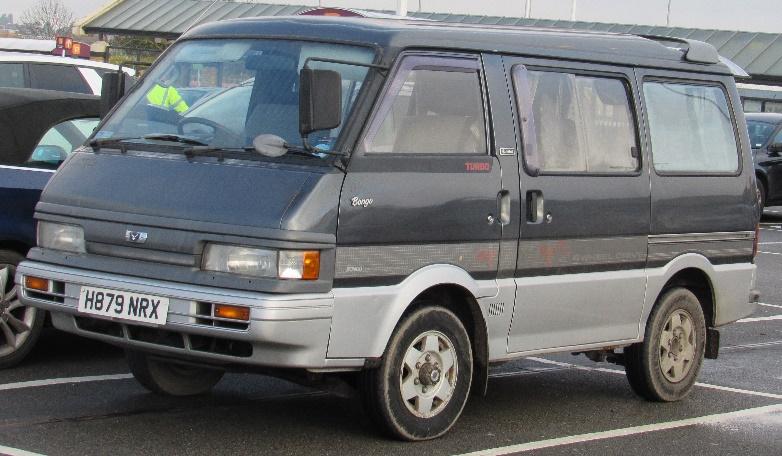
The first-generation Bongo (1966–1975) launched with a rear-mounted 782 cc water-cooled engine, growing to 1000 cc in 1968. It predated Japan's kei-car regulations — kei required 360 cc or 550 cc engines at the time — and Mazda built it as a passenger van, panel van, and cab-over truck. Production paused at the end of 1975 under the emissions pressure that followed the 1963 traffic-law update.
Mazda restarted the Bongo in 1977 with a front-engine, rear-wheel-drive layout — a 1.2L petrol through a 2.2L R2 diesel — and four wheels on the rear axle on heavier trims to raise payload. The E-series van and wagon that Mazda's own history logs as the third-generation Bongo followed in September 1983, with the E-series truck arriving in January 1984. Mazda exported the E-series through Ford, who sold it as the Econovan, Econowagon, and Spectron across Asia-Pacific markets. Survivors in North America arrived only through the 25-year rule; rust-free examples are the only reasonable buy.
Bongo Friendee Auto Free Top — the 1995 camper-van turning point
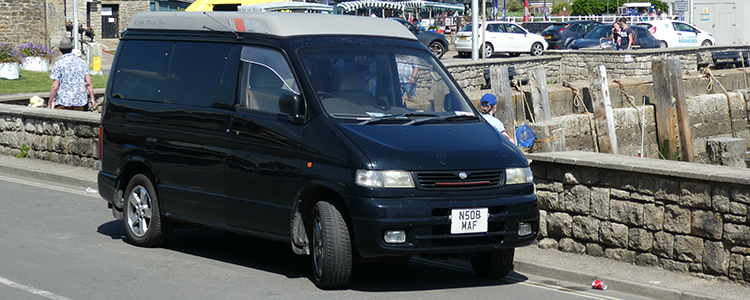
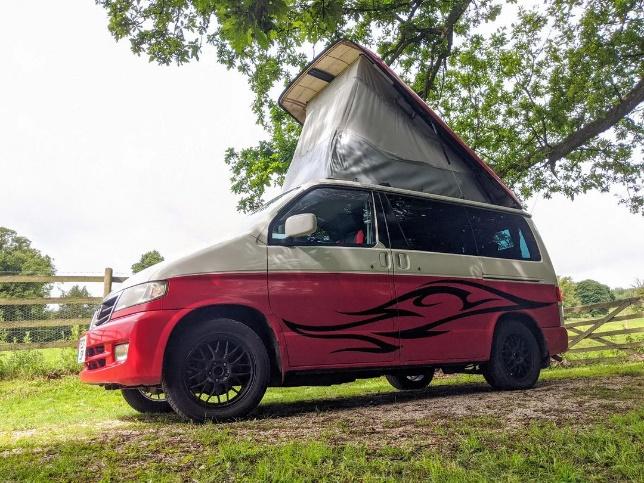
Mazda introduced the Bongo Friendee in 1995. The Friendee (SG5W/SG5P) shipped from the factory with the Auto Free Top: a powered elevating roof, curtains, and fold-flat sleeping for 4 people without aftermarket conversion. Engine options ran from a 2.0L FE-E petrol through a 2.5L J5-D V6 to the WL-T 2.5L turbodiesel, with selectable 4WD on most trims and JDM-only details like soft-close doors.
The Bongo Brawny ran on until 2010. The fourth-generation SK82 (1999–2020) shared a platform with the Nissan Vanette and was later rebadged across Kia, Mitsubishi, and — after 2020 — Toyota TownAce. The SK82 is the commercial-van generation: RF 2.0L diesel or F8 1.8L petrol, RWD or part-time 4WD, no camper-specific complexity.
Editorial notes
Quick read
Key takeaways
- Rust and underbody condition drives value more than mileage.
- 4WD + diesel variants command the strongest premiums.
- Friendee camper trims (Auto Free Top) are most collectible.
- Cooling system health is a top ownership risk and cost.
- Parts support is decent, but trim/camper bits can be scarce.
- Import legality improves demand as later years hit 25-year rule.
Constants
Common across all Bongo generations
- Cab-over van and truck body styles throughout production
- Rear-engine layout in early generations; under-floor mid-engine in later generations
- Rear-wheel drive standard, with selectable four-wheel drive on many later van variants
- Petrol and diesel four-cylinder engine options across most generations
- Right-hand drive throughout JDM production; badge-engineered to other makes (Nissan Vanette, Ford Econovan)
Chassis history
Generation timeline
The Bongo ran from 1966 until 2020. The 1966 original had a rear engine and is mostly a museum piece now. A front-engine cab-over replaced it in 1977, and the E-series van that Mazda's own history logs as the third-generation Bongo arrived in 1983, with the truck following in 1984 — that one is the rare find here. The SK82 fourth generation, from 1999, is the easy commercial Bongo to buy today. Separate from that commercial van line, Mazda launched the Bongo Friendee with its Auto Free Top pop-up roof in 1995, and that's the camper everyone wants.
Third generation — SD/SE (1983–1999)
Identification
Chassis-code reference
Generation names are broad families. The factory chassis codes below identify the variants represented in JDMBUYSELL's current Mazda Bongo guide data.
- Fourth generation — SK/SL (1999–2020)
- Chassis codes: SK82, SKF2, SKP2, and SKE6
- SE
- Chassis code: SE88T
- SG
- Chassis codes: SGL5, SG5W, and SGE3
Confirm the complete code on the vehicle's frame or VIN plate; drivetrain, body, and market variants can use different prefixes within one generation family.
Buyer's call
Should you buy a Mazda Bongo?
The Bongo's strong points and weak points are pretty obvious once you know the van. You get a small footprint, a real diesel option, and on the Friendee a factory pop-up roof. You give up easy engine access, cheap parts, and any pretense of handling at highway speeds.
Why you'll love it
- Camper-ready packaging Friendee layouts and flat floor make compact camping easy; huge interior for footprint.
- 4WD availability Selectable/part-time 4WD trims add winter and light off-road capability; boosts resale.
- Diesel efficiency Popular diesel variants offer strong low-end torque and better range; ideal for touring.
- Simple commercial roots Many trims use straightforward mechanicals; easier DIY than modern vans if maintained.
- Strong niche demand Camper/overland buyers keep liquidity high for clean, rust-free examples.
- Compact exterior size City-friendly dimensions with van-like cargo volume; fits small parking spaces.
Why you might not
- Rust is the deal-breaker Sills, arches, floors, and subframes rot; repairs can exceed purchase price quickly.
- Cooling system sensitivity Overheating risk if neglected; radiators, hoses, and fans must be kept perfect.
- Camper parts scarcity Auto Free Top, interior plastics, and trim pieces can be hard to source and pricey.
- Cab-over crash safety Driver sits over axle; older vans lack modern crash structures and airbags.
- Slow by modern standards Performance is modest; highway grades and headwinds expose limited power.
- Import/registration variability State rules, inspections, and insurance vary; paperwork quality affects total cost.
Who should not buy this
- Anyone unwilling to monitor real coolant temps
- Buyers who can’t handle sudden overheating risk
- People needing modern crash safety/airbags
- Those who can’t DIY or pay specialist labor
- Rust-averse buyers in salted-road climates
- Anyone needing easy parts at local auto stores
- Drivers expecting quiet, refined highway manners
- People who tow heavy without trans cooling upgrades
- Owners with no place to store a tall van/camper
- Those who need consistent rear-seat safety features
- Anyone who hates chasing water leaks and damp
- Buyers expecting modern MPG from a heavy brick
- People who won’t maintain ATF/transfer/diff fluids
- Short-trip only drivers (diesel soot/EGR issues)
- Anyone needing guaranteed emissions compliance
- Those who can’t inspect hidden rust thoroughly
- People who want set-and-forget reliability
- Owners who can’t tolerate slow steering/braking feel
- Anyone relying on one vehicle for critical commuting
- Buyers who can’t verify conversion gas safety
Reliability
Common issues & solutions
The Bongo is mechanically simple but the cooling system on the diesel will kill the engine if you ignore it. Most of the trouble is age, not engineering. The diesel runs hot when the coolant gets neglected. The valve cover gasket on the V6 petrol leaks. Rust eats the arches and sills. And on the Friendee the Auto Free Top motor can stick or burn out if the rubber seal is glued shut from sitting.
| Issue | Cause | Solution | Est. cost |
|---|---|---|---|
| Head gasket failure | Overheating from weak cooling system/airlocks | Pressure test, skim if needed, new HG/bolts, flush | $1800-4500 |
| Cracked cylinder head | Repeated overheating; hot spots from low coolant | Replace head, inspect block, renew cooling system | $3500-7500 |
| Radiator end tank leaks | Aged plastic tanks, corrosion, poor coolant mix | Replace radiator, cap, flush and correct coolant | $350-900 |
| Heater pipe corrosion | Underbody steel lines rot; road salt exposure | Replace pipes/hoses; consider stainless upgrades | $500-1400 |
| Cooling system airlocks | Poor bleeding after service; long coolant runs | Vacuum fill/bleed properly; check for leaks | $150-400 |
| Water pump failure | Age, contaminated coolant, bearing wear | Replace pump, belt, thermostat; flush system | $450-1100 |
| Thermostat sticking | Old coolant deposits; cheap aftermarket stats | Install OEM-quality thermostat; bleed system | $150-350 |
| Fan clutch/e-fan failure | Worn viscous clutch or failed fan switch/relay | Replace clutch or diagnose fan circuit; verify temps | $250-900 |
| Temp gauge misleading | Damped gauge logic; sender issues hide spikes | Add real temp gauge/OBD monitor; replace sender | $120-450 |
| Auto trans slipping | Burnt ATF, worn clutches, overheating towing/camper | Service ATF/filter early; rebuild if slipping | $350-3800 |
| Delayed gear engagement | Low ATF, worn valve body seals, tired pump | Correct level, service; valve body or rebuild | $250-3200 |
| Transfer case chain stretch | High mileage, mismatched tires, poor fluid service | Replace chain/bearings; match tire sizes | $900-2200 |
| 4WD binding/shudder | Mismatched tire diameters or seized viscous coupling | Replace tires as set; service/replace coupling | $600-2500 |
| Rear diff bearing whine | Old oil, overload, water ingress via breather | Rebuild diff; replace bearings/seals; change oil | $900-2200 |
| CV boot failure | Age/heat; lifted campers increase angles | Replace boots or complete axle; align suspension | $250-700 |
| Front ball joint wear | Age, poor lubrication, heavy loads/rough roads | Replace joints/arms; immediate if any play | $350-1100 |
| Steering rack leaks | Seal wear; contaminated fluid; torn boots | Rebuild/replace rack; flush fluid; new boots | $700-1800 |
| Brake hard line rust | Road salt; factory coating fails with age | Replace lines with copper-nickel; bleed system | $450-1400 |
| Caliper slider seizure | Dry pins, torn boots, corrosion | Rebuild/replace calipers; new pads/rotors as needed | $300-900 |
| Wheel bearing failure | Age, water ingress, incorrect torque | Replace bearing/hub; inspect spindle surfaces | $350-900 |
| Injector blow-by (diesel) | Failed copper washers; carbon builds under injectors | Pull injectors, clean seats, new washers/bolts | $400-1200 |
| Glow plug/relay faults | Aged plugs, relay contacts, corroded bus bar | Test resistance; replace plugs/relay; clean terminals | $200-650 |
| Turbo oil leaks/smoke | Worn seals from poor oil changes or overheat | Rebuild/replace turbo; check crankcase breather | $900-2500 |
| EGR/intake clogging | Diesel soot + oil mist; short trips | Clean intake/EGR; consider catch can where legal | $250-900 |
| Fuel pump/line leaks | Aged seals/hoses; vibration; poor clamps | Replace hoses/seals; renew filter head if cracked | $200-900 |
| Cabin heat soak | Engine under-seat; missing insulation or seals | Restore insulation, seal covers; check exhaust leaks | $150-600 |
| Exhaust manifold cracks | Heat cycling; turbo backpressure; age | Replace manifold/gaskets; check mounts and EGT | $600-1800 |
| Rusty sills/rails | Poor factory protection; salt; trapped moisture | Proper cut/weld repair; cavity wax; avoid cover-ups | $1500-8000 |
| Windshield frame rust | Stone chips + trapped moisture under trim | Glass out repair, weld as needed, repaint, reseal | $800-2500 |
| Sliding door roller wear | Dry track, misalignment, rusted mounts | Replace rollers, clean/lube track, align door | $250-900 |
| Water leaks into cabin | Roof gutter seams, door seals, pop-top seals | Trace with hose test; reseal; replace seals | $200-2000 |
| Camper wiring faults | DIY installs, undersized cables, poor fusing | Rewire with proper fuses/relays; inspect for heat | $400-2500 |
| Rear leaf spring sag | Constant camper load; age and corrosion | Replace springs/shackles; add helper springs if needed | $600-1800 |
Market
Differences between JDM & USDM
The Mazda Bongo was never officially sold in the United States. There is no USDM Bongo and no Lexus or Mercury equivalent. Every Bongo in North America is a gray-market import: either NHTSA's 25-year exemption (the standard US route, which makes 1999 build-year cars eligible in 2024 and progressively newer years thereafter), Canada's 15-year RIV rule, or a state-level Show-or-Display / commercial-exempt path. Outside Japan, the Bongo was sold through badge engineering: Ford Econovan / Spectron (Australia, Asia-Pacific, E-series), Kia Wide Bongo (Korea, third generation), Nissan Vanette (1994 onward), and Mitsubishi Delica Cargo (fourth generation). JDM-spec Bongos came with right-hand drive throughout production. The Friendee Auto Free Top is a JDM-only product; no factory pop-up Friendee was ever sold under any non-Mazda badge in any export market.
Specs
Technical specifications
Every Bongo runs a four-cylinder except the petrol V6 in the Friendee. The early cars had small 782cc and 1000cc engines. The E-series moved to 1.2 through 2.2 liter fours. The Friendee got the 2.5 liter WL-T turbodiesel that most camper buyers want, plus a 2.0 petrol and the 2.5 V6. The SK82 ran the F8 1.8 petrol and the RF 2.0 diesel. Most Bongos are rear-wheel drive but the Friendee and the Bongo Turbo 4x4 are factory 4WD.
Engine options
| Chassis | Engine | Displacement | Power | Boost | Notes |
|---|---|---|---|---|---|
| 1st gen Bongo, market-dependent | F8 | 1.8L | estimated | N/A | Carb/EFI varies by year/market |
| 1st gen Bongo, market-dependent | F6 | 2.0L | estimated | N/A | Gasoline I4; output varies |
| 1st gen Bongo, market-dependent | R2 | 2.2L | estimated | N/A | Diesel I4; NA; output varies |
| E-series (Bongo/Brawny, market-dependent) | F8 | 1.8L | estimated | N/A | Gas I4; carb/EFI by market |
| E-series (Bongo/Brawny, market-dependent) | FE | 2.0L | estimated | N/A | Gas I4; output varies by spec |
| E-series (Bongo/Brawny, market-dependent) | R2 | 2.2L | estimated | N/A | Diesel I4; NA; commercial tune |
| E-series (Bongo/Brawny, market-dependent) | RF | 2.0L | estimated | N/A | Diesel I4; NA; output varies |
| SG5W/SG5P (Bongo Friendee) | FE-E | 2.0L | estimated | N/A | DOHC/EFI varies; JDM spec varies |
| SG5W/SG5P (Bongo Friendee) | J5-D | 2.5L | estimated | N/A | V6 gasoline; output varies by year |
| SG5W/SG5P (Bongo Friendee) | WL-T | 2.5L | estimated | estimated | Turbo diesel; intercooler varies |
| SK82/SK22/SK (rebadged Vanette; market-dependent) | F8 | 1.8L | estimated | N/A | Shared with Vanette; tune varies |
| SK82/SK22/SK (rebadged Vanette; market-dependent) | RF | 2.0L | estimated | N/A | Diesel I4; NA; market-dependent |
Transmission options
| Type | Ratios | Availability | Notes |
|---|---|---|---|
| 5-speed Manual | estimated | 1st gen Bongo (various) | Ratios vary by engine/market |
| 4-speed Manual | estimated | 1st/2nd gen commercial (some) | Market-dependent commercial spec |
| 3-speed Automatic | estimated | 1st/2nd gen (some) | Early automatics; market-dependent |
| 4-speed Automatic | estimated | Bongo Friendee (many grades) | Jatco/Ford-derived; spec varies |
| 5-speed Manual | estimated | Bongo Friendee (some markets) | Less common; depends on engine |
| 4-speed Automatic | estimated | Bongo (SK) (some) | Shared with Vanette; spec varies |
| 5-speed Manual | estimated | Bongo (SK) (some) | Shared with Vanette; spec varies |
Lineup
Variants & trims
The Bongo came as a standard van, a panel van, a cab-over truck, the long-wheelbase Bongo Brawny, and the Bongo Friendee camper. The Friendee is the one with the Auto Free Top pop-up roof and the factory sleeping setup. The Brawny is the long one with more cargo space than a Toyota HiAce of the same year. Outside Japan the same van was sold as the Ford Econovan, the Kia Wide Bongo, the Nissan Vanette, and the Mitsubishi Delica Cargo.
| Generation | Trim | Engine | Key features |
|---|---|---|---|
| Bongo (1st gen) | Bongo Van Standard | F8/NA, F6/NA, R2/NA (market-dependent) | Steel wheels, vinyl, basic heater, manual windows |
| Bongo (1st gen) | Bongo Van Deluxe | F8/NA, F6/NA, R2/NA (market-dependent) | Upgraded trim, cloth, radio, chrome accents |
| Bongo (1st gen) | Bongo Wagon | F8/NA, F6/NA (market-dependent) | Passenger seats, interior trim, rear side windows |
| Bongo (1st gen) | Bongo Truck | F8/NA, F6/NA, R2/NA (market-dependent) | Cab-chassis, flatbed, heavy-duty rear springs |
| Bongo Brawny (long wheelbase) | Bongo Brawny Van | F6/NA, R2/NA (market-dependent) | LWB body, higher payload, commercial interior |
| Bongo Brawny (long wheelbase) | Bongo Brawny Wagon | F6/NA (market-dependent) | LWB passenger, more seats, rear A/C option |
| Bongo E-series (JDM/Export) | Bongo Van DX | FE/NA, F8/NA, R2/NA, RF/NA (market-dependent) | Commercial spec, vinyl, steel wheels, sliding door |
| Bongo E-series (JDM/Export) | Bongo Van GL | FE/NA, R2/NA, RF/NA (market-dependent) | Cloth, full wheel covers, radio, better sound deadening |
| Bongo E-series (JDM/Export) | Bongo Wagon | FE/NA, RF/NA (market-dependent) | Passenger trim, rear heater, tinted glass option |
| Bongo E-series (JDM/Export) | Bongo 4WD | FE/NA, RF/NA (market-dependent) | Part-time 4WD, raised ride height, skid plates |
| Bongo Brawny E-series (long wheelbase) | Bongo Brawny Van | FE/NA, RF/NA (market-dependent) | LWB cargo, higher GVW, dual sliding door option |
| Bongo Friendee | Friendee 2.0 City Runner | FE/NA 2.0 | 8-seat, dual A/C, power windows, captain seats opt |
| Bongo Friendee | Friendee 2.5 V6 | J5-D/NA 2.5 V6 | V6, higher trim, alloy wheels option, cruise opt |
| Bongo Friendee | Friendee 2.5 V6 4WD | J5-D/NA 2.5 V6 | 4WD, viscous coupling, higher ride height, ABS opt |
| Bongo Friendee | Friendee 2.5TD | WL-T Turbo Diesel 2.5 | Turbo diesel, long-range economy, dual batteries opt |
| Bongo Friendee | Friendee 2.5TD 4WD | WL-T Turbo Diesel 2.5 | 4WD, turbo diesel, LSD option, ABS option |
| Bongo Friendee | Friendee Auto Free Top | FE/NA, J5-D/NA, WL-T (by grade) | Power elevating roof, camper-ready, curtains, table |
| Bongo Friendee | Friendee Auto Free Top 4WD | J5-D/NA, WL-T (by grade) | AFT roof, 4WD, camper interior options, rear heater |
| Bongo Friendee | Friendee Limited | J5-D/NA, WL-T (by grade) | Higher trim, alloys, privacy glass, upgraded audio |
| Bongo Friendee | Friendee Limited Auto Free Top | J5-D/NA, WL-T (by grade) | AFT roof, Limited trim, alloys, curtains, table |
| Bongo Friendee | Friendee RS-V | J5-D/NA 2.5 V6 | Sport appearance, aero parts, alloys, firmer suspension |
| Bongo Friendee | Friendee RS-V Auto Free Top | J5-D/NA 2.5 V6 | RS-V trim, AFT roof, aero, alloys, curtains |
| Bongo Friendee | Friendee Aero | J5-D/NA, WL-T (by grade) | Aero kit, alloys, privacy glass, fog lamps |
| Bongo Friendee | Friendee Camp/Conversion base | FE/NA, J5-D/NA, WL-T (by grade) | Conversion-ready, rear power outlets option, curtains |
| Bongo (4th gen) SK/SL | Bongo Van DX | F8/NA 1.8, RF/NA 2.0D (market-dependent) | Commercial spec, sliding door, steel wheels, vinyl |
| Bongo (4th gen) SK/SL | Bongo Van GL | F8/NA 1.8, RF/NA 2.0D (market-dependent) | Cloth, wheel covers, radio, improved trim |
| Bongo (4th gen) SK/SL | Bongo Truck | F8/NA 1.8, RF/NA 2.0D (market-dependent) | Flatbed, cab-chassis, heavy-duty rear springs |
| Bongo (4th gen) SK/SL | Bongo 4WD | F8/NA 1.8 (market-dependent) | Part-time 4WD, raised ride height, commercial spec |
Pricing
Average prices & original MSRP
Standard Bongo vans and trucks trade between roughly $5,000 and $12,000 depending on rust and mileage. A Bongo Friendee Auto Free Top in diesel 4WD trim is the halo car and sits well above that. Rough cars stay cheap but rust and parts hunting catch up to you within a year of ownership.
Today's market range: $6,000 to $35,000 (median ~$16,000). Source: JDMBUYSELL / USS Auction.
Demand remains strongest for rust-free **Friendee/AFT** and **4WD diesel** imports. Prices are firm-to-rising for top-condition vans, while rough projects stay cheap but increasingly uneconomic due to rust and parts. Expect continued premiums as later years age into eligibility.
Inspect
Pre-purchase inspection checklist
Walk the Bongo with the seller, not in front of them. Pull the front passenger seat if you can and look at the engine bay underneath, because that's the only real way to check the diesel cooling system on a third-generation van. On a Friendee, cycle the Auto Free Top all the way up and all the way down twice. Pressure test the cooling system on any diesel before you sign anything.
Critical priority
High priority
Medium priority
Cross-shop
Comparable alternatives
If the Bongo doesn't end up being the right van, the Mitsubishi Delica is the natural step up. The Delica has better parts support, better ground clearance, and a stronger 4WD reputation, but it costs more. The Toyota HiAce is bigger and easier to find parts for. The Nissan Caravan is cheaper but doesn't have the camper factory option. For something smaller, the Honda Acty or Subaru Sambar are kei vans that fit a parking spot a Bongo won't.
Nissan Vanette Serena C23
Similar size/era; often cheaper entry to JDM van life
Suzuki Every/Carry (kei)
Smaller, cheaper, easier to park; less highway capable
Honda Stepwgn (early)
More MPV comfort; less 4WD/camper niche than Bongo
Compare
How it compares
Among the JDM mid-size vans, the Bongo Friendee is the cheapest factory camper option, the Delica is the most capable off-road, and the HiAce is the easiest to live with as a daily. The table below is how the Bongo stacks up against its direct rivals on the points that actually matter for buying one.
| Feature | Mazda Bongo | Toyota Hiace H100 | Mitsubishi Delica L400 |
|---|---|---|---|
| Body style focus | Van/truck; Friendee camper | Van; Super Custom/Hiace | Van; Space Gear camper |
| Drivetrain | RWD or 4WD (trim dependent) | RWD/4WD (market dependent) | 4WD common; off-road bias |
| Diesel popularity | High; diesel 4WD most wanted | High; diesel workhorse demand | Very high; diesel 4WD core appeal |
| Camper desirability | Friendee + Auto Free Top halo | Aftermarket campers common | Factory/aftermarket campers common |
| Parts availability | Good mechanical; trim can be hard | Strong global support; easier parts | Mixed; some parts pricier than Bongo |
| Rust risk | High; inspect sills/floors/subframes | High; depends on region and use | High; underbody and rear arches |
| Driving feel | Compact, car-like vs big vans | Bigger, more commercial steering | Tall, trucky; more body roll |
| Market pricing | Lower entry; big premium for AFT/4WD | Higher baseline; Toyota tax | Similar to higher; 4WD tax strong |
| Best buyer profile | Compact camper, daily utility, city use | Commercial hauling, long-distance vanlife | Overland, snow, rough-road touring |
Gallery
In pictures
Editorial
The buyer's read
The first decision is camper or workhorse. A Bongo Friendee (SG5W/SG5P) with the Auto Free Top, the WL-T turbodiesel, and factory 4WD is the camper everyone is after — budget around $10,000 for a clean example and another $2,000 for first-year catch-up maintenance. The Friendee's engine sits mid-ship under the front seats, so checking oil and topping up coolant means pulling a seat; that is the trade-off for the small footprint and tall interior.
For a working van, the SK82 fourth generation is the straightforward buy. The 1999 build year became NHTSA-eligible in 2024, with progressively newer years following; the RF 2.0 diesel is the engine to prioritize over the petrol F8. Parts crossover with the Nissan Vanette is the SK82's practical advantage — it is the only Bongo generation where sourcing is not a project in itself.
The Friendee to avoid is one with diesel overheating history. Once the head gasket fails on the WL-T, the cooling system gets contaminated and the head can crack — a repair that costs more than a cheap example is worth. Pressure-test the cooling system before purchase and pull the radiator cap to check for oily film or debris.
First-generation rear-engine vans (1966–1975) are collector territory now; parts are scarce and the project scope is large. Unless that appeals, the Friendee and the SK82 cover the full Bongo ownership experience.
Rust ends Bongos faster than mechanical wear does. Check the rear wheel arches, the sliding-door track, the sills, and the floor pans under the cargo area — surface rust is manageable, holes through the metal are not.
FAQ
Frequently asked questions
- What Bongo trims are most desirable?
- Top demand is Friendee with Auto Free Top, plus 4WD and diesel. Clean, rust-free examples bring the biggest premiums.
- What are the biggest mechanical risks?
- Overheating/cooling issues and neglected maintenance are the big killers. Budget for radiator, hoses, thermostat, and fan checks immediately.
- Where do Bongos rust most?
- Check sills, wheel arches, floorpans, subframes, and around rear suspension mounts. Fresh undercoat can hide serious corrosion.
- Is 4WD worth paying extra for?
- Usually yes: 4WD improves usability and resale. If you’re city-only, a clean RWD can be better value and simpler to maintain.
- Are camper conversions a red flag?
- Not always, but inspect wiring, propane, and water systems. Poor conversions hurt value; factory-like Friendee interiors are safest buys.
- How do prices vary by condition?
- Rust-free, documented vans trade at multiples of rough ones. Service history and underbody photos matter more than odometer readings.
- What should I check on an Auto Free Top?
- Verify smooth operation, seals, and water ingress. AFT canvas/seals and mechanisms can be expensive and time-consuming to refurbish.
- When is a Mazda Bongo US-legal?
- Under the 25-year rule, eligibility depends on build year. Many imports are 1990s; later 1999+ models become legal starting in 2024 onward.
Citations
Sources & references
Sources (10)
- Mazda Bongo — encyclopedic overview (generations, chassis codes, badge-engineering history) — Wikipedia Verified
- Mazda Bongo Friendee — Auto Free Top trim and SG/SGE chassis codes — Wikipedia Verified
- Mazda F engine family (F8/FE) — 1.8L and 2.0L gasoline four-cylinders — Wikipedia Verified
- Mazda J engine — 2.5L V6 (J5-D) used in Bongo Friendee — Wikipedia Verified
- Nissan Vanette — shared platform from 1994 onward (rebadged Bongo) — Wikipedia Verified
- NHTSA 25-year import exemption — vehicle importation rules — NHTSA Verified
- U.S. Customs and Border Protection — importing a vehicle — U.S. Customs and Border Protection Verified
- JDMEXPO Bongo stock listings — current market supply — JDMEXPO Verified
- Bongo Fury owners' community (UK Bongo Friendee specialists) — Bongo Fury Verified
- Mazda corporate history — Mazda Motor Corporation Verified
Sources last verified: