Subaru Impreza WRX (GD)
Turbo AWD performance; easier stock examples
Buyer's guide
15 min read
Buyer's guide & specs
Background
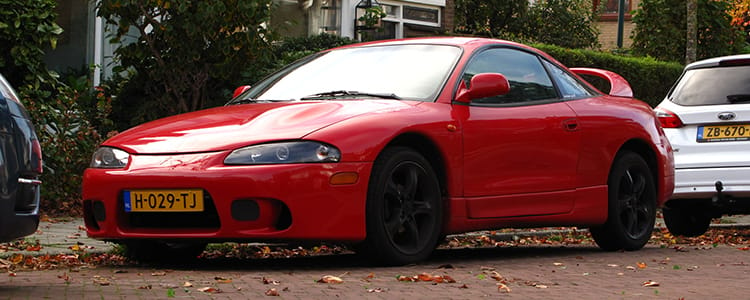
The Mitsubishi Eclipse ran four generations from 1989 to 2012, built at the Diamond Star Motors plant in Normal, Illinois — a 50/50 Chrysler-Mitsubishi joint venture. Most buyers want the 1G (D21A, 1989-1994) or 2G (D32A, 1995-1999) turbo DSM cars, particularly the AWD GSX with the 4G63T. The 3G (D52A, 2000-2005) and 4G (DK2A, 2006-2012) dropped the 4G63T and AWD entirely, switching to the 4G64 four-cylinder and 6G72/6G75 V6; those are budget front-drive coupes, not DSM collector cars. Clean, stock GSX and GS-T examples lead current pricing; modified cars typically sell below build cost.
The 1G (D21A, 1990-1994) and 2G (D32A, 1995-1999) Eclipse are what the DSM community means when it says Eclipse. Both used the 4G63T — Mitsubishi's iron-block 2.0-liter intercooled turbo four, originally developed for the Galant VR-4 and continued through the Lancer Evolution I–IX. In GSX trim, that engine drove all four wheels through a viscous-coupling center differential — a factory AWD turbo coupe that undercut the Toyota Supra A80, Mazda RX-7 FD, and Nissan 300ZX Z32 twin-turbo at launch.
The 1G ran 1989-1994; the 2G refresh (1995-1999) added smoother bodywork and introduced the Spyder convertible from 1996. Both generations share the same fault profile: crankwalk (thrust-bearing wear on certain 1996-1999 4G63 cranks), ECU capacitor leakage, and rust at rockers and strut towers.
DSMtuners.com still carries deep parts and tuning support for both generations.
All three DSM coupes rolled off the same Normal, Illinois line. The Plymouth Laser ran 1990-1994 only; the Eagle Talon ran 1990-1998 before the Eagle brand ended. The Eclipse continued as the sole Mitsubishi nameplate through 2012.
Mechanically the 1G siblings are interchangeable — same chassis codes, same engines, same transmissions. Cosmetic differences run to badging, grille treatment, tail-lamp design, and some interior trim. Eagle Talon TSi AWD is the GSX equivalent; Plymouth Laser RS Turbo equates to the Eclipse GS-T.
Cross-shopping between the three is common in the DSM market, with Talons often pricing below equivalent Eclipses on collector visibility alone.
Editorial notes
Quick read
Constants
Chassis history
The Eclipse had four generations from 1990 until 2012, and they split cleanly in half. The 1G and 2G are the DSM cars that everyone means when they say Eclipse. Turbo, 4G63T, AWD on the GSX. The 3G and 4G dropped all of that and went front drive only with a V6. If you're shopping for an Eclipse, the first thing to figure out is which half of the timeline you actually want.
First generation — D22A (1989–1994)
Third generation — D53A (2000–2005)
Buyer's call
The Eclipse is a car where the good and the bad are tied to which generation you pick. The 1G and 2G turbo cars give you a tuning ceiling that rivals the Lancer Evo on stock internals, and the 3G and 4G give you a cheap coupe with a V6. The downsides change generation to generation too, so look at the pros and cons against the trim you're actually considering.
Reliability
The Eclipse has a reputation for problems that's mostly fair. Three things cause most of the trouble on the turbo cars. The timing belt service gets skipped and the engine eats itself. The ECU capacitors leak on aging boards and cause running issues that look like a hundred other things. The crank thrust bearing wears on some 1996 to 1999 4G63 cars, which DSM owners call crankwalk. None of these are deal breakers if the paperwork shows the work was done.
| Issue | Cause | Solution | Est. cost |
|---|---|---|---|
| Timing belt failure (1G/2G) | Overdue belt, bad tensioner/idlers | Full belt kit + water pump; set timing correctly | $900-1800 |
| ECU capacitor leakage (1G/2G) | Aging electrolytic caps leak onto PCB | ECU rebuild/replace; repair traces; clean harness | $250-900 |
| Crankwalk (some 2G 4G63) | Thrust bearing wear; clutch load/oiling issues | Measure endplay; rebuild/replace engine if out | $2500-7000 |
| Turbo smoking/failed seals | Worn CHRA, coked oil, high crankcase pressure | Rebuild/replace turbo; fix PCV/venting; new lines | $900-2500 |
| Boost leaks/low power (turbo) | Cracked couplers, TB seals, IC end tank leaks | Boost leak test; replace couplers/seals; clamp right | $100-600 |
| Idle surge/hunting (1G/2G) | Vac leaks, dirty TB, bad IAC, FIAV issues | Smoke test; clean TB; replace IAC; block FIAV if needed | $150-700 |
| Overheating in traffic | Aging radiator, dead fans, air pockets, clogged fins | New radiator/thermostat; verify fans; proper bleed | $300-900 |
| Head gasket failure | Overheat, detonation, poor tune, old bolts | MLS gasket + studs; machine head; fix tune/cooling | $1200-3500 |
| Rod knock/spun bearings | Low oil, oil starvation, abuse, dirty oil | Engine rebuild/replace; inspect oil pump and pan | $3000-9000 |
| Oil leaks (valve cover/pan) | Hardened gaskets, RTV failure, PCV pressure | Reseal; replace PCV; check breather routing | $150-800 |
| Manual trans synchro grind | Worn synchros, wrong fluid, aggressive shifting | Rebuild trans; use correct fluid; inspect shift cables | $1500-3500 |
| Clutch slip/chatter | Worn disc/PP, oil contamination, bad flywheel | Clutch kit + resurface/replace flywheel; fix leaks | $900-2000 |
| AWD transfer case failure | Low fluid/leaks; recall not done; bearing wear | Verify recall; rebuild/replace case; new seals | $800-2500 |
| AWD diff whine | Worn bearings/gears from low fluid or abuse | Rebuild/replace diff; correct fluid; check mounts | $900-2500 |
| CV axle vibration/click | Torn boots, worn joints, lifted/poor angles | Replace axles; fix ride height; torque axle nuts | $250-900 |
| Wheel bearing hum | Age, impacts, incorrect torque, water intrusion | Replace hub/bearing; inspect knuckle damage | $250-700 |
| Control arm bushing wear | Age, oil contamination, cheap aftermarket arms | Replace bushings/arms; align; avoid no-name parts | $400-1400 |
| Brake caliper seizure | Rusty slide pins, torn boots, old fluid | Rebuild/replace calipers; new pins/boots; flush fluid | $250-900 |
| ABS light/wheel sensors | Broken sensor wires, rusted tone rings | Scan ABS; repair wiring; replace sensor/hub as needed | $150-800 |
| Power steering leaks/whine | Rack seal wear, old hoses, pump wear | Replace hoses/rack; flush; replace pump if noisy | $400-1600 |
| A/C weak or intermittent | Leaks, bad compressor clutch, condenser damage | Leak test; replace failed parts; vacuum/recharge | $300-1500 |
| Charging/alternator failure | Heat, oil contamination, worn brushes/bearings | Replace alternator; fix oil leaks; check grounds | $250-800 |
| Parasitic battery drain | Alarm/audio hacks, corroded grounds, stuck relays | Draw test; remove hacks; repair grounds/relays | $150-700 |
| Window regulator failure | Worn cables/guides, dry tracks, motor strain | Replace regulator; lube tracks; verify alignment | $200-600 |
| Interior water intrusion | Sunroof drains, hatch seals, cowl leaks | Clear drains; reseal; dry interior; treat corrosion | $100-800 |
| Catalyst efficiency codes | Aging cat, exhaust leaks, rich tune, bad O2 | Fix leaks/tune; replace O2/cat with quality unit | $250-1800 |
| Fuel pump/injector issues | Old pump, clogged sock, ethanol varnish, bad wiring | Test pressure; replace pump/filter; repair wiring | $250-1200 |
| Engine mounts collapse | Age, oil saturation, hard launches | Replace mounts; avoid solid mounts for street NVH | $250-900 |
Market
The Mitsubishi Eclipse is unusual in the JDM canon because it was never primarily a JDM car. All four generations were built at the Diamond Star Motors plant in Normal, Illinois, for the North American market. A right-hand-drive Eclipse was sold in Japan starting in the second generation (1995-1999), but volumes were low — Japanese buyers faced higher road taxes because the 2G Eclipse exceeded the dimensions for the lower-tax 'small car' class. The 3G and 4G were US-market focused; JDM sales were marginal. For most JDM importers today, an 'imported' Eclipse means re-importing a US-built RHD JDM 2G — a niche path with little advantage over the plentiful LHD US-market cars. The Eagle Talon and Plymouth Laser badge-engineered siblings were never sold in Japan in any form.
Specs
The 1G and 2G Eclipse runs the 4G63T 2.0 liter turbo on the GS-T and GSX trims, and a non-turbo 4G63 or 420A on the lower trims. The 3G dropped the turbo and the AWD, and went to a 2.4 liter four or a 3.0 V6. The 4G kept the same idea with a bigger 3.8 V6 on the GT. The 4G63T is the engine that matters. Everything else is a daily driver.
| Chassis | Engine | Displacement | Power | Boost | Notes |
|---|---|---|---|---|---|
| 1G (D20/D21A) | 4G37 | 1.8L | 92hp @ 5500rpm (estimated) | N/A | SOHC 8V; base early models |
| 1G (D20/D21A) | 4G63 | 2.0L | 135hp @ 6000rpm (estimated) | N/A | DOHC 16V; NA 2.0 (varies) |
| 1G (D20/D21A) | 4G63T | 2.0L | 195hp @ 6000rpm (estimated) | 11.0 psi (estimated) | Intercooled turbo; 1G DSM (varies) |
| 2G (D30/D31A) | 420A | 2.0L | 140hp @ 6000rpm (estimated) | N/A | DOHC 16V; Chrysler-sourced NA |
| 2G (D30/D31A) | 4G63T | 2.0L | 210hp @ 6000rpm (estimated) | 14.0 psi (estimated) | Intercooled turbo; GS-T/GSX |
| 2G (D30/D31A) | 4G64 | 2.4L | 141hp @ 5500rpm (estimated) | N/A | SOHC 16V; Spyder GS |
| 3G (D50) | 4G64 | 2.4L | 147hp @ 5500rpm (estimated) | N/A | SOHC 16V; RS/GS |
| 3G (D50) | 6G72 | 3.0L | 200hp @ 5500rpm (estimated) | N/A | SOHC V6; GT/Spyder GT |
| 4G (DK) | 4G69 | 2.4L | 162hp @ 5750rpm (estimated) | N/A | MIVEC; GS/SE |
| 4G (DK) | 6G75 | 3.8L | 263hp @ 5750rpm (estimated) | N/A | MIVEC V6; GT/GT-P |
| Type | Ratios | Availability | Notes |
|---|---|---|---|
| 5-speed Manual | varies by year/engine | 1G-4G (most trims) | Exact ratios depend on gearbox code |
| 6-speed Manual | varies by year/engine | 4G GT/GT-P (some years) | V6 applications; ratios vary |
| 4-speed Automatic | varies by year/engine | 1G-4G (most trims) | F4A/F4A33 family; year dependent |
| 5-speed Automatic | varies by year/engine | 4G GT/GT-P (some years) | V6 applications; year dependent |
Lineup
Eclipse trims went Base, GS, GS-T, and GSX on the 1G and 2G, then RS, GS, and GT on the 3G, then GS, SE, GT, and GT-P on the 4G. The GSX is the one you want from the DSM era. It's the AWD turbo trim that gave the Eclipse the launch advantage over the FWD Honda crowd and the rear drive Nissan 240SX. The Eagle Talon TSi AWD and the Plymouth Laser RS Turbo are the same car under a different badge.
| Generation | Trim | Engine | Key features |
|---|---|---|---|
| 1G (D20/D21A, 1989-1994) | Eclipse Base (FWD) | 4G37 1.8 NA, 4G63 2.0 NA (yr/market dependent) | FWD, pop-up headlamps, basic audio, steel wheels |
| 1G (D20/D21A, 1989-1994) | Eclipse GS (FWD) | 4G63 2.0 NA | FWD, upgraded interior, alloy wheels (varies) |
| 1G (D20/D21A, 1989-1994) | Eclipse GS-T (FWD) | 4G63T 2.0 Turbo | FWD, turbo, intercooler, sport suspension (varies) |
| 1G (D20/D21A, 1989-1994) | Eclipse GSX (AWD) | 4G63T 2.0 Turbo | AWD, turbo, intercooler, viscous center diff |
| 1G (D20/D21A, 1989-1994) | Eclipse GS (AWD, limited) | 4G63 2.0 NA | AWD, NA, rare configuration, viscous coupling |
| 2G (D30/D31A, 1995-1999) | Eclipse RS (FWD) | 420A 2.0 NA | FWD, base equipment, 5MT/4AT, 2G body |
| 2G (D30/D31A, 1995-1999) | Eclipse GS (FWD) | 420A 2.0 NA | FWD, more equipment than RS, alloys (varies) |
| 2G (D30/D31A, 1995-1999) | Eclipse GS-T (FWD) | 4G63T 2.0 Turbo | FWD, turbo, intercooler, 5MT/4AT |
| 2G (D30/D31A, 1995-1999) | Eclipse GSX (AWD) | 4G63T 2.0 Turbo | AWD, turbo, intercooler, 5MT/4AT |
| 2G (D30/D31A, 1995-1999) | Eclipse Spyder GS (FWD) | 4G64 2.4 NA | Convertible, FWD, 2.4L, power top (varies) |
| 2G (D30/D31A, 1995-1999) | Eclipse Spyder GS-T (FWD) | 4G63T 2.0 Turbo | Convertible, FWD, turbo, intercooler, rare |
| 3G (D50, 2000-2005) | Eclipse RS (FWD) | 4G64 2.4 NA | FWD, base equipment, 5MT/4AT |
| 3G (D50, 2000-2005) | Eclipse GS (FWD) | 4G64 2.4 NA | FWD, more equipment, alloys (varies) |
| 3G (D50, 2000-2005) | Eclipse GT (FWD) | 6G72 3.0 V6 NA | FWD, V6, larger brakes (varies), sport trim |
| 3G (D50, 2000-2005) | Eclipse Spyder GS (FWD) | 4G64 2.4 NA | Convertible, FWD, 2.4L, power top (varies) |
| 3G (D50, 2000-2005) | Eclipse Spyder GT (FWD) | 6G72 3.0 V6 NA | Convertible, FWD, V6, power top, sport trim |
| 4G (DK, 2006-2012) | Eclipse GS (FWD) | 4G69 2.4 NA | FWD, 2.4L MIVEC, 5MT/4AT (yr dep.) |
| 4G (DK, 2006-2012) | Eclipse SE (FWD) | 4G69 2.4 NA | FWD, appearance pkg, upgraded interior (varies) |
| 4G (DK, 2006-2012) | Eclipse GT (FWD) | 6G75 3.8 V6 NA | FWD, 3.8L MIVEC V6, 6MT/5AT (yr dep.) |
| 4G (DK, 2006-2012) | Eclipse GT-P (FWD) | 6G75 3.8 V6 NA | FWD, GT Premium, leather, Rockford Fosgate |
| 4G (DK, 2006-2012) | Eclipse Spyder GS (FWD) | 4G69 2.4 NA | Convertible, FWD, 2.4L, power top (varies) |
| 4G (DK, 2006-2012) | Eclipse Spyder SE (FWD) | 4G69 2.4 NA | Convertible, FWD, appearance pkg, upgraded trim |
| 4G (DK, 2006-2012) | Eclipse Spyder GT (FWD) | 6G75 3.8 V6 NA | Convertible, FWD, 3.8L V6, 6MT/5AT (yr dep.) |
| 4G (DK, 2006-2012) | Eclipse Spyder GT-P (FWD) | 6G75 3.8 V6 NA | Convertible, GT Premium, leather, Rockford Fosgate |
Pricing
The Mitsubishi Eclipse GSX launched at around $20,000 in 1990, which was undercutting the Toyota Supra and Mazda RX-7 by a wide margin at the time. The numbers below are what one costs today. Clean 1G and 2G turbo cars are appreciating, especially low mileage AWD GSX examples. The 3G and 4G have stayed flat and are still cheap entry points to a 2000s coupe.
Today's market range: $3,500 to $55,000 (median ~$18,500). Source: JDMBUYSELL / USS Auction.
Turbo 1G/2G DSMs are rising on scarcity and 90s nostalgia; best gains are stock, rust-free AWD cars. Modified drivers remain volatile. 3G/4G prices are mostly flat, with mild premiums for low-mile manuals.
Inspect
Walk this list with the seller, not in front of them. The Critical items mean walking away if there's no paperwork backing them up. The High items can usually be priced into the deal. Most of what kills an Eclipse is rust and a skipped timing belt, so spend extra time under the car and asking for the belt receipts.
Cross-shop
If the Eclipse doesn't end up being the right car, the natural alternatives are the Subaru WRX if you want the AWD turbo recipe with easier ownership, or the Nissan 300ZX if you want a 90s turbo coupe with more presence. The Eagle Talon TSi AWD is the same Eclipse under a different badge and usually sells for less.
Turbo AWD performance; easier stock examples
90s turbo GT rival; higher upkeep but iconic
90s sport coupe; reliable, strong resale
Modern RWD coupe; strong chassis, simpler buys
90s icon; lighter RWD, rotary maintenance tradeoff
Compare
Against the 90s turbo coupes, the Eclipse GSX gives you AWD that the Supra and RX-7 didn't have from the factory, and a 4G63T that responds to bolt-ons better than any naturally aspirated rival. Against the rear drive cars, the Eclipse is heavier and pushier in the corners. The table below leans toward the GSX because that's where the Eclipse actually wins.
| Feature | Mitsubishi Eclipse | Nissan 300ZX Z32 TT | Toyota Supra A80 (NA/TT) |
|---|---|---|---|
| Power output | 4G63T: ~195-210 hp (US) | ~255-276 hp | ~222-280 hp |
| Drivetrain | FWD or AWD (1G/2G turbo) | RWD | AWD |
| Weight | ~2,900-3,200 lb (DSM) | ~2,800-2,900 lb | ~3,300-3,500 lb |
| Tuning headroom | High; 4G63 proven 400+ whp | High; 2JZ-GTE 500+ whp | High; RB25DET 400+ whp |
| Reliability at stock | Good if maintained; age-sensitive | Very good; simple NA | Good; watch rotary upkeep |
| Handling feel | Neutral/secure; AWD grips, FWD pushes | Sharp FWD balance | RWD finesse, lighter nose |
| Braking/track use | Upgradeable; stock brakes modest | Strong aftermarket track kits | Excellent chassis; light |
| Cabin practicality | 2+2 hatch; usable cargo | 2-seater; less cargo | 2+2 coupe; small trunk |
| Collector demand | High for clean 1G/2G turbo | Very high; iconic halo | High; drift tax |
| Ownership costs | Moderate; varies by mods | Higher; complex twin-turbo | Moderate; parts plentiful |
| Auto vs manual value | Manual premium, esp. GSX/TSi AWD | Manual premium strong | Manual premium strong |
Gallery
Drivetrain
Editorial
If you're buying an Eclipse, the safest starting point is a documented 1995-1999 GSX with timing belt records and crank endplay measured. That gives you the 4G63T, AWD, and the more refined 2G chassis without paying 1G prices on a 35-year-old car. Skip anything under $8,000 unless you want a project — a cheap Eclipse almost always means deferred maintenance, hacked wiring from a previous boost controller install, and a clutch near the end. What you save on purchase you'll spend in the first year on catch-up work.
If you want the original DSM feel and can accept older electronics, look at a 1G GSX from 1992 to 1994. Pop-up headlights were dropped after 1991, the chassis settled down, and the 1G feels lighter and rawer than the 2G. The Eagle Talon TSi AWD is mechanically the same car and usually sells for less; cross-shop both. ECU capacitors need replacing, and finding an unmodified 1G is harder every year.
The Eclipse to avoid is a modified GSX with no tune logs, no dyno sheet, and no parts list. Big injectors without a proper ECU flash, a boost controller without a wideband, and a downpipe without a tune are how 4G63Ts spin bearings — the ones claiming 400 wheel horsepower are the cars to walk away from. The Eclipse worth buying is a stock example with a folder of receipts.
The 3G and 4G are a separate decision. They are not collector cars — they are front-drive coupes, priced accordingly. A clean 4G GT or GT-P with the 6-speed manual is an honest budget buy.
FAQ
Citations
Sources last verified:
New site! Spotted a bug? We're listening.