Chassis Code Explained
| Segment | Meaning | Detail |
|---|---|---|
| S | Platform | S-series Mazda rotary sports platform |
| A | Body type | A — fastback coupe body |
| 22 | Displacement code | 22 — 12A twin-rotor Wankel engine |
| C | Market variant | C — Japanese domestic market specification |
The SA22C used the naturally aspirated 12A twin-rotor; the turbocharged SA22C variant (introduced 1983, final run) is designated SA22C as well but identified by the T suffix in the engine code. Export models used the FB-series designation.
Editorial notes
Key Takeaways
The SA22C/FB had one generation but it ran for seven years and changed a lot along the way. Series 1 (1978 to 1980) is the lightest and most analog SA22C you can buy, with steel bumpers and the carbureted 12A. Series 2 (1981 to 1983) brought plastic bumpers and the GSL trim with rear discs and an LSD. Series 3 (1984 to 1985) is where the FB got the fuel-injected 13B in the US-market GSL-SE and picked up the duck-tail spoiler that most people picture when they think of a first-gen RX-7.
- Rust-free shells matter more than engine miles
- Originality beats big power mods for resale
- 12A rotary is simple, but rebuilds add up
- FB/SA prices rising; best cars now collector-grade
- GSL-SE and late cars command the premium
- Documentation and stock trim lift auction results
Technical Specifications
Most SA22C cars run the 12A twin-rotor at 1.1 liters, making around 100 hp through a 5-speed manual. The 1984 to 1985 US-market GSL-SE got the fuel-injected 13B at 135 hp, which is the most power any factory first-gen RX-7 made in North America. The JDM-only Savanna RX-7 Turbo from 1983 made around 170 hp on a turbocharged 12A but it never came to the US.
Engine Options
| Chassis | Engine | Displacement | Power — JDM | Notes |
|---|---|---|---|---|
| SA22C | 12A | 1.1L | 100hp @ 6000rpm (estimated) | Carb 4bbl; output varies by market/year |
| SA22C | 13B | 1.3L | 135hp @ 6000rpm (estimated) | EFI; GSL-SE; output varies by market/year |
Transmission Options
| Type | Ratios | Availability | Notes |
|---|---|---|---|
| 4-speed Manual | 3.483/2.015/1.391/1.000 | Standard (early) | Factory ratios vary by year/market (estimated) |
| 5-speed Manual | 3.483/2.015/1.391/1.000/0.864 | Most trims; GSL-SE | Common SA22C fitment; ratios market-dependent |
| 3-speed Automatic | 2.458/1.458/1.000 | Optional (varies) | Market/year dependent availability |
Livability
- Headroom
- 36.5"
- Low roof; helmet clearance is tight
- Rear Seats
- 2+2 (very small)
- Kids or short trips only; adults suffer
- Cargo
- Moderate hatch
- Good for groceries; spare well often rust-prone
Variants & Trims
SA22C trims went Standard, Deluxe, GS, and GSL, with the GSL adding power windows and rear discs late in the run. The 1984 to 1985 GSL-SE is the one you want if you can find it. That's the FB with the 13B, the LSD, and the four-wheel discs from the factory. In Japan the same car wore the Savanna RX-7 badge.
| Generation | Trim | Engine | Key Features |
|---|---|---|---|
| SA22C (Series 1) | Standard | 12A (carb) | 4-wheel disc, 4-spd man, steel wheels |
| SA22C (Series 1) | Deluxe | 12A (carb) | 5-spd man, upgraded interior, tachometer |
| SA22C (Series 1) | GS | 12A (carb) | 5-spd man, alloy wheels, rear wiper |
| SA22C (Series 1) | GSL | 12A (carb) | 5-spd man, power windows, rear wiper |
| SA22C (Series 2) | Standard | 12A (carb) | 4-wheel disc, 4-spd man, steel wheels |
| SA22C (Series 2) | Deluxe | 12A (carb) | 5-spd man, upgraded interior, tachometer |
| SA22C (Series 2) | GS | 12A (carb) | 5-spd man, alloy wheels, rear wiper |
| SA22C (Series 2) | GSL | 12A (carb) | 5-spd man, power windows, rear wiper |
| SA22C (Series 2) | GSL-SE | 13B (EFI) | EFI 13B, 5-spd, 4-wheel disc, alloys |
| SA22C (Series 3) | Base | 12A (carb) | 5-spd man, 4-wheel disc, updated interior |
| SA22C (Series 3) | GS | 12A (carb) | 5-spd man, alloy wheels, rear wiper |
| SA22C (Series 3) | GSL | 12A (carb) | 5-spd man, power windows, rear wiper |
| SA22C (Series 3) | GSL-SE | 13B (EFI) | EFI 13B, 5-spd, LSD (opt), alloys |
Should You Buy a Mazda RX-7 SA22C?
The SA22C is a simple car and that's most of what's good about it and what's bad about it. You get a light chassis, a rotary that loves to rev, and a layout you can actually work on yourself. You also get rust risk, a rebuild waiting in the engine, and a parts hunt for SA22C-specific trim that doesn't cross over to the FC or FD.
Why You'll Love It
- Lightweight, pure RWD feel Low mass and simple chassis deliver classic, communicative handling.
- Iconic rotary character Smooth revs and unique sound; huge enthusiast support and lore.
- Strong collector narrative Early RX-7s are increasingly recognized as blue-chip Japanese classics.
- Simple mechanical layout Less electronic complexity than later JDM icons; easier DIY ownership.
- Period-correct mods accepted Wheels/suspension/carb upgrades can be market-friendly if tasteful.
Why You Might Not
- Rust and prior repairs Sills, strut towers, floors, hatch area—poor repairs can be terminal.
- Rotary rebuild cost risk Compression issues mean rebuild; quality work isn’t cheap or quick.
- Age-related parts scarcity Trim, interior plastics, and specific SA/FB bits can be hard to source.
- Not fast by modern standards Stock power is modest; buyers must value feel over straight-line speed.
- Modded cars can be harder to sell Engine swaps and widebody builds narrow buyer pool and cap prices.
Who Should NOT Buy This
- Anyone needing reliable daily transportation
- Owners unwilling to premix and monitor temps
- People without access to rotary-experienced shop
- Rust-belt buyers without welding/body budget
- Drivers over 6'2" wanting helmet track days
- Anyone who hates carb tuning and vacuum leaks
- Budget buyers: cheap cars usually need $5k+
- Emissions-strict areas with limited exemptions
Common Issues & Solutions
The SA22C is honest about what goes wrong. Rust is the number one value killer and it shows up in the same places on every FB: rocker panels, strut towers, the spare tire well. The 12A rotary itself is simple but the seals wear and the only real fix is a rebuild. Carbs flood, fuel tanks rust from sitting, and the oil metering pump on the SA22C is something you check before you check anything else.
| Issue | Cause | Solution | Est. Cost |
|---|---|---|---|
| Low compression / hard hot start | Worn apex/side seals from age/overheat | Proper rebuild; verify cooling and tune | $3500-8000 |
| Overheating | Clogged radiator, weak fan clutch, old hoses | Radiator, hoses, thermostat, fan clutch | $600-1800 |
| Carb flooding / poor idle | Worn carb, vacuum leaks, bad choke settings | Rebuild carb, replace vac lines, set choke | $400-1200 |
| Fuel tank rust clogging system | Sits with old fuel; condensation in tank | Clean/coat or replace tank; new filters/lines | $500-1500 |
| Oil metering pump failure | Seized OMP, cracked lines, incorrect delete | Rebuild/replace OMP or premix correctly | $250-900 |
| Ignition misfire when hot | Weak coil/igniter, old leads, wrong plugs | Refresh ignition: coils, igniter, leads, plugs | $250-900 |
| 2nd gear synchro grind | Worn synchros from age/abuse | Rebuild trans or source good used unit | $1200-3000 |
| Brake calipers seized | Sitting; moisture corrodes pistons/bores | Rebuild/replace calipers; flush system | $400-1200 |
| Rusty brake/fuel hard lines | Road salt, age, trapped moisture | Replace lines; inspect underbody thoroughly | $600-2000 |
| Chassis rust (structural) | Poor factory rustproofing; water traps | Cut/weld metal; avoid heavily rotted shells | $2000-12000 |
| Hatch leaks soaking rear | Bad hatch seal, misaligned hatch, clogged drains | New seal, adjust hatch, clear drains, treat rust | $200-900 |
| Electrical gremlins | Corroded grounds, brittle connectors, hacked wiring | Clean grounds, repair harness, undo hacks | $200-1500 |
Differences between JDM & USDM
In Japan, the SA22C was badged Mazda Savanna RX-7 — a continuation of the Savanna nameplate that had carried the rotary-powered RX-3 — while every export market sold the same car as simply the RX-7. The shells, engine bays, and chassis numbers are common between the markets, but the differences worth knowing are: the 1983 turbocharged 12A (170 hp in JDM rating) was sold exclusively in Japan as the Savanna RX-7 Turbo and was never federalized for the US; the US-market GSL-SE was the first first-gen RX-7 to receive the fuel-injected 13B-RE (135 hp, 1984–1985 only), and that trim never ran in Japan under the same designation; JDM cars wear different lighting (chin-mounted indicators in earlier series, narrower sealed-beam headlamp inserts), JDM-only colour palettes, and right-hand drive throughout. For US buyers, the practical implications are that a JDM-import Savanna RX-7 Turbo is the rarest variant on this side of the Pacific, while a clean GSL-SE is the more attainable enthusiast spec and easier to register, insure, and source parts for.
Pre-Purchase Inspection Checklist
Walk this list slowly. On an SA22C the Critical items are rust and compression, in that order. A clean shell with a tired 12A is a known cost. A rusty shell with a fresh rebuild is a money pit. Do the warm compression test, then crawl underneath with a flashlight, then drive it.
Critical Priority
High Priority
Medium Priority
Generation History
RX-7 SA22C/FB (Gen 1) (1978-1985)
- Lightweight RWD rotary coupe
- 12A rotary; simple, analog feel
- GSL-SE: 13B + rear discs (US)
- Rust is the #1 value killer
- Strong vintage motorsport pedigree
Sales Numbers by Year
| Year | Notes |
|---|---|
| 1978 | Launch year (March 1978); Series 1, 12A, sold as Savanna RX-7 in Japan and RX-7 in export markets |
| 1980 | End of Series 1; mid-cycle interior and trim updates rolled in |
| 1981 | Series 2 launches: plastic bumpers replace steel for weight savings, new wheel options, revised side trims, GSL trim with rear discs and clutch-type LSD added |
| 1983 | JDM-only Savanna RX-7 Turbo introduced: turbocharged 12A, 5-speed manual; first turbo rotary in a Mazda sports car |
| 1984 | Series 3 launches: US-market GSL-SE gets fuel-injected 13B-RE (135 hp), duck-tail rear spoiler added, revised suspension dampers |
| 1985 | Final year of SA22C/FB production; ~471,000 first-gen RX-7s built globally before FC3S replaced the platform in 1986 |
Market Data
SA22C trims went Standard, Deluxe, GS, and GSL, with the GSL adding power windows and rear discs late in the run. The 1984 to 1985 GSL-SE is the one you want if you can find it. That's the FB with the 13B, the LSD, and the four-wheel discs from the factory. In Japan the same car wore the Savanna RX-7 badge.
Production Numbers & Rarity
| Generation | Years | Total Built | Notes |
|---|---|---|---|
| SA22C (1st gen RX-7, SA/FB) | 1978-1985 | ~471,000 (estimated) | Includes SA22C & FB; global total commonly cited |
Original MSRP & Pricing
Original MSRP: $6,395 at launch in 1979. USDM launch base price for the 1979 RX-7 in the United States (1978 was a partial-model-year Japan-only launch). Widely cited as approximately $6,395 for the base trim and $7,195 for the GS — undercutting the Porsche 924 (~$11,500) and Datsun 280ZX (~$9,900) by a margin that drove the RX-7's commercial success.
How It Compares
Among the late-70s and early-80s sports coupes, the SA22C is the lightest and the most analog. The Datsun 280Z makes more torque and feels like a GT. The Porsche 924 is more refined but costs more to own. The FB wins on weight, on rev character, and on the rotary noise that nothing else makes.
| Feature | SA22C | Datsun 280Z S30 | Toyota Celica Supra A40 |
|---|---|---|---|
| Curb weight | ~2,300–2,500 lb | ~2,650–2,900 lb | ~2,650–2,800 lb |
| Power (typical) | ~100–135 hp | ~145–170 hp | ~110–145 hp |
| Driving character | High-rev, light, nimble | Torquey, GT feel | Balanced, refined |
| Reliability risk | Rotary seals/compression | Cooling/rust/age issues | Transaxle/parts cost |
| Collector premium | High for clean originals | High; strong Z demand | Moderate; rising slowly |
Comparable Alternatives
If the SA22C ends up not being right, the obvious step up is the FC RX-7, which gives you more power and a more modern chassis without leaving the rotary world. The Datsun 280Z is the closest non-rotary alternative from the same era, and the Porsche 924 is the European comparison the SA22C was built to undercut.
Datsun 280Z S30
Similar era coupe; stronger torque and broad parts support
Porsche 924
Analog transaxle balance; European badge, different ownership costs
Mazda RX-7 FC
Next-gen rotary; more power and comfort, still classic-sized
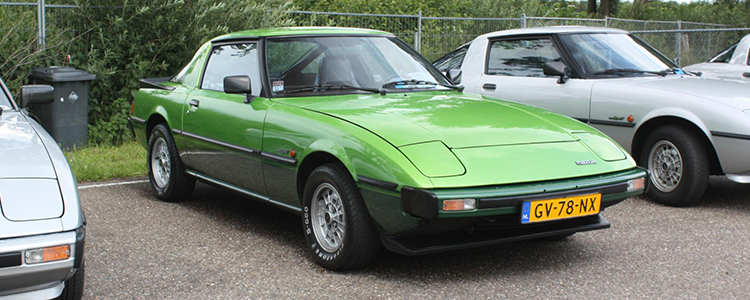
In Pictures
The Buyer's Read
Start with the shell. A rust-free Series 2 or Series 3 FB with documentation is worth more than a Series 1 with a fresh engine and bubbled rockers. The 12A rebuild runs $3,500 to $8,000 for competent work; cutting rust from an SA22C monocoque can exceed $10,000 with no natural ceiling, and a heavily rotted shell rarely makes financial sense to restore.
The documented 1984–1985 GSL-SE is the target for most US buyers: fuel-injected 13B at 135 hp, factory LSD, four-wheel discs, and the duck-tail spoiler. Clean examples are rising on Classic.com market data. The 13B injection components are harder to source than 12A parts that cross between Series 1 and 2 cars, so an original engine with matching paperwork justifies paying a premium over a car with an unknown service history.
Avoid a cheap Series 1 with no records and a recent repaint — rust hides under fresh paint, and the 12A runs fine until it's fully heat-soaked. Do a warm compression test first; an uneven result or slow hot restart points to worn apex or side seals. Avoid any FB with a 13B-REW or non-rotary swap: the SA22C holds its value as a rotary car, and an engine swap narrows the buyer pool to the specific crowd wanting that build.
The JDM-only Savanna RX-7 Turbo is the rarest variant outside Japan. Registration and parts sourcing present harder problems than a clean GSL-SE does, so weigh those costs carefully before committing.
Frequently Asked Questions
- What’s the difference between SA22C and FB?
- SA22C is early Gen 1; “FB” commonly refers to later updates. Focus on rust, spec, and history over badge wording.
- Which SA/FB RX-7 is most collectible?
- Generally GSL-SE and clean late cars with original trim/colors. Condition and documentation can outweigh trim level.
- What should I check first when inspecting one?
- Start with rust (sills/floors/strut towers) and compression. A clean shell is worth paying for.
- How do I tell if the rotary needs a rebuild?
- Look for hard hot starts, low power, smoke, and poor compression test results. Budget for a rebuild if numbers are weak.
- Are modified SA22C cars worth less?
- Usually yes at the top end. Tasteful period mods can be fine; swaps/widebodies often reduce buyer pool and ceiling.
- What’s the best use-case for an SA22C today?
- Best as a weekend classic and cars-and-coffee car. It’s charming, but age and parts needs make daily use harder.
- What options/features add value?
- Original paint/trim, factory wheels, A/C presence, uncut interior, and service records. Rare colors and stock stance help.
Sources & References
Sources (9)
- Mazda RX-7 SA22C — JDMBUYSELL wiki (source article) — JDMBUYSELL Verified
- Mazda RX-7 — encyclopedic overview — Wikipedia Verified
- Mazda RX-7 (first generation) — dedicated SA22C/FB article — Wikipedia Verified
- Mazda Wankel engine — 12A and 13B development history — Wikipedia Verified
- Mazda Savanna — JDM nameplate history — Wikipedia Verified
- Bring a Trailer — RX-7 first-gen auction archive — Bring a Trailer Verified
- Classic.com — Mazda RX-7 1st-gen market data — Classic.com Verified
- How the Mazda RX-7 saved the rotary engine — Road & Track Verified
- Hagerty Valuation Tools — Mazda RX-7 (1979–85) — Hagerty Verified
Sources last verified: