Chassis Code Explained
| Segment | Meaning | Detail |
|---|---|---|
| A | Model prefix | Anniversary/sports platform |
| P | Body type | P-designation — open roadster body |
| 2 | Generation | Second variant (2.2L F22C; 2004–2009) |
AP2 retained the same open roadster body as the AP1 with suspension revisions and the 2.2L F22C engine, which broadened the usable power band at lower rpm.
Key Takeaways
- October 2003 minor model change: "17-inch aluminum wheel, exterior and interior changes"
- November 2005 in Japan: "engine displacement" up to 2.2 litres for "[increased torque at low and mid range]", plus "DBW [Drive By Wire]"
- North America got the 2.2 for 2004: "240 horsepower @ 7800 rpm and 162 lb.-ft. of torque @ 6500"
- "Later 'AP2' models introduced from 2004 benefitted from 17-inch wheels, revised spring/ damper tuning and tweaked geometry"
- October 2007 in Japan added VSA as standard and a Type-S grade
- Oil use is unchanged and still the main check: "maybe a litre every 800 to 1000 miles"
Technical Specifications
Engine Options
| Chassis | Engine | Displacement | Power — JDM | Notes |
|---|---|---|---|---|
| AP2 (North America, 2004-2009) | F22C1 | 2.2L | 237hp @ 7,800rpm; 162lb-ft @ 6,800rpm | US spec; 11.1:1 comp; 8,200rpm redline |
| AP2 (Japan) | F22C | 2.2L | 242PS @ 7,800rpm; 221Nm @ 6,500rpm | JDM rating; 11.1:1 comp; 8,200rpm redline |
| AP2 (Europe/UK) | F20C | 2.0L | 240PS @ 8,300rpm; 208Nm @ 7,500rpm | AP2 chassis updates; engine remained 2.0L in EU |
Livability
- Headroom
- 37.0"
- Top up is tight with helmet; seat lowers limited
- Rear Seats
- None
- Strict 2-seater; no extra passenger capacity
- Cargo
- 5.0 cu ft
- Small trunk; weekend bags only; top down reduces use
This chassis will become eligible for US import under the 25-year rule in 2028. Calculate import costs →
Variants & Trims
| Generation | Trim | Engine | Key Features |
|---|---|---|---|
| AP2 (North America) | S2000 | F22C1 2.2L NA | LSD, 6MT, 17in wheels, revised suspension |
| AP2 (North America) | S2000 CR | F22C1 2.2L NA | Hardtop, aero, no soft top, stiffer suspension |
| AP2 (Europe/UK) | S2000 | F20C 2.0L NA | LSD, 6MT, 17in wheels, revised suspension |
| AP2 (Europe/UK) | S2000 GT | F20C 2.0L NA | Leather, A/C, cruise (market), premium audio |
| AP2 (Japan) | S2000 (base) | F22C 2.2L NA | LSD, 6MT, 17in wheels, revised suspension |
| AP2 (Japan) | S2000 Type V | F22C 2.2L NA | VGS variable steering, LSD, 6MT, 17in wheels |
| AP2 (Japan) | S2000 Type S | F22C 2.2L NA | Sport suspension, aero pieces, LSD, 6MT |
| AP2 (Japan) | S2000 Type S (VGS) | F22C 2.2L NA | Type S kit, VGS, sport suspension, LSD |
Should You Buy a Honda S2000 AP2?
Why You'll Love It
- More torque where you use it Japan's November 2005 change brought "engine displacement" up to 2.2 litres for "[increased torque at low and mid range]", plus "DBW [Drive By Wire]"; North America's 2004 car moved to "162 lb.-ft. of torque @ 6500", up from "153 ft.-lbs. @ 7500 rpm".
- Chassis revisions aimed at the twitchiness "Later 'AP2' models introduced from 2004 benefitted from 17-inch wheels, revised spring/ damper tuning and tweaked geometry in an effort to tame the transition to oversteer and tone down the twitchiness."
- Transmission improvements as well The 2004 changes included "Revised transmission gear ratios and improved shift feeling", and the synchromesh benefits from "the carbonfibre components fitted to AP2 cars".
- Stability control late in the run Japan's October 2007 change is recorded as a "Minor model change (equipped with VSA and satellite speakers as standard equipment)", alongside a new Type-S grade.
- A well-supported, long-lived model Honda records "total sales of more than 20,000 units in Japan, and total worldwide sales of more than 110,000" units "during the nine years it was in production".
Why You Might Not
- Oil consumption did not go away "Maybe a litre every 800 to 1000 miles. Honda says it should be checked every week, but people don't and knocks develop as the bearing shells break up."
- A lower rev ceiling on the bigger engine evo notes the larger North American engine came with "a touch more torque but a lower red line".
- Front lower arms still wear first A specialist changes "one front lower arm a month on average", and "it's at about 80,000 miles that clonks and knocks might start to appear".
- Thin underseal "To keep the weight down Honda didn't use much" underseal, "so check the underside to make sure it's clean and rust-free".
- Hood leaks and fragile trim "The hood often leaks near the screen pillars", and "the clips for the trim are really only good for fitting once".
Who Should NOT Buy This
- Buyers who will not check oil weekly — "Honda says it should be checked every week, but people don't and knocks develop as the bearing shells break up"
- Buyers who want the highest rev ceiling: the larger engine brought "a touch more torque but a lower red line"
- Buyers who will not establish which market and which model year the car is — the engine change happened in different years in different markets
- Buyers who skip the underside, given that "to keep the weight down Honda didn't use much" underseal
- Buyers who have not sat in one: "even shorter drivers might find the seat too high-set"
Common Issues & Solutions
| Issue | Cause | Solution | Est. Cost |
|---|---|---|---|
| Oil consumption leading to bearing damage | "They all burn a lot of oil," at "maybe a litre every 800 to 1000 miles", and when owners do not keep up, "knocks develop as the bearing shells break up". | Dip it yourself, ask how often the seller checks, and listen from cold — "beware of untoward noises". | Get a written estimate for a bottom-end inspection if you hear a knock. |
| Worn front lower arms | A specialist changes "one front lower arm a month on average" and calls it "usually the suspension part that wears first". | Listen for clonks, then have the geometry checked — "it's important to check the suspension geometry annually". | Get a written estimate for lower arms plus an alignment. |
| Corrosion from thin factory underseal | "To keep the weight down Honda didn't use much" underseal. | "Check the underside to make sure it's clean and rust-free. A careful owner will Waxoyl under there regularly." | Underbody protection is cheap compared with repair. |
| Damp carpets from a leaking hood | "The hood often leaks near the screen pillars." | "Also check the carpets for dampness." | Budget hood seals, then check for corrosion where water collected. |
| Broken interior trim fixings | "If there's an aftermarket radio, chances are the clip fixings around the air vents were broken when the radio was fitted." | "Check the radio flap doesn't come off in your hand, too." | Cosmetic, but "it's not the clips themselves that break, but the plastic parts they fit into". |
| Seized handbrake cables | "The brakes give no problems except that the handbrake cables must be kept lubricated." | Test the handbrake and ask when the cables were last serviced. | Minor, if caught early. |
Differences between JDM & USDM
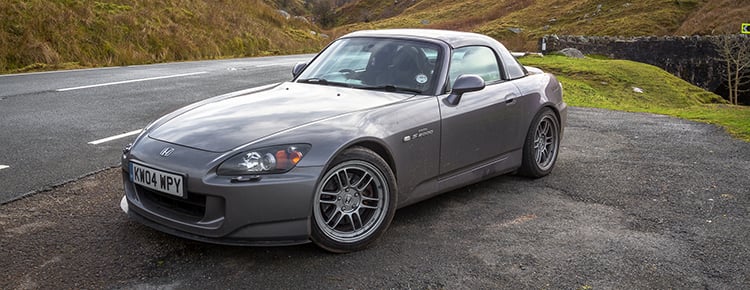
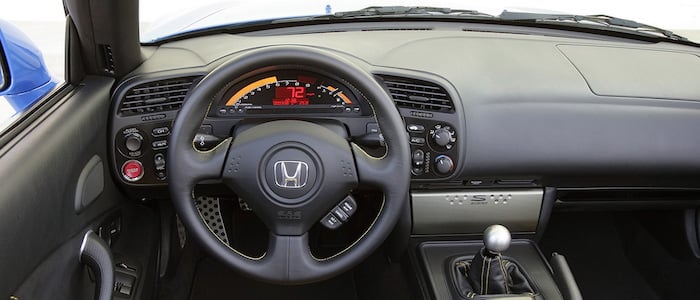
This is the phase where the S2000's markets diverge, so a buyer has to know which car is in front of them. North America moved first: for 2004 Honda fitted a "Larger displacement 2.2-liter engine (240 horsepower @ 7800 rpm and 162 lb.-ft. of torque @ 6500", replacing "240 hp @ 8300 rpm and 153 ft.-lbs. @ 7500 rpm", alongside "Larger wheels and tires (17-inch)", "Revised suspension tuning" and "Revised transmission gear ratios and improved shift feeling". Japan's own record puts its equivalent change two years later: "Nov. 2005", a "Minor model change" that raised "engine displacement" from 2.0 to 2.2 litres for "[increased torque at low and mid range]", added "DBW [Drive By Wire]" and brought "Exterior and Interior design changes", after an "Oct. 2003" change that had already brought the "17-inch aluminum wheel, exterior and interior changes". Europe is different again — evo notes only that "North American AP2s also got a larger, 2.2-litre engine with a touch more torque but a lower red line", while describing the chassis revisions as the change its market received. Japan closed the run with an "Oct. 2007" change adding VSA as standard and a Type-S grade. Check the car, not the model year.
Pre-Purchase Inspection Checklist
Critical Priority
High Priority
Medium Priority
Generation History
AP2 (F22C1) (2004-2009 (US))
- F22C1 2.2L; more torque, lower redline
- Revised suspension/steering for stability
- Updated interior/trim; incremental refinements
- Generally preferred for street drivability
- Late cars often command strongest premiums
Sales Numbers by Year
| Year | Exports | Domestic | Notes |
|---|---|---|---|
| 2004 | 9,606 | 1,087 | AP2 facelift; 2.2L F22C1 for US, 17-inch wheels, revised suspension |
| 2005 | 9,787 | 981 | |
| 2006 | 7,891 | 1,225 | F22C arrives in JDM; drive-by-wire throttle, VSA stability control |
| 2007 | 5,541 | 997 | |
| 2008 | 3,312 | 1,228 | USDM Club Racer (CR) and JDM Type S production begins |
| 2009 | 1,524 | 1,122 | Final year of production (June 2009) |
| 2010 | 126 | — | Leftover MY2009 inventory at dealer lots |
| 2011 | 5 | — | Final residual dealer-lot sales |
Market Data
Production Numbers & Rarity
| Generation | Years | Total Built | Notes |
|---|---|---|---|
| AP2 | 2004-2009 | estimated ~55,000 | Estimate; includes US-only CR subset |
| All (AP1+AP2) | 1999-2009 | ~110,673 | Commonly cited global total; verify by region logs |
Rarest variant: S2000 CR
Comparable Alternatives
Mazda MX-5 NB
Similar analog roadster feel; cheaper entry, less power
Nissan 350Z Z33
FR 6MT sports car; more torque and practicality
Porsche Boxster 986
MR balance and premium feel; higher upkeep but great drive
BMW Z4 E85 3.0i
FR roadster with strong torque; more comfort, more costs
Lotus Elise S2
Lightweight purity and track focus; rarer, harsher, pricier
In Pictures

The Buyer's Read
The later S2000 is not one car, it is a sequence of changes that landed in different years in different markets — so start by identifying what you are looking at. Honda's Japanese record lists an "Oct. 2003" "Minor model change (17-inch aluminum wheel, exterior and interior changes)", then a "Nov. 2005" a "Minor model change" that raised "engine displacement" from 2.0 to 2.2 litres for "[increased torque at low and mid range]", added "DBW [Drive By Wire]" and brought "Exterior and Interior design changes", and finally an "Oct. 2007" change "equipped with VSA and satellite speakers as standard equipment" that also "Added new grade" — the Type-S with its "exclusively designed seat, shift knob, front and rear spoiler".
North America got the bigger engine earlier. For 2004 Honda fitted a "Larger displacement 2.2-liter engine (240 horsepower @ 7800 rpm and 162 lb.-ft. of torque @ 6500", replacing "240 hp @ 8300 rpm and 153 ft.-lbs. @ 7500 rpm" — the same peak power lower down the rev range — plus "Larger wheels and tires (17-inch)", "Revised suspension tuning" and "Revised transmission gear ratios and improved shift feeling". evo's summary of the chassis work is that "later 'AP2' models introduced from 2004 benefitted from 17-inch wheels, revised spring/ damper tuning and tweaked geometry in an effort to tame the transition to oversteer and tone down the twitchiness", and notes the trade-off on the larger engine: "a touch more torque but a lower red line".
The buying checks are the same as the earlier car's, and the first one still matters most. "They all burn a lot of oil," at "maybe a litre every 800 to 1000 miles. Honda says it should be checked every week, but people don't and knocks develop as the bearing shells break up. So beware of untoward noises." The gearbox is not a worry — "the synchromesh lasts well, especially with the carbonfibre components fitted to AP2 cars".
After that: the front lower arm is "usually the suspension part that wears first" with noises "at about 80,000 miles", "to keep the weight down Honda didn't use much" underseal so "check the underside to make sure it's clean and rust-free", and "check the carpets for dampness, because the hood often leaks near the screen pillars". Sit in it before you commit, and if there is a hard-top, "check it comes with its cover and stand".
Frequently Asked Questions
- What actually changed, and when?
- In Japan, October 2003 brought a "Minor model change (17-inch aluminum wheel, exterior and interior changes)", and November 2005 a "Minor model change" that raised "engine displacement" from 2.0 to 2.2 litres for "[increased torque at low and mid range]", added "DBW [Drive By Wire]" and brought "Exterior and Interior design changes". North America received the larger engine for 2004.
- What are the North American 2.2's figures?
- "Larger displacement 2.2-liter engine (240 horsepower @ 7800 rpm and 162 lb.-ft. of torque @ 6500", replacing "240 hp @ 8300 rpm and 153 ft.-lbs. @ 7500 rpm".
- What else came with the 2004 update?
- "Larger wheels and tires (17-inch)", "Revised suspension tuning", "Revised transmission gear ratios and improved shift feeling", "Bolder front and rear exterior styling" and a "Freshened interior design".
- Did the chassis changes fix the reputation?
- They were aimed at it. "Later 'AP2' models introduced from 2004 benefitted from 17-inch wheels, revised spring/ damper tuning and tweaked geometry in an effort to tame the transition to oversteer and tone down the twitchiness."
- What came last?
- Japan's October 2007 "Minor model change (equipped with VSA and satellite speakers as standard equipment)", which also "Added new grade" — the Type-S, with an "exclusively designed seat, shift knob, front and rear spoiler".
- Does the later car still use oil?
- Yes — the specialist advice covers the model: "maybe a litre every 800 to 1000 miles. Honda says it should be checked every week."
Sources & References
Sources (10)
- Honda S2000 — encyclopedic overview — Wikipedia Verified
- Bring a Trailer auction results: Honda S2000 — Bring a Trailer Verified
- Classic.com market data: Honda S2000 — Classic.com Verified
- Hagerty Valuation Tools — Honda S2000 — Hagerty Verified
- 2006 Honda S2000 review — Edmunds Verified
- Honda S2000 Buyer's Guide — Road & Track Verified
- Honda S2000 — Everything You Need To Know Before Buying One Used — Carscoops Verified
- Buying a Honda S2000 — buyer's guide — Garage Dreams Verified
- S2000 owners community and tech resource — s2000.club Verified
- Why You Should Buy a Honda S2000 — Speedhunters Access blocked
Sources last verified: