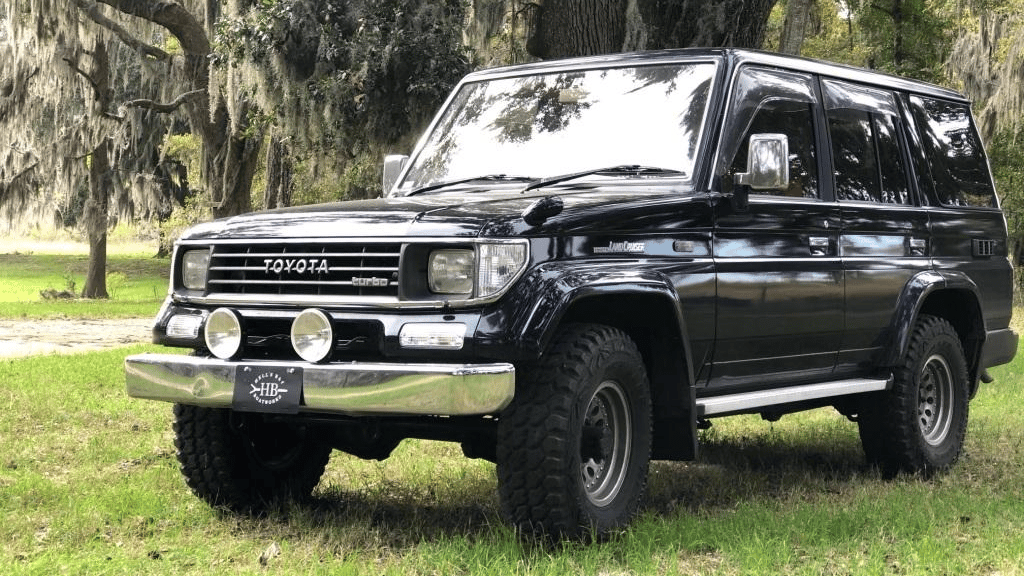
Toyota Land Cruiser Prado
Same body-on-frame durability with more luxury and refinement; better daily driver
Buyer's guide
16 min read
Buyer's guide & specs
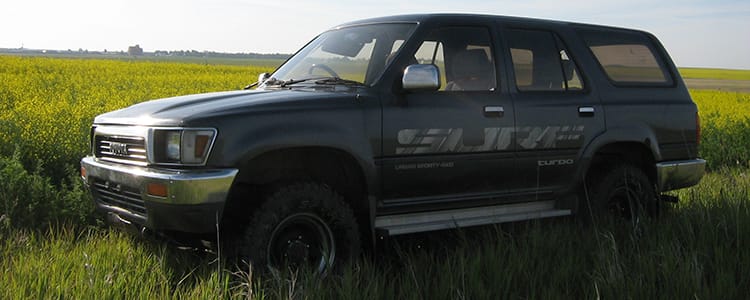
Background
The Toyota Hilux has run continuously since March 1968 — eight generations, still in production, second only to the Land Cruiser in Toyota's own catalogue for longevity. Most JDM importers want the Hilux Surf, the SUV body on the Hilux chassis that Japan sold alongside the pickup and that export markets received as the 4Runner. The N80 and N100 Surf with the 1KZ-TE 3.0L turbo-diesel are the canonical imports — RHD, factory diesel, body-on-frame, neither of which the export 4Runner ever got. The N150 KZN185W is now reaching 25-year eligibility in the US and entering the import market.
The Hilux launched in March 1968 with petrol engines only — 1.5L, 1.6L, 1.9L, and 2.0L four-cylinders — and a single 4-speed manual, leaf springs front and rear. The first two generations held that formula; no diesel, no 4×4, straightforward commercial pickup.
The N30 third generation (1978–1983) added a 2.2L L-series diesel and, from 1979, the first 4×4 variant — a gear-driven transfer case bolted to a solid front axle. Strong North American 4×4 sales justified the 1984 launch of the Hilux Surf in Japan and the 4Runner in export markets, both on the N50/N60/N70 chassis. The N50/N60/N70 fourth generation also brought the first turbocharged engines: the 22R-TE petrol and the 2L-T diesel, plus the 3VZ-E 3.0L V6 from 1988 in top trims.
The fifth generation N80–N110 (1988–1997) is where the Hilux Surf hit its peak as a JDM import: the 1KZ-TE 3.0L electronic-controlled turbo-diesel arrived in 1993, pairing real torque and reasonable fuel economy with the same body-on-frame durability as the pickup. The LN130, KZN130, and VZN130 sub-codes cover petrol, diesel, and V6 variants respectively.
The JDM Hilux Surf and the export 4Runner share transfer case, rear axle, and suspension architecture — mechanical service items cross-reference cleanly, which keeps long-term parts support viable in the US.
The divergence is powertrain and controls. JDM Surfs are right-hand drive with JDM-only audio and climate units; more critically, they were available with the 1KZ-TE turbo-diesel through the N80 and N100 generations, while the US 4Runner of the same period offered only the 22R-E petrol or 3VZ-E V6.
JDM-only trim — instrument cluster, headlight housings, tail lights — needs import suppliers rather than a Toyota dealer. Diesel emissions vary by state; CARB-state buyers need a compliance plan before committing.
Editorial notes
Quick read
Constants
Chassis history
The Hilux has been in production since 1968 and it's the longest-running Toyota nameplate after the Land Cruiser. Eight generations cover everything from the original 1.5 liter petrol pickup to the current 2.8 liter diesel. For US importers the relevant ones are the N50 fourth gen that started the Surf in 1984, the N80 fifth gen with the 1KZ-TE diesel that's the canonical import, and the N150 sixth gen Surf that's just now reaching the 25 year mark.
Fifth-gen late sub-codes — N100/N110 (1995–1997)
Eighth generation — AN110/AN120/AN130 (2015–present)
Buyer's call
The Hilux is one of those vehicles where the strong points and the weak points have stayed the same across the whole production run. Toyota built it to be cheap to own and hard to kill, not comfortable to drive every day. That trade is the whole reason people buy a Hilux, and it's also the reason people regret buying a Hilux when they wanted a Tacoma.
Reliability
The Hilux is a bulletproof truck mechanically, but that reputation gets the cars in trouble. Owners run them hard and skip the scheduled work because they think nothing will break. Most of the issues you'll see on an imported Hilux trace back to that. The 1KZ-TE head gasket, the EGR cooler, the rear leaf perches, the diesel injectors. None of these are deal breakers if the paperwork shows the work was done.
| Issue | Cause | Solution | Est. cost |
|---|---|---|---|
| 1KZ-TE head gasket failure | Cylinder-head cracking around injector seats on early/abused 1KZ-TE engines; symptom is white exhaust smoke and coolant loss | Resurface or replace cylinder head; replace head gasket and head bolts; verify cooling system pressure | $1,800–4,500 |
| 1KZ-TE EGR cooler clog | Carbon buildup in EGR cooler restricts flow and reduces cooling efficiency; common after 150,000 km | Remove and clean EGR cooler or replace with reconditioned unit; some owners delete EGR where legal | $300–900 |
| Diesel fuel injector clogging | Low-quality diesel and copper injector seals failing on pre-2007 engines (1KZ-TE, 2KD-FTV, 1KD-FTV) | Clean or replace injectors; switch to aluminum injector seals (Toyota updated part) | $400–1,800 |
| Diesel fuel pump failure | Age-related wear on injection pump; symptoms include sputtering, stalling, power loss | Rebuild or replace injection pump; replace fuel filter and inspect lines | $1,200–3,500 |
| Frame rust at leaf spring perches | Salt exposure on rear leaf perches and crossmembers; structural concern on N50–N100 cars | Frame repair or replacement; budget for cut-out and weld-in of new sections | $1,500–6,000 |
| Pitman and idler arm wear | Worn steering linkage on N50–N100 trucks; symptoms include vague steering and clunks | Replace pitman arm, idler arm, drag link, tie rods as a set; alignment after | $500–1,400 |
| Rear leaf spring sag | Age and load on factory rear leaves on pre-2004 cars; rear of truck sits noticeably low | Replace leaf springs (OEM or aftermarket); inspect U-bolts and shackle bushings | $400–1,200 |
| Front strut tower bushing crumble | Rubber bushings under front strut towers harden and crack with age | Replace bushings; consider polyurethane alternatives for overland use | $200–600 |
| Turbo failure on diesel engines | Age-related bearing wear plus oil starvation on cars driven hard or with skipped oil changes | Replace turbo; verify oil feed/return lines clear; address root cause (oil change interval) | $1,400–3,500 |
| Diesel turbo boost leaks | Aged intercooler piping, hoses, and clamps on turbo-diesel cars | Replace cracked piping and hoses; new clamps; pressure-test system | $150–600 |
| 4-speed automatic transmission failure | Worn clutch packs and valve body on neglected automatics; symptoms include slipping, harsh shifts, no engagement | Rebuild or replace transmission; service ATF and filter on remaining cars | $1,800–4,500 |
| Body panel and bed rust | Salt and moisture on rocker panels, door bottoms, bed corners, around fuel filler | Localized cut-and-weld repair; full bed replacement on severe cases | $500–3,500 |
| Power steering whine | Low power-steering pump fluid or contaminated fluid on older Surf models | Flush and refill; replace pump if whine persists; check rack for internal leaks | $200–800 |
| Window regulator and door lock actuator failure | Plastic regulator clips and aged actuator motors on Surf and pickup | Replace regulator or rebuild actuator; many owners do this as planned maintenance on imports | $150–500 per door |
| Headlight clouding and alternator load | Aged headlight lenses and high-mileage alternators causing dim lights and battery drain | Polish or replace headlights; test alternator output; replace battery if voltage drops under load | $150–600 |
Market
The Hilux and the Hilux Surf are JDM names; the same vehicles were sold in North America as the Hilux (until 1995, after which the Tacoma replaced it) and the 4Runner (still in production today). The biggest spec divergence is powertrain: every JDM Hilux Surf could be ordered with a turbo-diesel (2L-T, 1KZ-TE, 1KD-FTV depending on generation), while every US-market 4Runner was petrol-only. JDM Surfs are right-hand drive, with JDM-only instrument clusters, headlight housings, tail lights, and audio units. Mechanical parts (engine, transmission, transfer case, axles, suspension components, brakes) cross-reference cleanly with the export 4Runner of the same generation, which keeps long-term parts support viable in the US. The Hilux pickup variant is similar: JDM-spec pickups got diesel; US-market Hilux pickups (1968–1995) were petrol-only. The Hilux nameplate left the US market in 1995, replaced by the Tacoma — a North-America-specific design that shares less with the JDM Hilux than the 4Runner does with the Surf.
Specs
Every Hilux is body on frame with a leaf spring rear axle. The drivetrain choices are what change across the generations. The N80 and N100 Surf imports run either the 22R-E or 3RZ-FE petrol or the 1KZ-TE 3.0 liter turbo diesel. The 1KZ-TE is the engine you actually want on a JDM Surf, since the export 4Runner never got a diesel option.
| Chassis | Engine | Displacement | Power | Boost | Notes |
|---|---|---|---|---|---|
| N50/N60/N70 | 22R-E | 2.4L | 100–116 hp (estimated, varies by year/market) | N/A | EFI petrol I4; common in 4WD pickup and early Surf |
| N50/N60/N70 | 2L-T | 2.4L | ~85 hp (estimated) | low-pressure turbo | First Hilux turbo-diesel; predecessor to 1KZ-TE |
| N80/N100 (Surf) | 1KZ-TE | 3.0L | 125 PS (estimated, JDM) | factory turbo | Electronic-controlled turbo-diesel I4; the iconic JDM Hilux Surf engine |
| N80/N100 (Surf) | 3VZ-E | 3.0L | 150 hp (estimated) | N/A | V6 petrol option in higher trims |
| N100/N110 | 3RZ-FE | 2.7L | 150 PS (estimated, JDM) | N/A | DOHC EFI I4; common N100 Surf and pickup petrol |
| N150 (KZN185W) | 1KZ-TE | 3.0L | 130 PS (estimated, JDM) | factory turbo | Sixth-gen JDM diesel Surf; head gasket attention warranted |
| N150 | 5VZ-FE | 3.4L | 185 hp (estimated) | N/A | V6 petrol; same engine as US-market 4Runner of the era |
| AN10/AN20/AN30 | 1KD-FTV | 3.0L | 171 hp (estimated) | common-rail turbo | D-4D common-rail diesel; replaces 1KZ-TE family |
| AN10/AN20/AN30 | 2KD-FTV | 2.5L | 102 hp (estimated) | common-rail turbo | Smaller D-4D diesel; primarily Thailand/Asia-Pacific markets |
Lineup
JDM Hilux Surfs came in SSR-G, SSR-X, and SSR-Limited trims, with the V on later cars. The trim names sound bigger than they are. They mostly change interior content, wheels, and which 4WD setup you get. The drivetrain choice between the 1KZ-TE diesel and the V6 petrol matters way more than the trim badge.
| Generation | Trim | Engine | Key features |
|---|---|---|---|
| N10 (1968–1972) | Hilux Standard | 2R 1.5L petrol / 12R 1.6L petrol / 8R 1.9L petrol / 5R 2.0L petrol | First-generation commercial pickup, 4-speed manual, leaf-spring rear, RWD only |
| N20 (1972–1978) | Hilux Short/Long Wheelbase | 12R 1.6L petrol / 18R 2.0L petrol / 20R 2.2L petrol | Cabin comfort upgrades, optional 3-speed automatic and 5-speed manual added |
| N30/N40 (1978–1983) | Hilux 2WD / Hilux 4×4 (from 1979) | 12R 1.6L / 18R 1.8L / 20R 2.2L / 22R 2.4L petrol; L 2.2L diesel | First Hilux 4×4 with solid front axle, gear-driven transfer case; first diesel option |
| N50/N60/N70 (1983–1988) | Hilux Single Cab / Xtracab / Double Cab | 22R 2.4L / 22R-E 2.4L EFI / 22R-TE 2.4L turbo petrol / 2L 2.4L / 2L-T 2.4L turbo-diesel / 3VZ-E 3.0L V6 (1988) | First extended-cab Xtracab; first turbo-diesel (2L-T); independent front torsion bar on 4WD |
| N80/N90/N100/N110 (1988–1997) | Hilux Surf SSR-G / SSR-X / SSR-Limited; Hilux Pickup | 22R-E 2.4L / 3RZ-FE 2.7L / 3VZ-E 3.0L V6 petrol; 2L-TE 2.4L / 1KZ-TE 3.0L turbo-diesel | Hilux Surf (LN130/KZN130/VZN130) launched May 1989; 1KZ-TE electronic-controlled turbo-diesel from 1993 |
| N140/N150/N160/N170 (1997–2004) | Hilux Surf SSR-X / SSR-G / SSR-V; Hilux Sport Pickup | 3RZ-FE 2.7L / 5VZ-FE 3.4L V6 petrol; 1KZ-TE 3.0L turbo-diesel; KZN185W chassis | Sport Rider variant exclusive to Thailand; KZN185W is the popular JDM diesel Surf import |
| N210/AN10/AN20/AN30 (2004–2015) | Hilux Vigo (export); Hilux Sport Rider (Thailand) | 1TR-FE 2.0L / 2TR-FE 2.7L / 1GR-FE 4.0L V6 petrol; 2KD-FTV 2.5L / 1KD-FTV 3.0L turbo-diesel | Production moved entirely to Thailand; Japanese-market Hilux pickup discontinued |
| AN110/AN120/AN130 (2015–present) | Hilux Revo; Hilux Rocco; Hilux GR Sport | 2TR-FE 2.7L petrol; 2GD-FTV 2.4L / 1GD-FTV 2.8L turbo-diesel | Re-introduced to Japanese market September 2017 as right-hand-drive import; not US-market |
Pricing
Drivers trade Hilux Surfs in roughly the $8,000 to $25,000 range today. The bottom of the market is rough N50 and early N80 cars with frame rust and unknown service history, and you should walk away from those unless you're prepared to weld. The top of the range is clean low mileage 1KZ-TE diesel N80 Surfs with documented service. Those have been climbing since 2020 and they're not going back down.
Today's market range: $5,000 to $25,000 (median ~$13,500). Source: JDMBUYSELL editorial + Goo-net Exchange + USS Auction observations.
Diesel-powered N80 and N100 Hilux Surf imports remain the price leaders; clean low-mileage examples have trended upward since 2020 as US-importable years arrived. KZN185W (N150) Surfs are now eligible and entering the import market. Pickup variants stay cheaper than Surf SUVs because most US buyers want the SUV body. Rough examples remain available below $10k but reconditioning costs (frame, diesel injectors, suspension) close the gap to a tidy mid-grade import.
Inspect
Walk this list with the seller, not in front of them. The Critical items mean walking away if there's no paperwork backing them up, since frame rust and a 1KZ-TE head gasket are the two things that can total a Hilux. The High items can usually be priced into the deal. Twenty minutes underneath the truck with a magnet and a flashlight will tell you more than any auction sheet.
Cross-shop
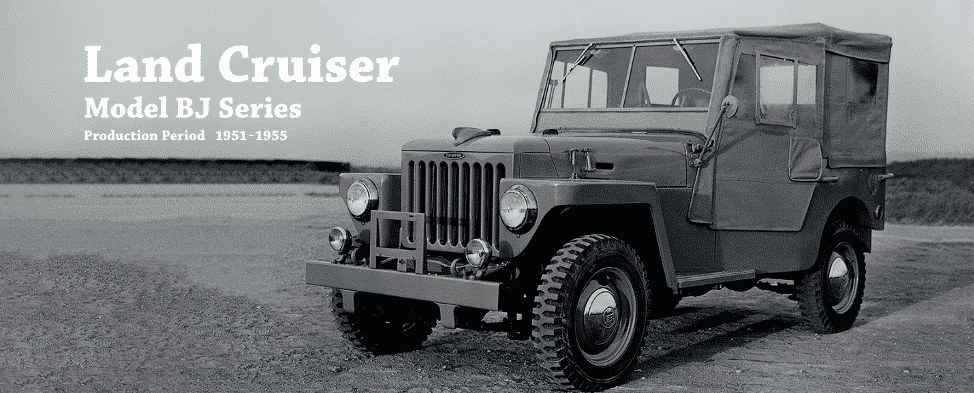
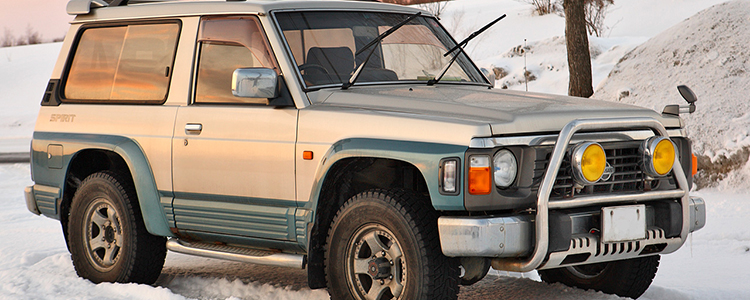
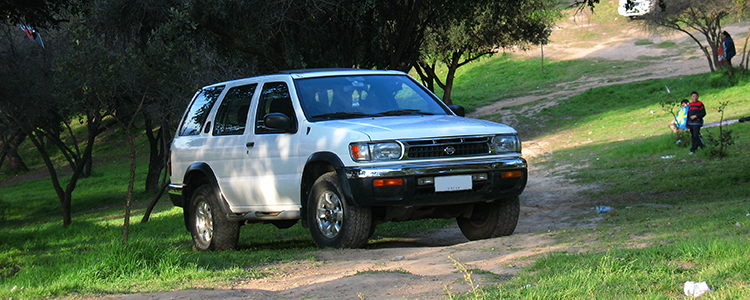
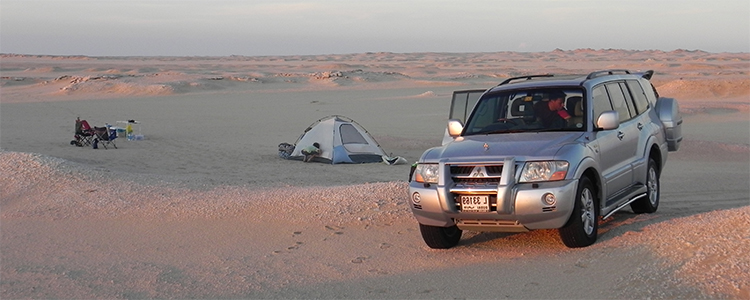
If the Hilux Surf doesn't end up being the right truck, the natural alternatives are the Toyota Land Cruiser Prado for more refinement, the Nissan Safari if you want something bigger, or the Mitsubishi Pajero if you want a different ride feel. The US market Toyota 4Runner is the same vehicle with petrol only and left hand drive, which is the easier path if you don't need the diesel.
Same body-on-frame durability with more luxury and refinement; better daily driver
Bigger brother to the Hilux Surf; more capable, more expensive to import
Larger SUV alternative with similar diesel options and JDM RHD
Direct Nissan competitor to the Hilux Surf in the JDM market
JDM 4×4 SUV with diesel options; different ride character (semi-monocoque later gens)
Compare
Among the JDM mid size pickups and pickup-based SUVs, the Hilux is the most durable, the Nissan Navara has the more modern diesel, and the Mitsubishi Triton is the cheapest to buy. The table below leans toward the Hilux's strengths because that's where it actually wins, on long term reliability and parts crossover with the US market 4Runner and Tacoma.
| Feature | Toyota Hilux | Nissan Navara/Frontier | Mitsubishi Triton/L200 |
|---|---|---|---|
| Body style | Pickup (Hilux) + SUV (Surf) | Pickup (4-door) | Pickup (4-door) |
| JDM diesel availability | 1KZ-TE, 1KD-FTV, 2KD-FTV | TD27, ZD30, YD25DDTi | 4D56, 4N15 |
| Reliability reputation | Exceptional (Top Gear durability tests) | Good — ZD30 has issues | Good — 4D56 timing belt critical |
| Off-road hardware | Body-on-frame, solid rear axle, low-range | Body-on-frame, solid rear axle, low-range | Body-on-frame, solid rear axle, low-range |
| Parts availability (US) | Strong via 4Runner/Tacoma crossover | Moderate via Frontier crossover | Limited — most parts JDM-only |
| Import popularity | Very high (most-imported pickup) | Moderate | Low |
| Typical price (good condition) | $8,000–$25,000 | $6,000–$18,000 | $5,000–$15,000 |
| Ford Ranger comparison (export) | Smaller, more compact than current Ranger T6 | — | Hilux is the global benchmark T6 targets |
Gallery
Editorial
A documented N80 Hilux Surf with the 1KZ-TE diesel and a manual gearbox is the safest starting point. That combination — JDM RHD, factory diesel — is what separates an import from a used 4Runner already at a US dealer. Skip anything under $8,000; at that price you are usually buying a frame rust problem or a diesel that's been run hard without scheduled maintenance.
Verify the frame before anything else. Rear leaf perches, rear crossmember, fuel-tank straps, and front frame horns are the failure points on N80–N100 cars. A rotted rear leaf perch is structural and will fail an inspection in most states; get underneath with a flashlight and magnet, not just a walk-around.
On any 1KZ-TE diesel, white smoke at cold start that clears when the engine warms up is the head-gasket symptom. A cooling-system pressure test confirms it. Budget $2,000–$4,500 for that repair if the seller hasn't done it; cleaning the EGR cooler is sensible at the same service interval.
The N50 fourth-gen without service records is the one to pass on. At this age, 40 years of unknown maintenance and frame rust risk make it a project rather than a driveable truck. Clean N50s with receipts and sorted frame work exist, but they mostly stay in Japan — importing one tends to cost more than buying a documented N80 Surf already in-country.
The N150 KZN185W diesel Surf is now reaching 25-year eligibility in the US. Slightly more refined than the N80 with improved sound insulation and updated interior, and the same 1KZ-TE drivetrain; that's where the next wave of clean imports will come from.
FAQ
Citations
Sources last verified:
New site! Spotted a bug? We're listening.