Mitsubishi Delica L400
Cult 4WD MPV; great camper base; similar import pricing
Buyer's guide
15 min read
Buyer's guide & specs
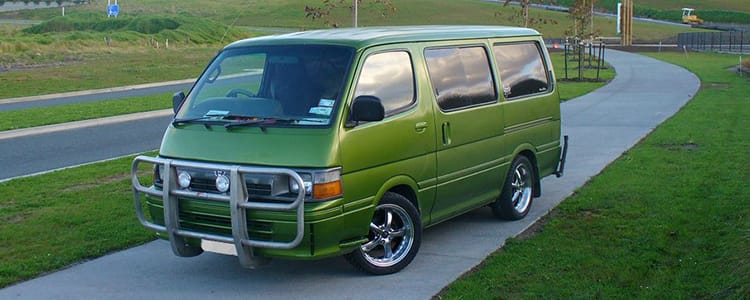
Background
The Toyota HiAce has been in continuous production since October 1967 — six generations across nearly six decades. The H10 launched as a delivery and passenger van; the H20/H30/H40 ran 1977–1982; the H50/H60/H70/H80/H90 added ambulances, minibuses, and camper variants; the H100 (1989–2004) became the global workhorse sold across Japan, China, the UK, Europe, Sri Lanka, South Africa, and the Philippines; the H200 has run since 2004 in Japan and was sold in the Philippines through 2026; the H300 replaced the H200 in most export markets starting 2026. The HiAce was never sold new in the United States — JDM imports under the 25-year rule are the only path for U.S. buyers. The cab-over packaging that runs ambulances and fish-market shuttles across Asia and Oceania makes it a capable vanlife and overland platform: narrow enough for city parking, simple enough to repair anywhere, and durable enough to clear 350,000 miles with consistent maintenance.
The 3.0L 1KZ-TE turbo diesel powered H100 exports from the early 1990s and is the engine U.S. import buyers specifically target. It has a documented track record of 300,000+ miles on stock injection hardware when cooling maintenance is current. A failed thermostat, a slow radiator leak, or a skipped coolant flush warps the head, and the head gasket plus machining bill on a 1KZ-TE can equal the purchase cost of the van.
The 3.0L 1KD-FTV replaced the 1KZ-TE in the H200, and the 2.8L 1GD-FTV joined the JDM lineup from roughly 2017. Both are common-rail D-4D units with higher output and considerably more electronics than the 1KZ-TE. They tolerate neglect less gracefully — fuel quality and EGR soot buildup become meaningful cost drivers at higher mileage.
The 2.4L 2L-TE shows up in earlier export markets and is the engine most prone to turbo failure from clogged air filters and oil starvation. White-smoke exhaust on a cold start typically means the turbo bearings are at end of life — a condition common in vehicles that spent decades in hard commercial use before entering the export pipeline.
The HiAce H100 Super Custom 4WD with the 1KZ-TE is the JDM van that vanlife and overland buyers in the U.S., U.K., Australia, and New Zealand consistently target. No other mass-produced van from that era combines a cab-over footprint, factory 4WD, a reliable diesel, and global parts support in a single package. The Mitsubishi Delica L400 has AWD and cult status, but it is narrower and carries less cargo; the Mazda Bongo Friendee has a pop-top but smaller payload; the Volkswagen T4 Syncro has a similar layout but parts and reliability vary by market.
JDM 4WD diesels regularly exceed $45,000 in the U.S. market when documented and rust-free. The 1999 H100s cleared the federal 25-year rule in 2024; 2000-model-year vans cleared in 2025, and the wave continues annually.
Rust-free, original-paint 4WD diesel inventory in Japan is finite. Import volume is rising as more H100s clear eligibility, but the supply of genuinely clean examples is not rising at the same rate — prices reflect that gap.
Editorial notes
Quick read
Constants
Chassis history
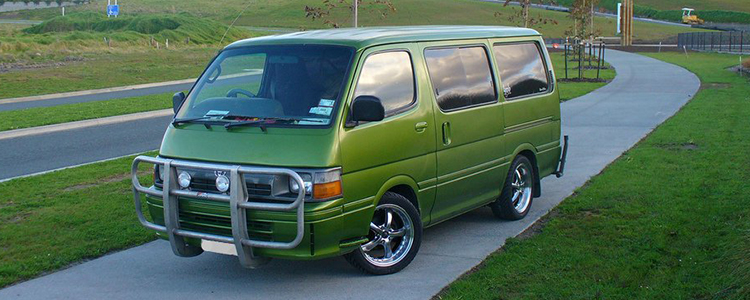
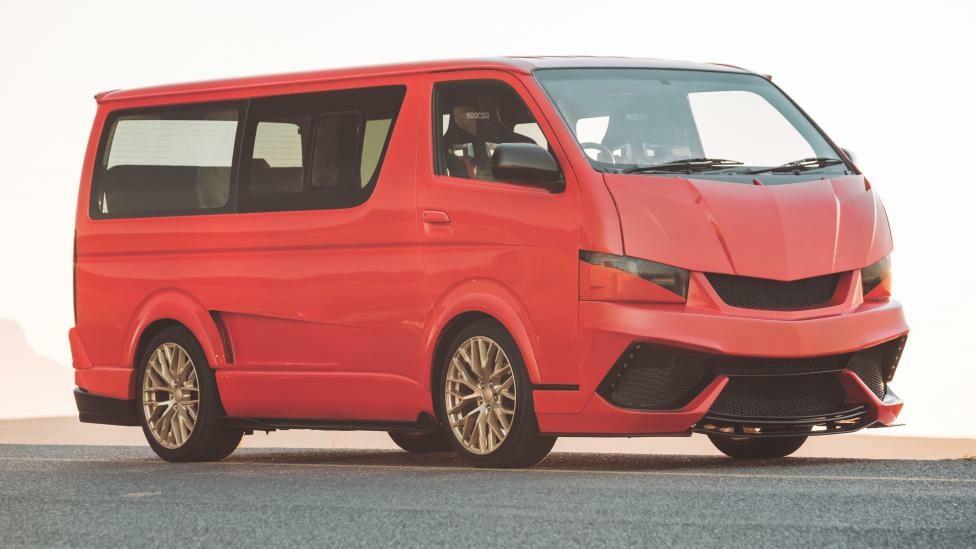
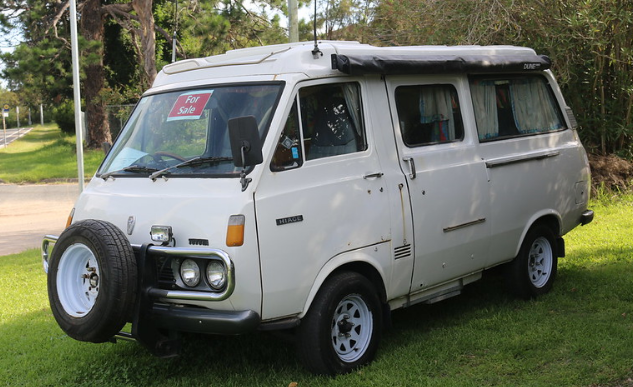
The HiAce has been in production since October 1967, longer than anything else Toyota builds. Six generations have moved roughly the same brief across nearly six decades. The H10 and H20 are mostly collector territory now, the H50 started the camper scene, the H100 is the icon, the H200 is the current JDM van, and the H300 is what Australia buys new today.
Buyer's call
The HiAce is a working van first and a lifestyle van second. What you give up in styling and ride quality you get back in load space, parts support, and the kind of mechanical simplicity that lets a HiAce keep working at 350,000 miles. The good and bad have stayed pretty consistent across every generation.
Reliability
The HiAce is bulletproof when you look after it. The trouble shows up when you don't. On diesel HiAce vans the turbo is the part that punishes neglect, the cooling system is the part that punishes neglect on the 1KZ-TE, and the body paint is just thin enough that rust gets a head start before you notice. None of these are deal breakers if the paperwork shows the work was done.
| Issue | Cause | Solution | Est. cost |
|---|---|---|---|
| Severe chassis rust | Salt use + poor undercoating + age | Walk away if perforated; proper cut/weld repairs | $2000-12000 |
| Step well rust-through | Trapped moisture under mats and seam sealer | Cut out, weld panels, treat cavities, reseal | $800-3000 |
| Sliding door roller wear | Dry track, rust, heavy use in commercial duty | Replace rollers, clean/grease track, align door | $250-1200 |
| Sliding door track rust | Water ingress + neglected cleaning | Derust/paint; replace track if pitted through | $300-2500 |
| Rear door hinge sag | Overloaded doors + worn hinges + rusted mounts | Replace hinges, repair metal, adjust latches | $300-1800 |
| Windshield frame leaks | Rust under seal and poor glass installs | Remove glass, repair rust, reseal properly | $600-2500 |
| Cooling system overheat | Old radiator, stuck thermostat, airlocks | Radiator/thermostat/cap; bleed; hoses | $400-1400 |
| Head gasket failure | Overheating + warped head (common on diesels) | Machine head, gasket set, bolts, cooling refresh | $1800-4500 |
| Cracked cylinder head | Repeated overheating or low coolant episodes | Replace head; pressure test; fix root cooling issue | $2500-6500 |
| Diesel injector wear | High km + poor fuel + overdue filter changes | Pop-test/replace injectors; set balance/timing | $800-2500 |
| Diesel pump leaks | Aged seals on mechanical injection pumps | Reseal/rebuild pump; replace fuel lines | $900-2500 |
| Hard cold starts (diesel) | Glow plugs/relay/timer faults or weak compression | Test glow circuit; replace plugs; compression test | $200-1800 |
| Turbo oil smoke | Worn turbo seals or restricted oil drain | Rebuild/replace turbo; clean drain; check PCV | $900-3000 |
| EGR/intake soot clog | Diesel EGR + short trips + low-quality oil | Remove/clean intake/EGR; address driving pattern | $300-1200 |
| Timing belt overdue | Unknown history on import/commercial vans | Do belt, tensioner, idlers, water pump ASAP | $700-1800 |
| Manual synchro wear | Commercial use + poor clutch habits + old oil | Fluid change may help; rebuild gearbox if grinding | $120-2500 |
| Clutch slip/shudder | Overloading + oil contamination + worn DMF (some) | Replace clutch kit; resurface flywheel; fix leaks | $700-2200 |
| Auto trans shift flare | Old ATF, worn solenoids, valve body wear | Service ATF; solenoids/valve body; rebuild if bad | $250-4500 |
| Driveshaft U-joint clunk | Neglected greasing + high load cycles | Replace U-joints/shaft; grease regularly | $250-1200 |
| Diff whine/leaks | Low oil from pinion/axle seals; heavy loads | Replace seals; refill; rebuild diff if noisy | $250-2500 |
| Front ball joint failure | Boot tears + water ingress + age | Replace joints ASAP; align; inspect control arms | $350-1200 |
| Steering wander | Worn idler/pitman/tie rods; alignment off | Replace worn links; alignment; check steering box | $300-1500 |
| Wheel bearing failure | Overloading + water ingress + old grease | Replace bearings/seals; inspect hubs/spindles | $300-1200 |
| Seized brake calipers | Corrosion on slide pins; infrequent fluid changes | Rebuild/replace calipers; new pads/rotors; flush | $400-1600 |
| Rusty brake lines | Salt exposure; line clips trap moisture | Replace hard lines; inspect flex hoses; bleed | $500-2500 |
| A/C weak or dead | Leaks at condenser/lines; worn compressor | Leak test, replace parts, evac/recharge | $300-1800 |
| Blower resistor failure | Heat stress; debris in blower | Replace resistor; clean blower and cabin intake | $80-350 |
| Cabin water intrusion | Door seals, roof gutters, rear windows, seams | Trace leaks; reseal; repair rust; replace seals | $200-3000 |
| Engine mount collapse | Age + diesel vibration + oil saturation | Replace mounts; check exhaust flex and brackets | $250-900 |
| Exhaust manifold crack | Heat cycling + missing studs + warped flange | Replace manifold; new studs/gaskets; check mounts | $400-1600 |
| Fuel filler neck rot | Road salt + trapped mud behind liner | Replace neck/hoses; clean area; undercoat | $250-900 |
| Electrical ground issues | Corrosion at chassis grounds; battery acid | Clean/replace grounds; dielectric grease; test drop | $50-400 |
| Odometer rollback risk | Import cluster swaps and weak documentation | Verify auction sheet/service stickers; inspect wear | $0-300 |
Market
The HiAce was never officially sold in the United States — no LHD U.S.-spec version exists, and the chicken tax (a 25% tariff on imported light trucks dating to 1964) made commercial van imports uneconomical for Toyota. The U.K. and Australia did receive factory HiAce sales: the U.K. sold the H100 and H200 as the 'HiAce' through Toyota GB, and Australia has imported the HiAce continuously through the H300, where it's still sold new today. For U.S. buyers, the only legal path is the federal 25-year import rule (NHTSA's FMVSS exemption for vehicles 25+ years old): H100 vans built in 1999 became U.S.-legal in 2024, 2000-model-year vans in 2025, and 2001 in 2026. The H200 (2004 onward) won't begin clearing eligibility until 2029. JDM-spec HiAce vans differ from export-market HiAce sales in three significant ways: engine availability (the 1KZ-TE 3.0L turbo diesel and 5L NA diesel were largely export-market engines due to Japanese road tax penalties on engines over 2.0L; JDM domestic units leaned on the 2.0L 1RZ-E and 2.7L 3RZ-FE petrols), trim hierarchy (JDM-only Super Custom, Super Custom Limited, Touring HiAce, Regius Ace, and Grand HiAce trims have no direct export equivalent), and 4WD availability (4WD was offered in JDM but not all export markets). The Granvia and Grand HiAce share H100 mechanicals but use wider wagon bodies aimed at the luxury MPV segment.
Specs
Every JDM HiAce is rear-wheel drive or part-time 4WD, with a four-cylinder engine sitting under or beside the driver. Petrol options ran from the early 2R and 12R through the modern 2TR-FE. The diesels are what the overland scene cares about, and that means the 2L-TE, the 1KZ-TE, and the common-rail 1KD-FTV and 1GD-FTV that came later.
| Chassis | Engine | Displacement | Power | Boost | Notes |
|---|---|---|---|---|---|
| H10 | 2R | 1.5L | estimated | N/A | Early carb I4; exact ratings vary by market |
| H10 | 12R | 1.6L | estimated | N/A | Carb I4; exact ratings vary by year/market |
| H10 | 3R | 1.9L | estimated | N/A | Carb I4; exact ratings vary by year/market |
| H20/H30/H40 | 13R | 1.8L | estimated | N/A | Carb I4; market-dependent DIN/JIS ratings |
| H20/H30/H40 | 18R | 2.0L | estimated | N/A | Carb I4; multiple tunes across years |
| H20/H30/H40 | 20R | 2.2L | estimated | N/A | Carb I4; some markets only |
| H50/H60/H70 | 1RZ-E | 2.0L | estimated | N/A | EFI I4; ratings vary by market and year |
| H50/H60/H70 | 2RZ-E | 2.4L | estimated | N/A | EFI I4; multiple calibrations |
| H50/H60/H70 | 3L | 2.8L | estimated | N/A | NA diesel; output varies by emissions spec |
| H50/H60/H70 | 1KZ-TE | 3.0L | estimated | Turbo | Turbo diesel; intercooler varies by model |
| H100 | 1RZ-E | 2.0L | estimated | N/A | EFI I4; market-dependent ratings |
| H100 | 2RZ-E | 2.4L | estimated | N/A | EFI I4; market-dependent ratings |
| H100 | 3RZ-FE | 2.7L | estimated | N/A | DOHC EFI I4; multiple tunes |
| H100 | 3L | 2.8L | estimated | N/A | NA diesel; commercial duty cycle |
| H100 | 5L | 3.0L | estimated | N/A | NA diesel; output varies by market |
| H100 | 1KZ-TE | 3.0L | estimated | Turbo | Turbo diesel; some models intercooled |
| H100 (Granvia/Grand HiAce) | 5VZ-FE | 3.4L | estimated | N/A | V6 petrol; wagon-only related platform |
| H200 | 1TR-FE | 2.0L | estimated | N/A | DOHC VVT-i I4; output varies by market |
| H200 | 2TR-FE | 2.7L | estimated | N/A | DOHC VVT-i I4; output varies by market |
| H200 | 2KD-FTV | 2.5L | estimated | Turbo | D-4D turbo diesel; tune varies by emissions |
| H200 | 1KD-FTV | 3.0L | estimated | Turbo | D-4D turbo diesel; market-dependent tune |
| H200/H300 | 1GD-FTV | 2.8L | estimated | Turbo | GD D-4D; outputs vary widely by market/year |
| Type | Ratios | Availability | Notes |
|---|---|---|---|
| 4-speed Manual | estimated | H10/H20 early commercial | Market/year dependent; multiple gearsets |
| 5-speed Manual | estimated | H50/H60/H70/H100/H200 | Multiple Toyota 5MT families used |
| 6-speed Manual | estimated | H200/H300 (market-dependent) | Typically paired with 1GD in some markets |
| 4-speed Automatic | estimated | H100/H200 (market-dependent) | Aisin 4AT variants; calibration varies |
| 5-speed Automatic | estimated | H200 (market-dependent) | Aisin 5AT variants; engine dependent |
| 6-speed Automatic | estimated | H300 (market-dependent) | Aisin 6AT variants; region-specific |
Lineup
JDM HiAce trims include the Super Custom, Super Custom Limited, Touring HiAce, Regius Ace, Grand HiAce, and the wide-body Granvia. Export markets mostly got the simpler DX and GL grades. The wagon-bodied Regius Ace, Grand HiAce, and Granvia share H100 mechanicals but use wider bodies aimed at the luxury MPV segment, so they drive softer and seat more.
| Generation | Trim | Engine | Key features |
|---|---|---|---|
| H10 (1st gen) | Standard Van | 1.5L 2R / 1.6L 12R / 1.9L 3R | Panel van, bench seats, steel wheels |
| H10 (1st gen) | Wagon/Commuter | 1.6L 12R / 1.9L 3R | Side windows, multi-row seating, heater |
| H10 (1st gen) | Pickup (HiAce Truck) | 1.5L 2R / 1.6L 12R / 1.9L 3R | Separate bed, leaf rear, work-grade interior |
| H20/H30/H40 (2nd gen) | Van (Standard/Super) | 1.6L 12R / 1.8L 13R / 2.0L 18R / 2.2L 20R | Panel/GL, improved cabin, optional A/C |
| H20/H30/H40 (2nd gen) | Wagon/Commuter | 1.8L 13R / 2.0L 18R / 2.2L 20R | High-roof option, multi-row, interior trim |
| H20/H30/H40 (2nd gen) | HiAce Truck | 1.6L 12R / 1.8L 13R / 2.0L 18R | Pickup bed, leaf rear, heavy-duty payload |
| H50/H60/H70 (3rd gen) | DX Van | 2.0L 1RZ-E / 2.4L 2RZ-E / 2.8L 3L (diesel) | Work trim, vinyl, steel wheels, basic HVAC |
| H50/H60/H70 (3rd gen) | GL Van | 2.0L 1RZ-E / 2.4L 2RZ-E / 2.8L 3L | Upgraded trim, A/C option, better seating |
| H50/H60/H70 (3rd gen) | Super Custom (Wagon) | 2.4L 2RZ-E / 3.0L 1KZ-TE | Captain seats, twin A/C, higher trim |
| H50/H60/H70 (3rd gen) | Super Custom Limited | 3.0L 1KZ-TE | Top trim, power options, premium interior |
| H50/H60/H70 (3rd gen) | Commuter | 2.8L 3L / 3.0L 1KZ-TE | High roof, high capacity seating, rear HVAC |
| H50/H60/H70 (3rd gen) | HiAce Truck | 2.0L 1RZ-E / 2.4L 2RZ-E / 2.8L 3L | Pickup bed, leaf rear, commercial spec |
| H100 (4th gen) | DX Van | 2.0L 1RZ-E / 2.4L 2RZ-E / 2.8L 3L / 3.0L 5L | Commercial trim, vinyl, steel wheels |
| H100 (4th gen) | GL Van | 2.0L 1RZ-E / 2.4L 2RZ-E / 3.0L 5L | Better trim, A/C option, cloth seats |
| H100 (4th gen) | Super Custom | 2.7L 3RZ-FE / 3.0L 1KZ-TE | Wagon, twin A/C, power options |
| H100 (4th gen) | Super Custom Limited | 3.0L 1KZ-TE | Top wagon, premium interior, power features |
| H100 (4th gen) | Grand HiAce / Granvia (related) | 3.4L 5VZ-FE / 3.0L 1KZ-TE | Wide-body wagon, luxury seating, twin A/C |
| H100 (4th gen) | Commuter | 2.8L 3L / 3.0L 5L / 3.0L 1KZ-TE | High roof, high capacity, rear HVAC |
| H200 (5th gen) | DX | 2.0L 1TR-FE / 2.7L 2TR-FE / 2.5L 2KD-FTV | Commercial, vinyl, steel wheels, basic audio |
| H200 (5th gen) | GL | 2.0L 1TR-FE / 2.7L 2TR-FE / 2.5L 2KD-FTV | Uptrim, body-color parts, better seats |
| H200 (5th gen) | Super GL | 2.0L 1TR-FE / 2.7L 2TR-FE / 2.8L 1GD-FTV | Keyless, upgraded interior, privacy glass |
| H200 (5th gen) | Super GL Dark Prime | 2.8L 1GD-FTV | Dark trim, LED lamps, upgraded seats |
| H200 (5th gen) | Super GL Dark Prime II | 2.8L 1GD-FTV | Further dark trim, safety tech, interior upgrades |
| H200 (5th gen) | Super GL Dark Prime S | 2.8L 1GD-FTV | Special edition, appearance pack, premium trim |
| H200 (5th gen) | Commuter DX | 2.7L 2TR-FE / 3.0L 1KD-FTV / 2.8L 1GD-FTV | High roof, high capacity seating, rear A/C |
| H200 (5th gen) | Commuter GL | 2.7L 2TR-FE / 3.0L 1KD-FTV / 2.8L 1GD-FTV | Uptrim commuter, better seats, rear HVAC |
| H200 (5th gen) | Commuter Super GL (market-dependent) | 2.8L 1GD-FTV | Top commuter, privacy glass, upgraded trim |
| H300 (6th gen) | LWB Panel Van | 2.8L 1GD-FTV | TNGA-F, TSS, cargo focus, sliding doors |
| H300 (6th gen) | LWB Crew Van | 2.8L 1GD-FTV | Second-row seating, cargo area, TSS |
| H300 (6th gen) | Commuter/Bus | 2.8L 1GD-FTV | High capacity seating, rear A/C, safety tech |
Pricing
A 2006 H200 base model starts around $9,000 in Japan, which makes the HiAce cheaper than a Ford Transit of the same age. Clean H100 4WD diesels with the 1KZ-TE are a different conversation and regularly clear $45,000 on the U.S. market. The numbers below are what a HiAce costs today, not what it cost new.
Today's market range: $7,000 to $65,000 (median ~$24,000). Source: JDMBUYSELL / USS Auction.
Demand remains strong for rust-free H100s, especially **4WD diesels** and clean campers. Prices cooled from peak frenzy but stabilized; best examples still set records. As more late-90s/early-00s vans hit 25-year eligibility, supply rises, supporting steady—not explosive—growth.
Inspect
Walk this list with the seller, not in front of them. The Critical items mean walking away if there's no paperwork backing them up. The High items can usually be priced into the deal. Spend ten minutes at idle and 30 minutes driving the HiAce and you'll catch most of what matters.
Cross-shop
If the HiAce isn't the right van, the obvious alternatives are the Mitsubishi Delica if you want narrower with factory AWD, the Nissan Caravan if you want the closest direct rival, or the Mazda Bongo if you want smaller. None of them have the parts support or the global reputation the HiAce has, but each one wins on a specific axis.
Cult 4WD MPV; great camper base; similar import pricing
Often cheaper; similar cab-over utility; simpler trims
Smaller, cheaper Toyota van; easier city use; some 4WD
Popular camper with pop-top; compact; strong community support
More MPV comfort than base HiAce; often better interiors
Compare
Among the JDM cab-over vans, the HiAce is the most reliable and the easiest to get parts for. The Nissan Caravan runs it close on most measures but trails on resale and aftermarket support. The Mazda Bongo is smaller and less robust, and the Mitsubishi Delica L400 is narrower with cult AWD status but harder to find clean.
| Feature | Toyota HiAce | Nissan Caravan E24 | Mitsubishi Delica L400 |
|---|---|---|---|
| Core layout | Cab-over, RWD/4WD | Cab-over, RWD/4WD | Cab-over, RWD/4WD |
| Typical JDM engines | 1KZ-TE, 2KD, 3RZ | TD27, QD32, KA24 | 4M40 2.8TD, 6G72 V6 |
| 4WD desirability | High; overland premium | Medium; fewer cult buyers | Very high; cult status |
| Reliability reputation | Excellent overall | Good; varies by engine | Good; more complex |
| Rust vulnerability | High on older gens | High on older gens | High; watch seams/floors |
| Parts availability (US) | Good via import network | Fair; smaller ecosystem | Good; strong Delica scene |
| Highway comfort | Fair to good (gen/trim) | Fair; older feel | Good; MPV-like trims |
| Interior/camper space | Excellent; many configs | Very good; boxy cargo | Very good; tall roof options |
| Typical US import pricing | $12k-$45k (H100) | $8k-$25k (E24) | $15k-$45k (L400) |
| Fuel economy (diesel) | Mid-20s mpg possible | Low- to mid-20s mpg | Low-20s mpg typical |
| Driving position | Upright; bus-like | Upright; utilitarian | More MPV-like in trims |
| Best buyer use-case | Work + camper + overland | Budget cargo/people mover | Adventure MPV/camper |
| Auto transmission feel | Durable; can be sluggish | Varies; age-related wear | Smooth; more complexity |
Gallery
Editorial
The safest H100 to buy is a documented Super Custom from the late 1990s with the 1KZ-TE 3.0L turbo diesel and a confirmed cooling system service record. That combination gives you the engine the overland market built its reputation on, parts support through the global Toyota network, and a body style with an established conversion community. Anything under $15,000 without receipts warrants scrutiny — a low price on a HiAce typically reflects a tired turbo, a compromised cooling system, or rust that has been painted rather than repaired.
On any 1KZ-TE, baseline the radiator, thermostat, hoses, water pump, and cap on day one. A $700 service prevents a $3,500 head job. The cooling system is the failure mode that converts a 300,000-mile-capable engine into a write-off.
Rust survey priority: step wells, rear arches, floor seams, and anywhere seam sealer has been disturbed. A HiAce from a coastal Japanese prefecture is rarely as clean as one from inland. Auction sheets and pre-export inspection reports are the most reliable way to confirm history for vehicles with no paper trail.
Avoid converted campers without documentation showing who did the work and when. DIY wiring, overweight builds, and poorly sealed roof penetrations are common problems that do not appear in listing photos. A factory panel van you convert yourself ends up cheaper and more predictable than an unknown conversion someone else walked away from.
If your budget reaches the H200, note that U.S. import eligibility does not open until 2029 — the 1KD-FTV and 1GD-FTV diesels are capable and well-supported, but confirm your country's import age rule before committing to that generation.
FAQ
Citations
Sources last verified:
New site! Spotted a bug? We're listening.