Acura Integra GS-R
Lighter, B18C VTEC; huge support; often pricier
Buyer's guide
15 min read
Buyer's guide & specs
Background
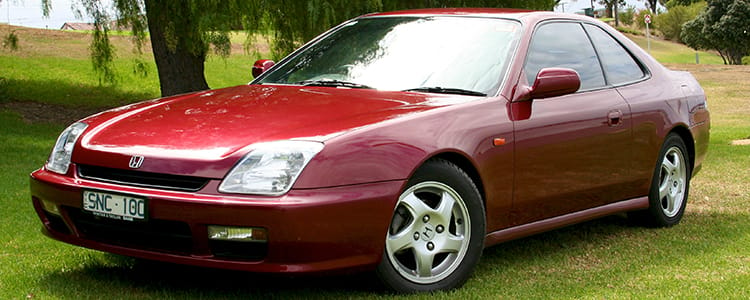
The Honda Prelude ran five generations from 1978 to 2001, producing approximately 826,082 units before Honda discontinued it against declining global coupe demand. Most buyers now target the fifth-generation BB5/BB6 cars — H22A VTEC, ATTS on Type SH and JDM SiR-S, and the trim that leads current pricing. The 1987 BA4 introduced the world's first passenger-car four-wheel steering system; the fourth-generation cars brought it under electronic control and added the H22A1 VTEC. A sixth-generation hybrid revival was announced in 2023 and confirmed for 2025-2026 production.
Honda's mechanical four-wheel steering, introduced as an option on the 1987 BA4 Prelude, was the first passenger-car 4WS system on the global market. The setup ran a shaft from the front steering rack to a planetary-gear box at the rear axle. At small steering inputs past roughly 130 degrees of steering wheel rotation, the rear wheels turned opposite the front, shortening the turning circle; at smaller inputs they turned in phase, improving high-speed lane changes.
The 4WS-equipped Prelude became the first 4WS car sold in the United States in 1988. The fourth-generation BB1-BB4 cars (1992-1996) replaced the mechanical linkage with a computer-controlled electric motor at the rear axle.
Both systems remain functional on surviving cars, but parts support is thin — the mechanical rear box is now a specialist rebuild item. A working 4WS car carries a desirable-curiosity premium; a non-working unit can be locked centered if rebuild parts are unavailable.
The fifth-generation Prelude launched in late 1996 with the H22A engine in both JDM and U.S. specifications, but the two cars are not mechanically identical. The JDM SiR and SiR-S used the higher-compression H22A 'red-top' rated at 220 PS at 7200 rpm with a 7500 rpm redline; the U.S. Type SH used a USDM-specific H22A4 rated at 195 hp at 7000 rpm.
Active Torque Transfer System (ATTS) — a hydraulic torque-vectoring front differential biasing torque to the outside wheel through a corner — appeared on the JDM SiR-S and the U.S. Type SH only. Other JDM-only equipment on SiR-S included optional Alcantara interior, embroidered seat lettering, and active ABS.
A clean JDM SiR-S with documented ATTS function commands the highest prices in the Prelude market today. Rebuilt or non-functioning ATTS units carry several thousand dollars of deferred maintenance, and parts crossover with the Type SH is incomplete because of the engine and ECU differences.
Editorial notes
Quick read
Constants
Chassis history
The Prelude ran across five generations from 1978 until 2001, and a sixth one is coming back as a hybrid in 2025-2026. The SN started as a quiet 2+2 with pop-up headlights. The BA cars in the late 80s added the world-first 4WS in 1987. The BB1 generation brought the H22A VTEC in. The BB6 cars from 1996 to 2001 are the ones everyone wants today, and the new 2024 Prelude concept is Honda's way of saying the name still matters.
Fourth generation — BB1–BB4 (H22A; 1991–1996)
Buyer's call
The Prelude is a car you buy for the chassis and the engine, not for the practicality. The good stuff is real. The H22A revs cleanly to redline, the steering is sharp, and the BB6 cars feel special in a way most front-drive coupes don't. The trade-offs are also real. Rust is everywhere on older Preludes, the automatics are weak, and trim parts are getting hard to find.
Reliability
The Prelude is reliable when it's been looked after, and a money pit when it hasn't. Most of the trouble on a 25 year old Prelude isn't the H22A engine itself. It's the timing belt that nobody changed, the valve cover gasket leaking onto the exhaust, and the automatic transmission that was already weak when the car was new. The Type SH cars add the ATTS system, which is great when it works and expensive when it doesn't.
| Issue | Cause | Solution | Est. cost |
|---|---|---|---|
| Auto trans failure (4th/5th gen) | Heat, poor maintenance, worn clutch packs | Rebuild/replace; add cooler; use Honda ATF | $2500-4500 |
| Manual 2nd gear grind | Synchro wear from hard shifts/old MTF | Rebuild trans; use Honda MTF; avoid power shifts | $1800-3200 |
| ATTS warning / no torque vector | Low fluid, bad pressure switch, pump wear | Service ATTS fluid; diag switches; rebuild unit | $400-3500 |
| ATTS binding in tight turns | Wrong fluid or contaminated ATTS system | Multiple ATTS flushes; inspect clutch packs | $250-1200 |
| Oil consumption | Worn rings, valve seals, high-RPM use | Leakdown test; rebuild top/bottom as needed | $800-4500 |
| VTEC solenoid gasket leak | Aged gasket and screen clogging | Replace gasket/screen; clean mating surface | $80-250 |
| Distributor failure (older gens) | Internal bearing/igniter/coil heat failure | Replace distributor or rebuild with OEM parts | $250-650 |
| Ignition switch wear | High key weight; worn contacts | Replace ignition switch; inspect cylinder | $150-450 |
| Idle surge / hunting | IACV dirty, vacuum leaks, FITV issues | Clean IACV; fix leaks; service FITV if equipped | $80-400 |
| EGR clog / EGR code | Carboned EGR ports in intake manifold | Clean EGR ports; replace EGR valve if needed | $150-600 |
| P0420 catalyst efficiency | Aged cat, exhaust leaks, tired O2 sensors | Fix leaks; replace O2; replace cat if needed | $250-1800 |
| Head gasket failure after overheat | Neglected cooling system; warped head | Pressure test; machine head; gasket set | $1200-2800 |
| Cracked radiator end tanks | Aged plastic tanks; heat cycling | Replace radiator and cap; bleed system | $250-600 |
| Heater core leak | Corrosion; old coolant; electrolysis | Replace heater core; flush system | $700-1400 |
| Power steering rack leak | Worn seals; torn boots; contaminated fluid | Replace/reseal rack; flush; new hoses as needed | $900-1800 |
| PS pump whine/leak | Worn pump, bad o-rings, aerated fluid | Replace pump seals/o-rings; flush; replace pump | $120-650 |
| Front compliance bushing tear | Age, aggressive driving, lowered suspension | Replace bushings/arms; align; avoid cheap parts | $400-1200 |
| Ball joint failure risk | Boot tears; lack of grease; age | Replace ball joints/control arms; align | $350-900 |
| Seized brake calipers | Corrosion, torn boots, old brake fluid | Rebuild/replace calipers; flush fluid | $300-900 |
| Warped rotors / brake shimmy | Pad deposits, stuck caliper, cheap rotors | Fix caliper; quality rotors/pads; bed properly | $250-700 |
| ABS light (sensor/wiring) | Broken sensor wire, rusted tone ring, hub play | Repair wiring; replace sensor/hub as needed | $150-650 |
| Wheel bearing noise | Age, impacts, low-quality hubs | Replace hub/bearing; torque axle nut correctly | $250-650 |
| CV axle vibration | Worn inner joint; cheap reman axles | Use quality axle; check mounts and alignment | $250-700 |
| Engine mount collapse | Age, oil saturation, hard launches | Replace mounts; avoid solid mounts for street | $300-900 |
| Sunroof leaks | Clogged drains; hardened seals | Clear drains; reseal; repair rusted channels | $50-600 |
| Trunk water intrusion | Tail light seals, antenna grommet, seam sealer | Reseal lamps/seams; treat rust in spare well | $80-500 |
| Rust at rockers/quarters | Trapped debris, salted roads, poor repairs | Cut/weld metal; proper rustproofing; repaint | $800-5000 |
| Window regulator failure | Worn cables/sliders; dry tracks | Replace regulator; lube tracks; check switches | $200-500 |
| Blower resistor failure | Heat stress; clogged cabin intake | Replace resistor; check blower motor draw | $80-250 |
| A/C weak or inop | Leaks, bad compressor clutch, low charge | Leak test; replace O-rings; compressor if needed | $200-1400 |
| Fuel pump failure | Age, running low fuel, clogged sock/filter | Replace pump/strainer; check relay and wiring | $250-650 |
| Main relay intermittent no-start | Cracked solder joints from heat cycling | Resolder or replace relay; confirm fuel prime | $40-180 |
| O2 sensor aging | High miles; exhaust leaks; contamination | Replace upstream/downstream sensors as needed | $150-450 |
| Timing belt overdue risk | Neglect; unknown history; age cracking | Do belt, tensioner, water pump, seals ASAP | $700-1400 |
Market
JDM and USDM Preludes diverged most sharply in the fifth generation. The JDM SiR and SiR-S used a higher-compression H22A 'red-top' factory-rated at 220 PS at 7200 rpm with a 7500 rpm redline. The U.S. Type SH used a USDM-specific H22A4 rated at 195 hp at 7000 rpm — same architecture, different cams, ECU, intake manifold, and emissions calibration. The Type S name was used in Europe (H22A5, also reduced output relative to JDM red-top) and is distinct from the JDM SiR/SiR-S nomenclature. Active Torque Transfer System (ATTS) appeared on the JDM SiR-S and the U.S. Type SH only; base JDM SiR and other markets did not receive it. JDM Type S/SiR cars also received options not sold in North America — Alcantara interior trim, embroidered seat lettering, and active ABS on top trims. Pre-1996 generations have fewer JDM-vs-USDM mechanical differences but JDM Si-spec second and third-generation cars often shipped with higher-output B20A engines than U.S. equivalents.
Specs
Every Prelude is front-wheel drive with a Honda four-cylinder. The early cars use small SOHC engines around 1.6 to 1.8 liters. The third and fourth generation Preludes get the B20A and then the H23A1, both 2.0 to 2.3 liter DOHC engines. The fifth generation Prelude is where it gets interesting. The H22A red-top makes 220 PS in JDM form and 195 hp as the USDM H22A4. The five-speed manual is the one to have. The automatic Preludes are cheaper for a reason.
| Chassis | Engine | Displacement | Power | Boost | Notes |
|---|---|---|---|---|---|
| SN (1st gen) | EK1 | 1.6L | 80hp @ 5000rpm (estimated) | N/A | Carb SOHC; figures market-dependent |
| AB (2nd gen) | ES1/ES2 | 1.8L | 100hp @ 5500rpm (estimated) | N/A | Carb/PGM-FI varies by market/year |
| AB (2nd gen) | A18A | 1.8L | 105hp @ 5800rpm (estimated) | N/A | PGM-FI SOHC; output varies by market |
| BA4/BA5 (3rd gen) | B20A3 | 2.0L | 104hp @ 5500rpm (estimated) | N/A | DOHC; US S trim typical |
| BA4/BA5 (3rd gen) | B20A5 | 2.0L | 135hp @ 6000rpm (estimated) | N/A | DOHC PGM-FI; common Si spec |
| BA8/BA9 (4th gen) | F22A1 | 2.2L | 135hp @ 5200rpm (estimated) | N/A | SOHC; base/S trim in some markets |
| BA8/BA9 (4th gen) | H23A1 | 2.3L | 160hp @ 5800rpm (estimated) | N/A | DOHC; Si in US/NA markets |
| BA8/BA9 (4th gen) | H22A1 | 2.2L | 190hp @ 6800rpm (estimated) | N/A | DOHC VTEC; VTEC trim typical |
| BB5/BB6/BB7/BB8 (5th gen) | H22A4 | 2.2L | 195hp @ 7000rpm (estimated) | N/A | USDM; Type SH uses same longblock |
| BB5/BB6/BB7/BB8 (5th gen) | H22A5 | 2.2L | 185hp @ 6500rpm (estimated) | N/A | Europe; emissions tune differs |
| BB5/BB6/BB7/BB8 (5th gen) | H22A | 2.2L | 200hp @ 7000rpm (estimated) | N/A | JDM SiR; output varies by year |
| Type | Ratios | Availability | Notes |
|---|---|---|---|
| 5-speed Manual | 3.307/1.809/1.250/0.909/0.702 (estimated) | Most trims, all gens (market-dependent) | Ratios vary by engine/market/year |
| 4-speed Automatic | 2.714/1.500/1.000/0.705 (estimated) | Most trims (market-dependent) | Lock-up TC on later units |
| Tiptronic-style 4AT (SportShift) | 2.714/1.500/1.000/0.705 (estimated) | 5th gen (some markets) | Manual mode; ATTS not on 4AT SH |
Lineup
JDM Preludes and USDM Preludes diverged hard in the fifth generation. The JDM SiR-S got the H22A red-top, optional ATTS, Alcantara, and embroidered seat lettering. The US Type SH got a detuned H22A4 with ATTS and stiffer suspension. The European Type S sat in the middle. The earlier cars are simpler, but the Si and Si 4WS trims on the third and fourth generation Prelude are the ones that move the needle on price.
| Generation | Trim | Engine | Key features |
|---|---|---|---|
| 1st gen (SN, 1978-1982) | Prelude (base) | EK1 1.6L SOHC I4 | Pop-up headlights, 2+2 coupe, carbureted |
| 2nd gen (AB, 1983-1987) | Prelude (base) | ES1/ES2 1.8L SOHC I4 | Double wishbone F/R, pop-ups, carb/PGM-FI |
| 2nd gen (AB, 1983-1987) | Prelude Si | A18A 1.8L SOHC I4 | PGM-FI, sport suspension, upgraded interior |
| 3rd gen (BA4/BA5, 1988-1991) | Prelude S | B20A3 2.0L DOHC I4 | 4WS optional, double wishbone, pop-ups |
| 3rd gen (BA4/BA5, 1988-1991) | Prelude Si | B20A5 2.0L DOHC I4 | PGM-FI, 4WS optional, sport seats |
| 3rd gen (BA4/BA5, 1988-1991) | Prelude Si 4WS | B20A5 2.0L DOHC I4 | Mechanical 4WS, PGM-FI, sport suspension |
| 4th gen (BA8/BA9, 1992-1996) | Prelude S | F22A1 2.2L SOHC I4 | ABS optional, double wishbone, 4WS optional |
| 4th gen (BA8/BA9, 1992-1996) | Prelude Si | H23A1 2.3L DOHC I4 | 4WS optional, larger brakes, sport suspension |
| 4th gen (BA8/BA9, 1992-1996) | Prelude VTEC | H22A1 2.2L DOHC VTEC I4 | VTEC, 4WS optional, 4-wheel discs |
| 4th gen (BA8/BA9, 1992-1996) | Prelude Si 4WS | H23A1 2.3L DOHC I4 | Mechanical 4WS, sport suspension, 4-wheel discs |
| 4th gen (BA8/BA9, 1992-1996) | Prelude VTEC 4WS | H22A1 2.2L DOHC VTEC I4 | VTEC, mechanical 4WS, upgraded brakes |
| 5th gen (BB5/BB6/BB7/BB8, 1997-2001) | Prelude (base) | H22A4 2.2L DOHC VTEC I4 | ATTS optional, 4-wheel discs, revised chassis |
| 5th gen (BB5/BB6/BB7/BB8, 1997-2001) | Prelude Type SH (US) | H22A4 2.2L DOHC VTEC I4 | ATTS, stiffer suspension, unique wheels |
| 5th gen (BB5/BB6/BB7/BB8, 1997-2001) | Prelude SiR (JDM) | H22A 2.2L DOHC VTEC I4 | High-output H22A, sport trim, 5MT/4AT |
| 5th gen (BB5/BB6/BB7/BB8, 1997-2001) | Prelude SiR S-spec (JDM) | H22A 2.2L DOHC VTEC I4 | Recaro seats, Momo wheel, aero/trim upgrades |
| 5th gen (BB5/BB6/BB7/BB8, 1997-2001) | Prelude Type S (Europe) | H22A5 2.2L DOHC VTEC I4 | High-output, sport suspension, 5MT |
Production
Honda sold around 826,082 Preludes across five generations from 1978 until 2001. The first generation moved roughly 313,000 cars on its own. Volume dropped each generation after that as the global coupe market shrank, which is also why the BB6 cars are the rarest of the lot in good condition. The 2023 concept reveal at the Japan Mobility Show set up the 2025-2026 hybrid return.
| Year | Total | Notes |
|---|---|---|
| 1978 | — | First-generation SN launched in November 1978; sold initially as a Japan-market Honda Verno dealer model. |
| 1979 | — | U.S. launch at approximately $6,500 USD list price (1.8L SOHC, 5-speed manual or 2-speed Hondamatic). |
| 1982 | — | First generation discontinued; ~313,000 SN-chassis cars built across full production run. |
| 1987 | — | Third-generation BA4 launched with optional mechanical 4WS — passenger-car world-first. |
| 1988 | — | 4WS-equipped Prelude becomes first 4WS car sold in the United States. |
| 1992 | — | Fourth-generation BB1-BB4 launched; mechanical 4WS replaced with electronically controlled rear-steer motor. |
| 1994 | — | Fourth-generation Prelude used as the second official Formula 1 Japanese Grand Prix safety car. |
| 1996 | — | Fifth-generation BB5-BB9 launched November 1996; H22A red-top in JDM SiR/SiR-S, H22A4 in U.S. Type SH. |
| 2001 | 826,082 | Production ended August 2001 after 23 years; cumulative production across all five generations reached approximately 826,082 units (source: WP body, Honda corporate communications). |
| 2023 | — | Honda Prelude Concept revealed at Japan Mobility Show, October 2023; first preview of sixth-generation hybrid revival. |
Pricing
Driver-grade Preludes still trade in the $6,000 to $12,000 range. Clean fifth-generation manual cars sit between $12,000 and $20,000. A documented JDM SiR-S with working ATTS, or a low mile US Type SH, can clear $25,000 and is starting to reach $30,000 on auction sites. The cheap Preludes are cheap because they need a timing belt, a clutch, bushings, or all three.
Original MSRP: $6,500 at launch in 1979. USD list price at U.S. launch of the first-generation SN Prelude (1.8L SOHC). Cited from period U.S. press materials; JDM launch pricing was set in yen and varied by trim grade.
Today's market range: $3,500 to $35,000 (median ~$13,500). Source: JDMBUYSELL / USS Auction.
Prelude prices are in a steady upswing, led by clean 5th-gen manuals and SH/ATTS cars. Modified or rusty examples lag. Expect continued appreciation for stock, documented cars as 90s Honda demand stays strong and supply thins.
Inspect
The Prelude checklist below is long because there's a lot to look at on a 25 year old Honda coupe. Walk it with the seller, not in front of them. The Critical items are walk-away points if there's no paperwork. The High items can be priced into the deal. A compression test and a 30 minute drive will tell you more about a Prelude than any inspection sheet will.
Cross-shop
If the Prelude doesn't end up being the right car, the natural alternatives are the Acura Integra GS-R if you want something lighter with the B-series, or the Toyota Celica if you want a cheaper entry point with a similar feel. The Nissan 240SX is the option if you want rear-wheel drive. The Accord Coupe V6 is the option if you want more comfort and less collector appeal.
Lighter, B18C VTEC; huge support; often pricier
Similar coupe vibe; reliable NA; cheaper entry
RWD balance and drift demand; higher chassis premiums
More comfort; strong V6 torque; less collectible
Budget modern-ish coupe; easier parts; less character
Compare
The Prelude sits between the lighter Integra and the heavier Z32. It's quicker than the Celica in stock form, slower than the Supra, and the only car in this group with ATTS or 4WS. The table below leans on the Prelude's strengths, which are the H22A redline, the chassis balance, and the parts crossover with the rest of the Honda lineup.
| Feature | Honda Prelude | Toyota Celica SS-II | Nissan 200SX SE-R |
|---|---|---|---|
| Power (stock) | H22A4 195hp (US 5th) | 3S-GE 200hp (BEAMS) | SR20DE 140-165hp |
| Torque (stock) | 156 lb-ft (H22A4) | 159 lb-ft (BEAMS) | 160 lb-ft (KL-DE) |
| Drivetrain layout | FWD (SH adds ATTS) | RWD | RWD |
| Handling tech | ATTS (Type SH) / 4WS (older) | Super Strut (some trims) | HICAS (some trims) |
| Transmission | 5MT/4AT (most markets) | 5MT/4AT | 5MT/4AT |
| Weight (typical) | ≈2,900-3,050 lb (5th) | ≈2,600-2,750 lb | ≈3,050-3,250 lb |
| Aftermarket depth | Strong (H/F-series ecosystem) | Very strong (B-series) | Strong (SR20 ecosystem) |
| Collectibility | Rising; SH/manual/stock best | High; top-tier 90s Honda | High; JDM halo coupe |
| Reliability baseline | High if maintained; watch belts | High; watch oil leaks | Good; turbo heat issues |
| Ownership costs | Moderate; trim parts pricey | Higher; turbo/4WD upkeep | Higher; RWD sports tax |
| Cabin practicality | 2+2; usable trunk | 2+2; hatch utility | 2-seater; limited cargo |
Gallery
Editorial
The safest entry into the Prelude market is a documented fifth-generation BB6 with the 5-speed manual and the H22A4. Skip anything under $8,000 unless you want a project — a cheap Prelude almost always means a timing belt that was never done, an automatic that's about to fail, or rust in the rockers that's been painted over.
If you want the Type SH, verify the ATTS before you commit. The ATTS system is what separates the Type SH from a base Prelude on a back road, but it's an old hydraulic torque-vectoring unit that most shops won't service. A non-working ATTS Prelude is a $3,000 to $5,000 repair; confirm the ATTS light behavior and listen for binding in tight turns.
The JDM SiR-S carries the H22A red-top at 220 PS and optional Alcantara, but importing one isn't cheap and parts crossover with the U.S. Type SH is incomplete because of engine and ECU differences. A clean U.S. Type SH gives you most of the experience for less money if a domestic SiR-S isn't available.
A modified Prelude with no paperwork is the one to avoid. Cut wiring, cheap turbo kits, missing OEM parts, and unchecked coilovers hide problems the seller won't disclose. A stock car with full records trades higher and is easier to sell when you're ready to move on.
FAQ
Citations
Sources last verified:
New site! Spotted a bug? We're listening.