Lexus GS300/400 (S160)
US-market sibling; easier parts/registration
Buyer's guide
15 min read
Buyer's guide & specs
Background
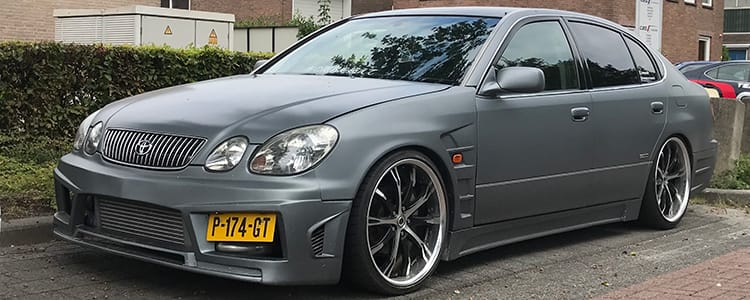
The Toyota Aristo ran two generations from 1991 to 2005 as Toyota's JDM luxury sport sedan — the car every other market received as the Lexus GS. The first generation (JZS147, 1991–1997) offered the 2JZ-GE naturally aspirated alongside the 2JZ-GTE twin-turbo, with bodywork by Italdesign Giugiaro and roughly 4,200 robot welds in the body assembly. The second generation (JZS161, 1997–2005) put the same 2JZ-GTE fitted to the A80 Supra RZ into a four-door RHD body — the V300 trim is why the Aristo is collected today. Production ended in 2005 when Toyota folded the line into the global Lexus GS.
The 2JZ-GTE in the JZS161 V300 received VVT-i on the intake camshaft from the 1997 introduction, sequentially-staged twin turbochargers, and a JDM-cap factory rating of 280 PS at 5600 rpm — the same figure quoted for the Supra RZ of the same era. Power routed through a 4-speed or 5-speed automatic; a 6-speed Getrag manual was offered only on the V300 Vertex Edition and is the rarest factory configuration of any Aristo.
The V300 launched with VSC and TRC standard, four-channel ABS, and 16-inch wheels with brakes upsized over the S300. The chassis around it was tuned for highway composure rather than touge response — heavier and longer-wheelbase than the Supra it shared an engine with.
None of this carried over to the export Lexus GS. The GS400 used Toyota's 4.0L 1UZ-FE V8, not the 2JZ-GTE, and the GS300 retained the naturally aspirated 2JZ-GE.
The Aristo carries the same drivetrain as the A80 Supra Turbo — but in a four-door luxury sedan, automatic gearbox, RHD only, with no factory motorsport history outside Japan. The Skyline GT-R earned legend status through Group A, Bathurst, and Gran Turismo; the Supra earned it through the MkIV's coupe silhouette and aftermarket drag and time-attack cars. The Aristo got neither, and it spent most of the 2000s as a low-premium import.
Three things are changing that picture. The 25-year US import rule reached the JZS161 V300 in 2022, and post-facelift cars are clearing customs year by year. Clean MkIV Supras have priced past $100,000 — a V300 Aristo offers the same engine and the same tuning headroom for a fraction of that.
The VIP tuning scene that built its identity around the Celsior has expanded into Aristo and Crown Athlete platforms, pulling JDM-spec examples back into demand in Japan and in importing markets.
Editorial notes
Quick read
Constants
Chassis history
The Aristo had two generations from 1991 until 2005, and the second one is the one everyone talks about. The JZS147 is the cheaper way in, and it's the same chassis underneath. The JZS161 is where the V300 lives, and that's the four-door 2JZ-GTE that Toyota never sold anywhere outside Japan.
First generation — S140 series (JZS147; 1991–1997)
Buyer's call
The Aristo is a luxury sedan that happens to have the Supra's engine. That sentence captures most of what's good and bad about it. You get the 2JZ-GTE tuning headroom in a body that hides what's under the hood, and you give up the manual gearbox most buyers want and the coupe styling that drives Supra prices.
Reliability
The Aristo is a Toyota underneath, so the engine is bulletproof if you stay on top of it. Most of the trouble on a V300 comes from the sequential turbo system getting tired, the A340E auto cooking itself under heavy boost, and the cooling system aging out. None of these are deal breakers if the paperwork's there.
| Issue | Cause | Solution | Est. cost |
|---|---|---|---|
| A340E auto trans failure | Heat, old ATF, high boost, worn clutches | Rebuild + shift kit + external cooler | $2500-5500 |
| 2-3 shift flare/harsh shift | Valve body wear, solenoids, low line pressure | Valve body rebuild/solenoids; verify TPS | $600-1800 |
| Radiator end tank crack | Aging plastic tanks, heat cycling | Replace radiator + cap; flush with Toyota coolant | $350-900 |
| Water pump seep/leak | Age, bearing wear, neglected timing service | Timing belt kit + water pump + seals | $900-1800 |
| Timing belt overdue risk | Unknown history; importers skip major service | Full timing service immediately after purchase | $900-1800 |
| Crank pulley wobble | Harmonic damper rubber delaminates | Replace crank pulley; inspect keyway and bolt | $350-900 |
| VVTi gear rattle/leak (2JZ) | Worn VVTi cam gear; seal hardening | Replace VVTi gear and cam seal; fresh oil | $600-1400 |
| Valve cover gasket leaks | Gasket shrink; overtorque; heat cycles | Replace gaskets + plug tube seals; clean PCV | $250-700 |
| Cam/crank seal oil leak | Aged seals; timing service skipped | Replace seals during timing belt service | $900-1800 |
| Rear main seal leak | Age; crankcase pressure; long oil intervals | Confirm source; replace seal when trans out | $900-2000 |
| Turbo oil seal smoke | Worn CHRA, high mileage, poor oiling | Rebuild/replace turbo; check oil feed/return | $900-2500 |
| Boost leaks/hesitation | Old couplers, cracked hoses, loose clamps | Pressure test; replace couplers/lines; retune | $150-700 |
| Detonation on bad tune | Aggressive boost, poor fuel, wrong plugs | Compression check; proper tune; colder plugs | $500-6000 |
| Fuel pump weak under load | Old pump, clogged sock/filter, low voltage | Replace pump + filter; check wiring and relay | $300-900 |
| Injector imbalance/misfire | Dirty injectors, aging coils, oil in plug wells | Injector clean/flow + coils/boots + gaskets | $400-1500 |
| O2 sensor slow/rich running | Aged sensors; exhaust leaks upstream | Replace O2 sensors; fix leaks; reset trims | $250-800 |
| Idle hunting/stall | Dirty IAC/TB, vacuum leaks, BOV venting | Clean TB/IAC; smoke test; recirc BOV | $150-600 |
| Power steering rack leak | Inner seals fail; boots fill with fluid | Rebuild/replace rack; flush system | $900-2200 |
| PS pump whine/aeration | Suction hose cracks; low fluid; worn pump | Replace suction/return hoses; rebuild pump | $250-900 |
| Front tension rod bushings | Hydraulic bush leaks; age and potholes | Replace bushings/arms; alignment afterward | $350-900 |
| Lower ball joint wear | Age; torn boots; heavy front end | Replace LBJs; inspect control arms | $300-800 |
| Rear toe bushing wear | Rubber degradation; aggressive alignment | Replace bushings/arms; full 4-wheel alignment | $500-1400 |
| Wheel bearing hum | Age, impacts, water intrusion | Replace hub/bearing assembly | $350-900 |
| Brake caliper slide seizure | Dry pins, torn boots, corrosion | Service/replace calipers; new rotors/pads | $400-1200 |
| ABS/TRAC warning lights | Wheel speed sensors, tone rings, wiring breaks | Scan codes; replace sensor/repair harness | $150-700 |
| A/C weak at idle | Low refrigerant, tired compressor, condenser clog | Leak test; recharge; replace compressor if needed | $200-1600 |
| Heater core seep | Age corrosion; neglected coolant changes | Replace heater core; flush cooling system | $900-1800 |
| Cluster backlight/pixels | Aging bulbs/LEDs, solder cracks | Cluster rebuild or replacement | $200-700 |
| Window regulator failure | Cable fray, plastic guides break | Replace regulator; lube tracks | $250-650 |
| Door lock actuator weak | Small motor wear; cold weather worsens | Replace actuator or motor rebuild | $150-450 |
| Rear subframe mount rust | Salt exposure; trapped moisture under undercoat | Rust repair/weld; treat; avoid severe cases | $800-4000 |
| Trunk water intrusion | Tail light seals, trunk gasket, body seam leaks | Reseal lights/seams; dry and treat rust | $100-800 |
| Aftermarket wiring gremlins | Alarm/AV/boost controller hacks and poor grounds | Remove hacks; re-pin/repair harness properly | $300-2000 |
Market
The Toyota Aristo and the Lexus GS300 / GS400 are the same car at the platform and bodyshell level — JZS147 / JZS161 chassis codes for the JDM Aristo, JZS147 / UZS161 for the export Lexus. The split is in the drivetrain and trim. The Aristo V300 (JZS147 and JZS161) ran the 2JZ-GTE twin-turbo inline-six — the same engine as the A80 Supra RZ, JDM only, never offered in any export Lexus GS. Export markets got the Lexus GS300 with the naturally aspirated 2JZ-GE and, on the JZS161 generation, the Lexus GS400 with the 1UZ-FE 4.0L V8 — a V8 that was never sold in the Aristo. The Aristo Vertex Edition body kit, the S300 5MT, the V300 Vertex Edition 6MT (Getrag), the JDM-spec navigation and audio modules, the EMV multimedia screen, and the RHD configuration are all JDM-only. Lexus GS-spec parts cross over for most service items — brakes, suspension, cooling, much of the interior — but the 2JZ-GTE long-block, the JDM ECU, and the V300-specific drivetrain are not interchangeable with any Lexus GS. For a US buyer the practical upshot is: the Aristo gets you a 2JZ-GTE in a sedan, but you import the car under the 25-year rule and source GTE-specific parts through the JDM aftermarket, not through Lexus.
1997 Toyota Aristo 2JZ Twin Turbo (Canada Import) Japan Auction Purchase Review
Specs
Every Aristo runs a 2JZ. The S300 and 3.0V cars use the 2JZ-GE naturally aspirated. The V300 and 3.0V Turbo use the 2JZ-GTE twin-turbo, the same engine as the A80 Supra RZ. The gearbox is almost always an automatic. Factory manuals exist on the V300 Vertex Edition with the Getrag 6MT and on some early NA cars, but you'll spend years looking for one.
| Chassis | Engine | Displacement | Power | Boost | Notes |
|---|---|---|---|---|---|
| JZS147 | 2JZ-GE | 3.0L | 220PS @ 5800rpm (162kW) | N/A | DOHC 24V, NA, JDM rating |
| JZS147 | 2JZ-GE | 3.0L | 230PS @ 6000rpm (169kW) | N/A | VVT-i intro varies by year (est.) |
| JZS147 | 2JZ-GTE | 3.0L | 280PS @ 5600rpm (206kW) | 11.6 psi (0.8 bar) (est.) | Sequential twins, JDM cap-rated |
| JZS161 | 2JZ-GE | 3.0L | 230PS @ 6000rpm (169kW) | N/A | VVT-i, ETCS-i (typical) |
| JZS161 | 2JZ-GTE | 3.0L | 280PS @ 5600rpm (206kW) | 11.6 psi (0.8 bar) (est.) | VVT-i, sequential twins, JDM rated |
| Type | Ratios | Availability | Notes |
|---|---|---|---|
| 4-speed Automatic (A340E) | 2.804/1.531/1.000/0.705 | JZS147 NA & Turbo (most) | RWD electronic auto |
| 5-speed Automatic (A650E) | 3.357/2.180/1.424/1.000/0.753 | JZS161 S300/V300 (var.) | RWD electronic auto |
| 5-speed Manual (R154) | 3.251/1.955/1.310/1.000/0.753 | JZS147 3.0V & 3.0V Turbo (rare) | Factory rare; strong Toyota 5MT |
| 6-speed Manual (Getrag V160/V161) | 3.827/2.360/1.685/1.312/1.000/0.793 | JZS161 V300 Vertex Ed. (6MT) | Getrag; limited factory fitment |
Lineup
JDM Aristos came in 3.0V, 3.0Q, S300, V300, and the Vertex Edition body kit cars. The Vertex Edition is the JDM-only sport pack with the aero and the sport seats. The V300 Vertex Edition with the 6MT is the rarest factory Aristo and the one people chase.
| Generation | Trim | Engine | Key features |
|---|---|---|---|
| JZS147 (1st gen, 1991-1997) | 3.0V | 2JZ-GE 3.0 NA | RWD, luxury spec, 4AT, traction control (var.) |
| JZS147 (1st gen, 1991-1997) | 3.0Q | 2JZ-GE 3.0 NA | RWD, higher luxury, leather/wood (var.), 4AT |
| JZS147 (1st gen, 1991-1997) | 3.0V (5MT) | 2JZ-GE 3.0 NA | RWD, rare 5MT, sportier tune, limited availability |
| JZS147 (1st gen, 1991-1997) | 3.0V Turbo | 2JZ-GTE 3.0 TT | RWD, twin turbo, 4AT, larger brakes (var.) |
| JZS147 (1st gen, 1991-1997) | 3.0V Turbo (5MT) | 2JZ-GTE 3.0 TT | RWD, rare 5MT, twin turbo, sport suspension (var.) |
| JZS161 (2nd gen, 1997-2005) | S300 | 2JZ-GE 3.0 NA | RWD, 5AT, VSC/TRC (var.), luxury interior |
| JZS161 (2nd gen, 1997-2005) | S300 Vertex Edition | 2JZ-GE 3.0 NA | RWD, aero, sport seats (var.), 5AT |
| JZS161 (2nd gen, 1997-2005) | S300 (5MT) | 2JZ-GE 3.0 NA | RWD, rare 5MT, sport-oriented, limited availability |
| JZS161 (2nd gen, 1997-2005) | V300 | 2JZ-GTE 3.0 TT | RWD, twin turbo, 4AT/5AT, larger brakes (var.) |
| JZS161 (2nd gen, 1997-2005) | V300 Vertex Edition | 2JZ-GTE 3.0 TT | RWD, aero, sport suspension (var.), 4AT/5AT |
| JZS161 (2nd gen, 1997-2005) | V300 Vertex Edition (6MT) | 2JZ-GTE 3.0 TT | RWD, Getrag 6MT, LSD (var.), rare factory combo |
Pricing
The Aristo trades wider than most JDM sedans because the V300 turbo and the S300 NA are completely different cars in market terms. A rough S300 import sits at the bottom of the range. A documented stock V300 with paperwork sits at the top. The middle of the market is where you'll spend most of your time looking, and it's where modified V300s end up because mods don't help resale.
Today's market range: $9,000 to $55,000 (median ~$24,000). Source: JDMBUYSELL / USS Auction.
Clean, stock V300s are trending up as US eligibility expands and supply tightens; NA cars stay affordable. Modified/high-km examples lag. Expect continued premiums for documented, rust-free, original-condition cars.
Inspect
Walk this list with the seller, not in front of them. The Critical items mean walking away if there's no paperwork backing them up. Pay extra attention to the turbo health and the timing belt history on a V300, because both are expensive to fix after the fact.
Cross-shop
If the Aristo doesn't end up being the right car, the natural alternative is the Lexus GS300 or GS400, which is the same chassis with US specs and easier parts. The JZX100 Chaser gets you a 1JZ-GTE and a factory 5MT for less money. The Soarer is the coupe version of the same Toyota DNA.
US-market sibling; easier parts/registration
1JZ-GTE, lighter feel; 5MT available
RB25DET sedan; similar sleeper vibe
AWD twin-turbo wagon; rare, fast GT
1JZ/2JZ grand tourer; shared Toyota DNA
Compare
Among the JDM 2JZ and RB sedans, the Aristo is the most luxurious, the Chaser is the most playful, and the R33 Skyline is the most capable on a track. The table below leans toward what the Aristo actually does well, which is highway comfort and tuning headroom in a body that doesn't look fast.
| Feature | Toyota Aristo | Nissan Skyline R33 | Toyota Chaser JZX100 |
|---|---|---|---|
| Engine/Induction | 2JZ-GTE TT / 2JZ-GE NA | RB25DET T / RB26DETT TT | 1JZ-GTE TT / 2JZ-GE NA |
| Power (factory) | 280 PS (V300) / ~220 PS NA | 250-280 PS depending trim | 280 PS (1JZ-GTE) / NA lower |
| Transmission | Mostly 4AT A341E | 5MT/4AT depending model | 5MT available on Tourer V |
| Drivetrain layout | FR (RWD) | FR or AWD (GT-R) | FR (RWD) |
| Tuning ceiling | High; 2JZ supports big power | High; RB strong but costlier | High; 1JZ strong, cheaper |
| Aftermarket support | Excellent (2JZ ecosystem) | Excellent (Skyline ecosystem) | Strong (JZX drift/GT scene) |
| Ride/comfort | High; luxury-biased | Medium; sportier, noisier | Medium-high; sedan comfort |
| Handling feel | Stable, less agile due to weight | More agile; GT-R very capable | More playful; lighter front feel |
| Collector premium | Rising for clean V300s | High for GT-R; mixed for GTS | Strong for Tourer V manuals |
| Running costs | Moderate; Toyota parts access | Higher; RB/ATTESA parts cost | Moderate; 1JZ parts plentiful |
| Best buy criteria | Stock V300, records, no rust | Unmodified, rust-free, service | Manual Tourer V, clean shell |
Gallery
Drivetrain
Editorial
A documented JZS161 V300 with stock turbos, a clean auction sheet, and a recent timing belt service is the safest starting point. Skip anything under $12,000 on a V300 — a cheap V300 almost always means the previous owner ran it hard, and turbo seals, blown couplers, and a tired A341E automatic will absorb what you saved on the purchase price.
The S300 is the sensible Aristo. A clean S300 runs about half what a V300 does, and the 2JZ-GE naturally aspirated will outlast most other components on the car. If comfort and long-term durability matter more than tuning headroom, the S300 is the better fit — the trade-off is softer resale because it's not the car the 2JZ crowd is searching for.
The JZS147 is the cheaper entry point on the same chassis, and that can make sense for a budget buyer. Age is the problem: rubber is end-of-life, rear subframe mount rust is a known failure mode, and the early cars without VVT-i lack the refinements that make the JZS161 a better daily driver. A documented JZS147 3.0V Turbo with the R154 5MT changes the conversation; otherwise the JZS161 V300 holds more value.
The one Aristo to pass on is a modified V300 with a single-turbo swap, a cut harness, and no tune documentation. The 2JZ-GTE will support serious power when the work is done correctly and documented, but undocumented modifications transfer risk entirely to the buyer. On this car, a stock example beats a badly modified one every time.
FAQ
Citations
Sources last verified:
New site! Spotted a bug? We're listening.