Import guide
Are Kei Trucks Legal in the US? State-by-State Rules
Kei trucks are not freely road-legal in the US. A new kei truck can only be imported for off-road / private-property use — never road-registered. Even a 25-year-old kei truck is prohibited or speed/road-restricted for on-road use in most states (unrestricted road use in only about 7 states as of a June 2026 review), and excluded from interstate highways in nearly every state.
On this page
Quick answer
Kei trucks are not freely road-legal in the United States. New kei trucks cannot be imported for highway use at all; only 25-year-old examples clear the federal import gate under the 25-year exemption. Even then, only about 7 states allow unrestricted on-road use — roughly 27 restrict kei trucks to lower-speed or special-class roads, and about 14 prohibit on-road registration entirely. Nearly every state bars kei trucks from interstate highways. If you want to browse available kei trucks, see the kei trucks for sale listings.
What This Covers
The short answer: a kei truck is not freely road-legal in the United States. A new kei truck cannot be road-registered anywhere in the US — it can only be brought in as an off-road / private-property vehicle that will never be driven on public roads. A 25-year-old kei truck clears the federal import gate, but that does not make it road-legal: most states still prohibit it or restrict it to low-speed local roads, only about 7 states allow unrestricted road use, and nearly every state bars kei trucks from interstate highways. So for the typical buyer who wants to drive a kei truck on public roads, the realistic answer in most of the country is no, or only with significant restrictions.
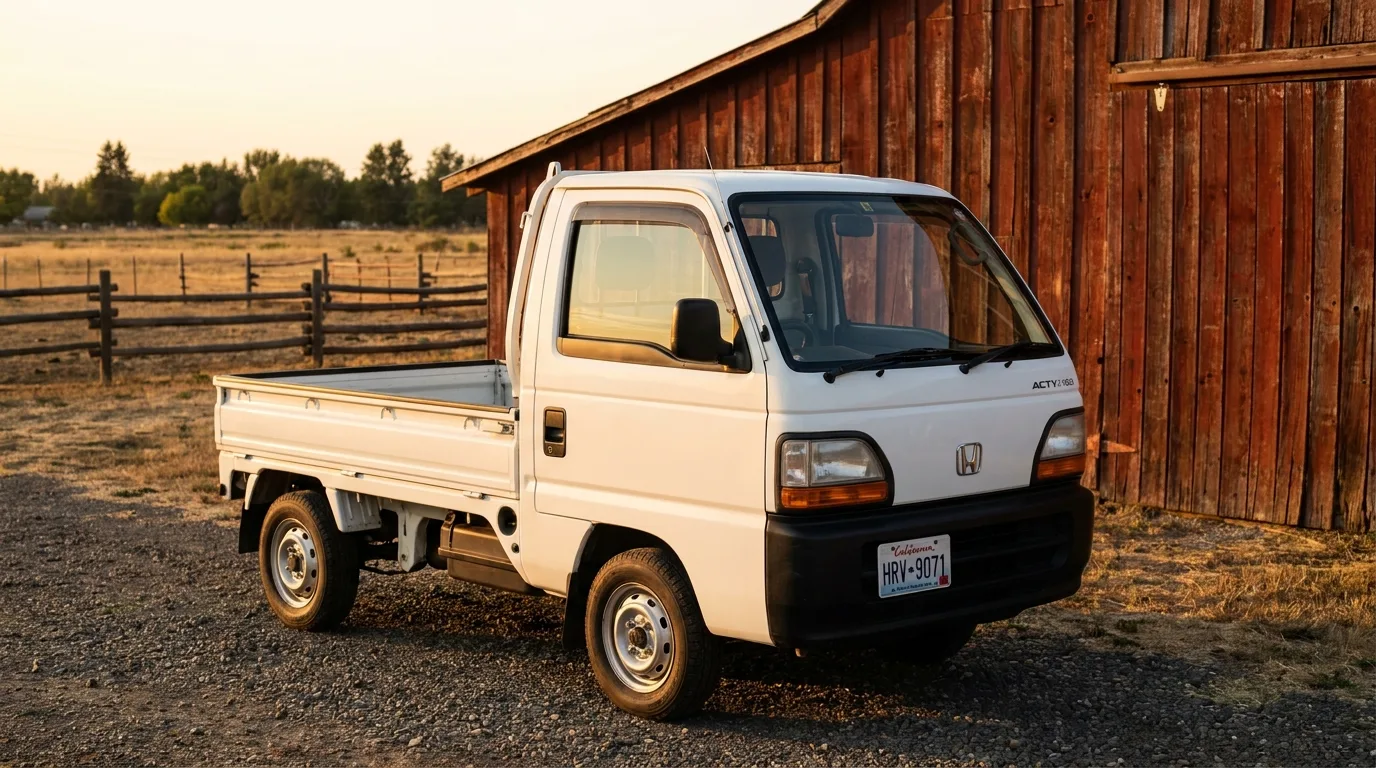
Kei trucks (軽トラック, keitora) and their van counterparts (kei vans such as the Honda Acty Van, Subaru Sambar Van, and Daihatsu HiJet Van) are Japanese domestic-market light-utility vehicles defined by Japan's kei-car dimensional and displacement limits. The reason the bottom line above is not a simple yes/no is that there are two distinct legal questions buyers commonly conflate: (1) whether a kei truck can be imported into the US, and (2) whether it can be driven on public roads after importation. These are governed by different bodies of law — and clearing the first does not clear the second.
This guide addresses both questions with reference to the applicable federal regulations and the current state-level road-use landscape. For the general federal import framework, see the 25-year rule and importing a car from Japan. Note that the rules described here apply specifically to kei trucks and kei vans; kei passenger cars — the Beat, Cappuccino, AZ-1, and similar — are covered at the end of this guide.
Are New Kei Trucks Legal? (Federal Import Status)
A new kei truck cannot be registered for road use anywhere in the United States. Any kei truck under 25 years old cannot legally be imported for US highway use at all. The federal gate is 49 USC 30112 ("Prohibitions on manufacturing, selling, and importing noncomplying motor vehicles and equipment"), which prohibits importing or selling for road use any vehicle that has not been certified as complying with all applicable Federal Motor Vehicle Safety Standards (FMVSS). Kei trucks have not been certified to FMVSS; a Covington & Burling analysis published in December 2025 described new kei trucks designed for highway use as "de facto banned" for US road use on this basis.
The only pathway for a newer kei truck is to import it as an off-road / non-highway vehicle that will never be registered for public-road use. Under this pathway the vehicle must be permanently modified to a maximum speed of 25 mph and certified to applicable non-road (off-road) emissions standards. This is what dealers mean when they describe a truck as an "off-road only" import — it is legal for private property only, not for any public road in any state. The title issued in this case — where a title is issued at all — reflects off-road status, not road registration, and (as the state sections below explain) an off-road title generally cannot later be converted to a road-use registration.
The 25-year exemption (49 CFR 571.7 + 49 CFR Part 591) is the practical federal pathway for most kei truck imports. A vehicle whose manufacture date is 25 or more years in the past is exempt from NHTSA FMVSS conformance and from EPA emissions conformance (the EPA's parallel exemption kicks in at 21 years). This is the same exemption that makes the Skyline GT-R and Honda NSX importable — but for kei trucks, federal eligibility is only half the story. See the 25-year rule guide for the full federal eligibility framework and form-filing sequence.
The State-by-State Road-Use Layer
Federal clearance under the 25-year exemption settles only the import question. Whether a 25-year-eligible kei truck can then be titled, registered, and driven on state public roads is determined entirely by the state — and in most states the answer is no, or only with restrictions. As of a June 2026 state-by-state review: only about 7 states impose no kei-specific road restrictions; roughly 27 allow registration with restrictions (speed or road-class caps, county or local-ordinance opt-ins, or farm/special vehicle classes); about 14 refuse on-road registration outright; and 2 have no clear statewide rule. Nearly every state excludes kei trucks from interstate highways — Texas is the clearest exception. Looser compilations count up to 17 “street legal” states by ignoring road-class limits; the table below applies the stricter test of whether any kei-specific restriction exists. The landscape is actively in flux, with states reclassifying in both directions.
Several state prohibitions trace to the American Association of Motor Vehicle Administrators (AAMVA) — a non-governmental body that produces model guidance for state DMVs, not binding law — whose "Best Practice" document characterises kei vehicles as substandard in safety and emissions. Following that guidance, multiple states have issued their own binding rules: New York's DMV "will not register or title any Kei-class vehicle" lacking FMVSS and EPA compliance (NY DMV, Register an Imported Vehicle); Georgia's Department of Revenue bars titling and registration of kei vehicles and is revoking existing titles (GA DOR Policy Bulletin MVD-2023-05); and Pennsylvania (PennDOT Mini Trucks FAQs) limits kei trucks to off-road, farm-exemption, or antique (occasional-use) titles unless the owner holds a pre-December 2021 grandfathered-status letter. California's registration rules require FMVSS certification and CARB emissions compliance that kei trucks cannot meet (CA DMV, Register an Imported Vehicle). Where a state's own published source exists, the table below cites it; for states without a clean public bulletin, the status reflects state DMV guidance and state-law compilations and should be confirmed with the state DMV before purchase.
The table below lists every state. The five states with dedicated registration guides on this site are linked in the first column. A buyer's specific county and road class can add restrictions even within a permissive state.
| State | On-road status | Current rule |
|---|---|---|
| Alabama | Restricted | Mini-truck class (Ala. Code §32-6-59); 25 mph governor required; no interstates |
| Alaska | Prohibited | DMV limits imported mini trucks to off-road / private-property use |
| Arizona* | Full road use | Titles as OHV with on-road designation; no kei-specific road or speed limit |
| Arkansas* | Restricted | Class 8 farm-vehicle registration (§27-14-726); roads ≤55 mph; no interstates |
| California | Prohibited | FMVSS + CARB compliance required; off-highway registration only |
| Colorado | Restricted (from 2028) | HB25-1281 (2025): roads ≤55 mph, no limited-access highways; registration window opens Jan 1, 2028 |
| Connecticut* | No clear rule | No statute; DMV decides case-by-case with inconsistent outcomes |
| Delaware* | No clear rule | No statute or confirmed registration pathway; outcomes vary by office |
| Florida | Restricted | Fla. Stat. §316.2122: roads posted ≤35 mph only; may cross higher-speed roads |
| Georgia | Prohibited | DOR bulletin MVD-2023-05; existing titles revoked; legislative fix vetoed May 2025 |
| Hawaii* | Prohibited | No on-road registration framework; off-road use only |
| Idaho* | Full road use | No kei-specific restriction; standard registration |
| Illinois* | Restricted | “NON USA STANDARD” title limits use to special-interest status; some municipalities allow roads ≤35 mph |
| Indiana | Restricted | BMV mini-truck title; all public roads except interstates |
| Iowa | Prohibited | Iowa Code §321.30: FMVSS manufacturer label required; registration refused at any age |
| Kansas | Restricted | KSA 8-15,106: city streets only where a city ordinance permits; no highways |
| Kentucky | Restricted | SB 63 (eff. June 2025): county opt-in; no interstates or parkways; 20-mile cap on marked highways |
| Louisiana | Restricted | La. RS 32:299.2: roads ≤55 mph; no interstates or controlled-access highways |
| Maine | Prohibited | Registrations halted around 2023; working group and follow-on bill pending (2026) |
| Maryland* | Prohibited | MVA issues no on-road registration; no legal framework |
| Massachusetts | Full road use | RMV registers kei vehicles since Sept 18, 2024 (after a three-month halt) |
| Michigan | Full road use | Secretary of State dropped off-road-only stance Nov 2024; standard titles issued |
| Minnesota | Restricted | Minn. Stat. §169.045: only on roads designated by local ordinance |
| Mississippi* | Restricted | Titles as a standard truck; operation limited to roads ≤35 mph |
| Missouri* | Restricted | Local-ordinance opt-in only; roads ≤45 mph where allowed |
| Montana* | Full road use | No kei-specific restriction; permanent plates available on 11+ year vehicles |
| Nebraska | Restricted | DMV mini-truck title; no interstates, expressways, or freeways (Neb. §60-6,379) |
| Nevada* | Prohibited | DMV routes kei trucks to OHV registration; street use prohibited |
| New Hampshire* | Restricted | RSA 259:50-a: roads ≤35 mph; 25-mile radius for commercial use |
| New Jersey* | Prohibited | MVC requires full FMVSS/EPA compliance; no registration pathway |
| New Mexico* | Prohibited | MVD applies FMVSS/equipment rules to exclude kei trucks |
| New York | Prohibited | DMV will not register or title any kei-class vehicle |
| North Carolina | Restricted | G.S. §20-121.1 (2019): roads ≤55 mph; no interstates |
| North Dakota* | Restricted | No kei statute; reported roads ≤55 mph with one-time inspection; no interstates |
| Ohio | Restricted | ORC §4511.215: local-ordinance opt-in; roads ≤35 mph |
| Oklahoma | Restricted | 47 O.S. §1151.3: roads ≤55 mph; no interstates |
| Oregon | Prohibited | No registration pathway; HB 4063 (2026) died in committee |
| Pennsylvania | Restricted | Off-road, farm-exemption, or antique titles only; pre-Dec 2021 grandfather letters; HB 1205 pending |
| Rhode Island | Prohibited | H8013 (July 2024) ended new registrations; ~30 grandfathered vehicles limited to ≤35 mph roads |
| South Carolina* | Full road use | No kei-specific restriction; standard title and registration |
| South Dakota* | Restricted | Street-legal UTV class; roads ≤65 mph; no interstates |
| Tennessee | Restricted | Medium-speed vehicle (TCA §55-1-125): roads ≤35 mph; no interstates |
| Texas | Full road use | Legal since April 2024; SB 1816 (eff. Sept 2025) treats it as an ordinary motor vehicle — no road-class limit |
| Utah* | Restricted | Roads ≤50 mph; no interstate access |
| Vermont | Prohibited (change pending) | S.326 passed both chambers May 2026; would allow registration from July 1, 2026 if signed |
| Virginia* | Restricted | Low-speed-vehicle class: roads ≤35 mph; 2026 bill to raise the cap died in committee |
| Washington | Restricted | Low-speed-vehicle framework: roads ≤35 mph; confirm with DOL |
| West Virginia | Restricted | Special Purpose Vehicle (§17A-13-1): no controlled-access or federal-aid roads; 20-mile cap on marked roads |
| Wisconsin | Restricted | Standard registration refused (§341.10(6)); collector-plate path with occasional-use conditions |
| Wyoming* | Restricted | Multipurpose-vehicle class; all roads except interstates |
Interstate highways: excluded almost everywhere
In nearly every state that allows kei trucks on the road, the registration carries speed or road-class limits that exclude interstate highways — restricted states cap use to lower-speed local roads, and Colorado's HB25-1281 (2025) expressly bars kei vehicles from roads posted above 55 mph and from limited-access highways. Texas is the clearest exception: SB 1816 (effective 2025) treats a qualifying miniature vehicle as an ordinary motor vehicle, with no road-class or interstate restriction in the statute — operation is subject only to general traffic law. Check your state's specific road-class rule rather than assuming either way.
States that reversed or tightened rules recently
Texas is the clearest example of a state moving toward permission: its DMV first allowed titling and registration of "mini vehicles" in an April 2024 Registration and Title Bulletin, and the legislature then codified road-legal status in Senate Bill 1816 (89th Legislature, effective September 1, 2025). Massachusetts halted kei registrations in June 2024, then reversed course that September after public backlash; since September 18, 2024 the RMV again registers 25-year-old kei vehicles. Michigan's Secretary of State dropped its off-road-only classification in November 2024 and issues standard titles. Kentucky's SB 63 (effective June 2025) created a county opt-in registration path, and Colorado's HB25-1281 (signed May 2025) legalizes kei vehicles on roads posted 55 mph and below — though its registration window does not open until January 1, 2028.
In the other direction: Georgia's Department of Revenue (Policy Bulletin MVD-2023-05) bars titling and revokes existing registrations (an administrative challenge stalled in 2025, and a legislative fix — HB 308 — was vetoed in May 2025); Rhode Island ended new kei registrations with H8013 (July 2024), leaving only a small grandfathered fleet on ≤35 mph roads; Maine halted registrations around 2023, with a working group and follow-on bill still pending; Pennsylvania tightened in December 2021 following AAMVA guidance; and Oregon's HB 4063 (2026), which would have created a pathway, died in committee. Vermont sits at the hinge: S.326 passed both chambers in May 2026 and would allow registration from July 1, 2026 — but the governor's signature was unconfirmed at this guide's June 2026 review. Treat this as a snapshot, not a permanent reference.
Off-Road and Private-Property Use
In every US state, a kei truck can be operated on private property without registration — on a farm, a ranch, a construction site, or an off-road recreation area. This is the primary use case for kei trucks imported as off-road-only vehicles (speed-limited to 25 mph and modified to non-road emissions standards), and it is the use case the AAMVA guidance was not targeting.
Off-road-only kei trucks imported under this pathway typically: carry no standard NHTSA VIN; may have no title at all in some states (property records or a bill of sale serve as ownership documentation); are mechanically or electronically limited to 25 mph; and may not be registered or insured for road use. Buyers who want a truck for farm, ranch, property management, or off-road recreation and have no need for public-road use can source a kei truck under this pathway from most states without the state-law complications described in the section above.
The practical trap documented in the existing blog post at Kei Trucks: Are They Here to Stay? applies here: a buyer who purchases a truck with an off-road-only title intending to later register it for road use in a state that does not allow kei truck registration will find that the off-road title cannot be converted. Confirm the title status before buying, and confirm your state's registration rules before committing.
Registering a Kei Truck — Practical Steps
For buyers in states where road registration is permitted, the registration sequence for a 25-year-eligible kei truck generally follows the same federal-clearance path as any other 25-year import — CBP port entry, NHTSA Form HS-7 (Box 1 for the 25-year exemption), and EPA Form 3520-1 — then a state-level title and registration step that varies by state. The US JDM import process guide covers the federal CBP entry sequence in detail.
At the state DMV step, kei trucks present complications that standard JDM passenger cars do not: Japanese-format VINs (fewer than 17 characters) often require state-assigned VIN inspection; some states treat kei trucks under a separate vehicle class ("multipurpose vehicle", "specialty vehicle", or "farm vehicle") rather than under the standard passenger-car or light-truck title classification; and several states require proof that the vehicle is not speed-limited before issuing a road-use title. The most common mistake is purchasing a truck with an off-road-only or farm-use title from another state and then discovering the destination state will not convert that title to a road-use registration.
- Confirm your state's current policy on kei truck road registration before purchasing — rules have changed in both directions since 2023.
- Check the title status of any used kei truck already in the US: off-road-only titles and farm-use registrations are not convertible to road-use titles in most states.
- Verify the VIN format — most Japanese kei trucks carry a non-standard VIN that requires a state VIN inspection and, in some states, a state-assigned replacement VIN.
- For a fresh import, use a licensed customs broker familiar with kei truck entries; the HS-7 and EPA 3520-1 form sequence is the same as other 25-year imports but the vehicle class may prompt additional scrutiny.
- If you are in a restricted state, understand the specific road-class limit (35 mph? 55 mph? no interstates?) before you register, since driving above the permitted speed limit on a road-class-restricted registration can have insurance and liability consequences.
Kei Vans, Kei Cars, and the Distinction
The AAMVA guidance and most state restrictions specifically target mini-trucks (kei trucks) and kei vans used as light utility vehicles — that is, vehicles in the small-pickup and van body styles that overlap with regulated commercial light-truck categories. The safety and emissions concerns cited by AAMVA relate to the utility-vehicle class.
Kei passenger cars — the Honda Beat, Suzuki Cappuccino, Autozam AZ-1 (Mazda), Suzuki Alto Works, Mitsubishi Minica, and similar two- or four-seat kei sports and micro-cars — generally do not fall under the mini-truck registration restrictions and register through the same pathway as standard JDM passenger cars. State DMVs have not, as a general matter, extended the kei-truck restrictions to kei passenger cars; however, if a buyer's state has broad language prohibiting "vehicles that do not meet FMVSS" (as Iowa Code §321.30 does), that language could apply to kei cars as well as kei trucks. Confirm with your specific state DMV.
Kei vans — Honda Acty Van (Street), Subaru Sambar Van, Daihatsu HiJet Van — share the kei truck's utility-vehicle profile and tend to be subject to the same state restrictions as the flatbed/tipper kei truck body styles.
Buying Tips — Avoiding the Title Trap
The single most common and most costly mistake in the US kei truck market is buying a truck without understanding its title status and the road-use rules of your state. Several documented patterns to watch for:
- Off-road-only title sold without disclosure — Some dealers in states where kei trucks cannot be road-registered title them as off-road or farm vehicles and sell them without clearly disclosing the restriction. Ask explicitly for the title type before purchase.
- Speed limiter present or absent — A truck imported under the off-road pathway is mechanically limited to 25 mph. This is not always disclosed, and a speed-limited truck cannot be registered for highway use in any state regardless of the state's general kei truck posture.
- Stale state-law assumptions — Dealers and online forums often carry state-by-state lists that have not been updated since 2023. Texas was widely cited as prohibiting kei trucks until April 2024; Massachusetts was widely cited as prohibiting them until mid-2024. Verify the current rule with the specific state DMV, not a forum post.
- County-level variations in permissive states — Even in states where road registration is broadly permitted, some counties impose stricter emissions rules. Utah's Salt Lake County enforces emissions checks that rural counties do not require.
- For a comprehensive overview of what kei trucks are, the popular models (Acty, HiJet, Carry, Sambar), and their practical uses, see Kei Trucks: Are They Here to Stay?
FAQ
Frequently asked questions
- Are new kei trucks legal in the USA?
- No. A new kei truck cannot be imported for US highway use because it has not been certified to Federal Motor Vehicle Safety Standards (FMVSS), as required by 49 USC 30112. New kei trucks can only be imported as off-road / non-highway vehicles, permanently modified to a 25 mph maximum speed and meeting non-road emissions standards. They cannot be registered for public-road use in any state.
- Can you drive a kei truck on public roads in the US?
- In most of the US, not freely — and in many states, not at all. A kei truck 25 years old or older clears the federal import hurdle under the 25-year exemption (49 CFR 571.7 + 49 CFR Part 591), but that does not make it road-legal. As of a June 2026 review, only about 7 states allow unrestricted on-road use; roughly 27 restrict use (lower-speed roads, county opt-ins, or special vehicle classes — interstates are excluded almost everywhere), and about 14 prohibit road registration entirely. A newer truck, or any truck imported on an off-road-only title, cannot be registered for road use in any state. Whether your specific kei truck can be driven on public roads depends entirely on your state — confirm with the state DMV before buying.
- Which states prohibit kei truck road registration?
- As of a June 2026 review, about 14 states do not allow kei trucks to be registered for public-road use: Alaska, California, Georgia, Hawaii, Iowa, Maine, Maryland, Nevada, New Jersey, New Mexico, New York, Oregon, Rhode Island (new registrations ended July 2024), and Vermont (where legislation that would allow registration passed in May 2026 and awaited the governor's signature). Several of these are confirmed by the state's own government: New York (NY DMV will not register or title any kei-class vehicle), Georgia (GA Dept. of Revenue Policy Bulletin MVD-2023-05), Iowa (Iowa Code §321.30), Maine (registrations halted, working group pending), and Oregon (no pathway; the 2026 bill died in committee). For states without a published bulletin, the status reflects cross-checked state-law compilations. Rules change in both directions — verify with your state DMV before purchasing.
- Are kei trucks street legal in Texas?
- Yes, as of April 2024. Texas reversed a prior restriction and now allows kei trucks to be titled and registered like normal vehicles, and Senate Bill 1816 (effective September 1, 2025) codified this — a qualifying miniature vehicle is treated as an ordinary motor vehicle, with no road-class or interstate restriction in the statute. Road registration for 25-year-old kei trucks is available through the county Tax Assessor-Collector in the same manner as other imported vehicles; the <a href="/learn/topics/us-import-process/texas/">Texas import registration guide</a> covers the process step by step.
- Are kei trucks street legal in California?
- No. California does not permit kei trucks to be registered for general on-road use. To register an imported vehicle, the CA DMV requires FMVSS certification plus California Air Resources Board (CARB) emissions compliance and a smog certificate (CA DMV, Register an Imported Vehicle) — requirements a kei truck cannot meet. Kei trucks can instead be registered as off-highway vehicles for private-property and designated off-road use only. The <a href="/learn/topics/us-import-process/california/">California import registration guide</a> covers the process for standard JDM passenger cars.
- Are kei trucks street legal in Florida?
- With restrictions. Florida titles and registers kei trucks as mini trucks, but Florida Statute §316.2122 limits their operation to roads with a posted speed limit of 35 mph or less (crossing a higher-speed road at an intersection is permitted) — interstates and highways are off-limits. Florida has no statewide emissions test, which removes one obstacle. The <a href="/learn/topics/us-import-process/florida/">Florida import registration guide</a> covers the title process; confirm the current restriction with the FLHSMV before purchasing.
- Are kei trucks street legal in New York?
- No. The New York DMV will not register or title any kei-class vehicle unless it is brought into compliance with the FMVSS and EPA requirements in effect when it was manufactured — not practically achievable for a kei truck. The 25-year federal exemption clears the import at the border but does not compel New York to register the vehicle. Kei trucks in New York are limited to off-road and private-property use; the <a href="/learn/topics/us-import-process/new-york/">New York import registration guide</a> covers standard JDM passenger cars.
- Are kei trucks street legal in Washington State?
- With restrictions. Current state-law compilations report that Washington registers kei trucks under its low-speed-vehicle framework, limiting operation to roads with posted speed limits of 35 mph or less — no highways or interstates. Washington publishes little kei-specific guidance, so confirm the current policy with the Department of Licensing before purchasing. The <a href="/learn/topics/us-import-process/washington/">Washington import registration guide</a> covers the standard import and title process.
- What is an off-road-only kei truck?
- A kei truck imported as an off-road vehicle has been permanently modified to a maximum speed of 25 mph and certified to non-road (off-road) emissions standards, rather than FMVSS highway standards. These trucks are legal for use on private property (farms, ranches, construction sites, off-road areas) but cannot be registered for or driven on public roads in any US state. They often carry no standard 17-character VIN and may have no title in some states.
- Are kei vans legal in the US?
- Kei vans (Honda Acty Van, Subaru Sambar Van, Daihatsu HiJet Van) are subject to the same state-level road-registration restrictions as kei trucks, because they share the utility-vehicle profile targeted by AAMVA guidance. The federal import framework is the same: 25-year-old examples are importable under the 25-year exemption; state registration depends on the state. Kei passenger cars (Honda Beat, Suzuki Cappuccino, Mazda AZ-1) are a distinct category and are generally not subject to the mini-truck restrictions.
- What role did AAMVA play in kei truck bans?
- The American Association of Motor Vehicle Administrators (AAMVA), a non-governmental advisory body, published a Best Practice document characterising kei vehicles as substandard in safety and emissions. Beginning around 2010, several states — including Georgia, Pennsylvania, and Rhode Island — moved to restrict or revoke kei truck registrations following this guidance. AAMVA guidance is not binding law, but it carries significant weight with state motor vehicle agencies.
- Does the 25-year rule make a kei truck street legal?
- The 25-year exemption (49 CFR 571.7 + 49 CFR Part 591) clears the federal import gate — NHTSA and EPA conformance are not required for vehicles 25 years or older. It does not guarantee road registration in a specific state. State registration is a separate question governed entirely by state law, and approximately 14 states prohibit kei truck road registration regardless of the vehicle's age. Confirm your state's rules before importing.
- How do I know if a kei truck has a road-use title or an off-road title?
- Ask the seller for the title document before purchasing and note the title type. An off-road-only or farm-use title will typically say so on its face; in some states there is no title at all for off-road vehicles. A road-use title is issued by a state DMV as a standard certificate of title. If the truck is still in Japan, its imported status (off-road vs. standard) will depend on how it is declared at US CBP entry — ask the importer or exporter what entry code and off-road modification status applies.
See also
Related topics
Sources
- US Code via govinfo.gov (GPO, govt) — 49 USC 30112, Prohibitions on manufacturing, selling, and importing noncomplying motor vehicles and equipment (the FMVSS-certification gate that keeps non-compliant kei trucks off US roads)
- US Code of Federal Regulations (govt) — 49 CFR 571.7, applicability of Federal Motor Vehicle Safety Standards
- US Code of Federal Regulations (govt) — 49 CFR Part 591, CBP importation of motor vehicles; 25-year FMVSS exemption at §591.5(i)
- US NHTSA (govt) — Importing a Vehicle (Form HS-7 and the 25-year exemption)
- US EPA (govt) — Importing Vehicles and Engines (emissions requirements; age-based exemption)
- US CBP (govt) — Importing a Motor Vehicle (vehicles under 25 years old must meet all FMVSS; HS-7 declaration)
- New York DMV (state govt) — Register an Imported Vehicle ("the DMV will not register or title any Kei-class vehicle" lacking FMVSS/EPA compliance)
- Georgia Dept. of Revenue (state govt) — Policy Bulletin MVD-2023-05, Japanese Kei Vehicles and Mini-trucks (bars titling/registration; not FMVSS-compliant, not street legal)
- Pennsylvania PennDOT / DMV (state govt) — Mini Trucks FAQs (no unrestricted on-road registration without a pre-Dec 2021 grandfathered-status letter; off-road or farm-exemption titles only)
- California DMV (state govt) — Register an Imported Vehicle (FMVSS certification, CARB emissions and smog requirements that kei trucks cannot meet for on-road use)
- Texas Legislature (state govt) — Senate Bill 1816, 89th Legislature (codifies title, registration, and on-road operation of qualifying miniature/kei vehicles)
- Maine Secretary of State (state govt) — Working Group on Nonconforming Vehicles (kei registrations halted; legislative review ongoing)
- Iowa Code (state govt) §321.30 — prohibition on registering vehicles lacking a manufacturer FMVSS label
- Colorado General Assembly (state govt) — HB25-1281 (legalizes kei vehicles on roads ≤55 mph, no limited-access highways; registration from Jan 1, 2028)
- Alabama Dept. of Revenue (state govt) — Mini Truck / LSV license plates (25 mph governor; restricted operation)
- Alaska DMV (state govt) — Foreign Vehicles (imported mini trucks limited to off-road / private-property use)
- Florida Legislature (state govt) — Fla. Stat. §316.2122, operation of mini trucks (roads posted 35 mph or less)
- Indiana BMV (state govt) — Mini Trucks special titling (road use permitted; interstates excluded)
- Kansas Legislature (state govt) — KSA 8-15,106 (micro utility trucks: city streets by ordinance; highways prohibited)
- Louisiana Revised Statutes (state law, via Justia) — RS 32:299.2 (mini-trucks: roads ≤55 mph; no interstates or controlled-access highways)
- Massachusetts RMV (state govt) — Advisory: Kei vehicle policy update (registrations resumed September 18, 2024)
- Minnesota Statutes (state govt) — §169.045 (mini trucks: operation only on roads designated by local ordinance)
- Nebraska DMV (state govt) — Minitruck titling (no interstates, expressways, or freeways)
- Ohio Revised Code (state govt) — §4511.215 (mini-trucks: local-ordinance opt-in; roads ≤35 mph)
- Oklahoma Statutes (state law, via Justia) — 47 O.S. §1151.3 (mini trucks: roads ≤55 mph; no interstates)
- Oregon DOT (state govt) — 2026 Legislative Summary (HB 4063, kei truck registration pathway, died upon adjournment)
- South Dakota Dept. of Revenue (state govt) — Off-Road Vehicles (street-legal UTV titling framework)
- Vermont General Assembly (state govt) — S.326 (2026) bill status (mini-truck registration path; passed both chambers May 2026)
- West Virginia DMV (state govt) — Special Purpose Vehicles (§17A-13-1: road-class and distance restrictions)
- AAMVA — American Association of Motor Vehicle Administrators (non-governmental standards/advisory body; its Best Practice model guidance on kei/mini-trucks is followed by many state DMVs but is not binding law)
- Covington & Burling (non-governmental legal analysis) — Kei Trucks and U.S. Regulation: Opportunities and Obstacles Ahead (Dec 2025)
- Carmanji — Kei Truck & Kei Car Laws by State (secondary state-by-state compilation; verify against the state-government sources above and your state DMV)