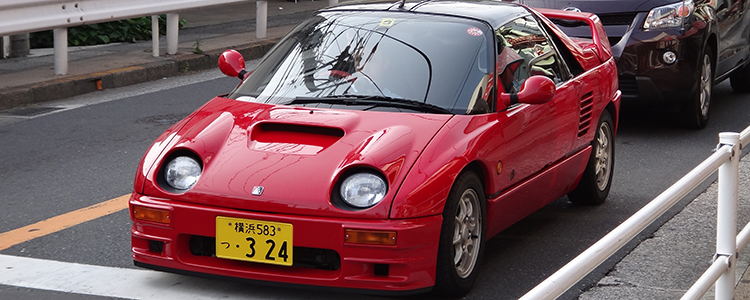
Honda Beat PP1
NA 3cyl scream, 5MT; higher collector premium
Buyer's guide
15 min read
Buyer's guide & specs
Background
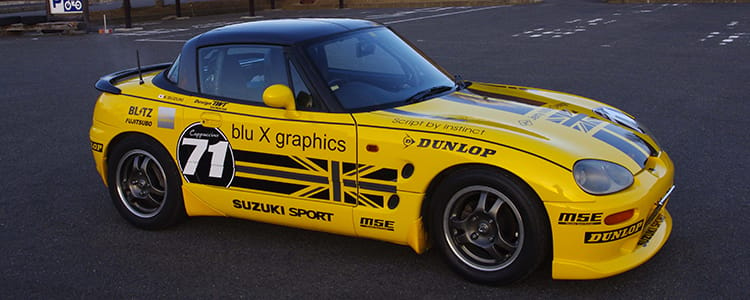
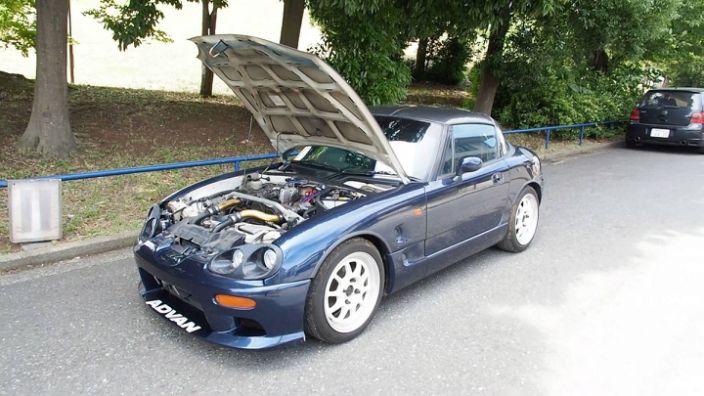
The Suzuki Cappuccino ran from 1991 to 1998 across two chassis — the EA11R with the F6A and the EA21R with the K6A. Both are front-engine, rear-drive kei roadsters capped at 657 cc and 64 PS. The three-piece removable hardtop lets the same car run as a coupe, T-top, targa, or full open — the most versatile roof of the ABC trio. US buyers reach them only through the 25-year import rule; 1991 cars became legal in 2016.
The ABC trio — Cappuccino, Honda Beat PP1, and Mazda Autozam AZ-1 — arrived within an 18-month window between 1991 and 1992, all bounded by the same 660 cc, 64 PS kei ceiling and a 1.4-metre body-width limit.
The Beat (PP1, 1991–1996) used a mid-engine naturally aspirated 656 cc E07A revving to 8,100 rpm; the AZ-1 (PG6SA, 1992–1995) put a mid-engine 657 cc turbocharged F6A behind gullwing doors. The Cappuccino mounted the same 657 cc F6A longitudinally up front, routing power rearward — a front-mid layout Suzuki positioned far enough back to produce a near-50/50 weight split.
Launch curb weight was 725 kg (1,598 lb), with aluminium bonnet, roof panels, and rear deck contributing to the figure. English-language specification coverage sourced from Wikipedia, verified 2026-05-15, aligns with Suzuki factory data on the weight and layout figures.
The Cappuccino roof is three removable aluminium panels plus a rear glass and roll bar that folds back into the body. With all panels in place the car is a fixed coupe; remove the front centre panel for a sunroof configuration, both outer panels for T-top, or all three for targa — lower the rear glass and roll bar from inside the cabin and it becomes a full convertible.
The three panels stack in the trunk for storage, which explains why cargo space drops to roughly 2.5 cu ft with the roof down. Club Cappo's owner notes, current as of 2026-05-15, document that panels ding easily from being shuffled in and out; replacement seals and latches are among the harder Cappuccino parts to source today, particularly for EA11R cars with 30-year-old rubber.
Editorial notes
Quick read
Constants
Chassis history
The Cappuccino had two generations between 1991 and 1998, and they feel closer to each other than most JDM split runs. The EA11R is the rawer car with the F6A and a timing belt to keep on top of. The EA21R got the K6A with a chain instead of a belt, plus a few build quality tweaks that make it the easier Cappuccino to live with.
EA21R (657cc K6A turbo; 1995–1998)
Buyer's call
The Cappuccino is one of those cars where the good and the bad come from the same place. It's a tiny RWD turbo kei roadster, so the fun stuff (light weight, balance, the four piece roof) and the headaches (rust, cooling, small parts) all trace back to that same brief.
Reliability
The Cappuccino engine is nearly bulletproof if you keep up with maintenance. Most of the trouble comes from age and from cars that sat. Rust is the big one, especially on the sills and floorpans. Cooling system parts get tired and overheating cooks the head gasket or turbo. The roof seals leak and soak the carpet if you don't catch it.
| Issue | Cause | Solution | Est. cost |
|---|---|---|---|
| Sill/rocker rust perforation | Trapped moisture, blocked drains, poor repairs | Cut/weld proper panels; treat cavities; re-seal drains | $1500-6000 |
| Floorpan rust & seam rot | T-top leaks soaking carpet; salt exposure | Weld patches, seam seal, undercoat; fix leak source | $800-4000 |
| Rear arch rust | Mud traps in inner arch; thin factory coatings | Arch repair sections; cavity wax; clean liners/drains | $800-3500 |
| Trunk water intrusion | Roof seal shrink, tail lamp seals, trunk gasket | Replace seals; reseal lamps; clear drains; dry interior | $200-1200 |
| T-top/hardtop seal leaks | Aged rubber, misaligned latches, warped panels | New seals, adjust latches, shim hardtop; condition rubber | $300-1500 |
| Overheating in traffic | Weak radiator, fan faults, clogged coolant passages | New radiator/thermostat; fan relays; full coolant flush | $400-1400 |
| Radiator end tank cracks | Old plastic tanks heat-cycling and pressure spikes | Replace radiator cap and radiator; inspect hoses | $250-800 |
| Heater core leak | Corrosion from old coolant; constant dampness | Replace heater core; flush system; replace foam seals | $600-1600 |
| Turbo oil smoke | Worn turbo seals/bearings; poor oiling; high boost | Rebuild/replace turbo; clean intercooler; fix oil feed | $700-2200 |
| Turbo boost creep/spike | Sticky wastegate, cracked hoses, wrong restrictors | Service wastegate; restore OEM plumbing; proper boost ctrl | $150-900 |
| Detonation under boost | Lean from mods, weak fuel pump, bad plugs, hot intake | Restore airbox; fuel pump; colder plugs; proper tune | $300-2000 |
| Vacuum hose failures | Heat-cycled brittle hoses and incorrect routing | Replace all vacuum lines; verify diagram routing | $80-400 |
| Idle hunting/stalling | Vac leaks, dirty IAC, failing TPS, low base idle | Smoke test; clean IAC; set TPS; fix leaks | $150-900 |
| Timing belt overdue (F6A) | Neglected service intervals; unknown import history | Timing belt kit + water pump + seals immediately | $500-1200 |
| Timing chain rattle (K6A) | Oil neglect; stretched chain/tensioner wear | Chain/tensioner/guides; verify oil pressure | $700-1800 |
| Oil leaks (cam/turbo seals) | Aged gaskets, crankcase pressure, turbo line seals | Reseal cam cover; replace turbo line gaskets; PCV service | $200-1200 |
| Blow-by/low compression | Worn rings from abuse/overheat; poor oil changes | Leakdown confirm; rebuild or replace long block | $2000-6000 |
| 2nd/3rd gear synchro wear | Hard shifting, old fluid, high km | Fresh GL-4; rebuild gearbox with synchros/bearings | $900-3000 |
| Clutch slip | Worn disc; oil contamination; higher-than-stock boost | Clutch kit; resurface flywheel; fix rear main if leaking | $600-1600 |
| Clutch master/slave leaks | Aged seals; moisture-contaminated fluid | Replace master/slave; flush fluid; inspect hard line | $200-600 |
| Diff whine/leaks | Old fluid, worn bearings, pinion seal aging | Fluid change; replace seals; rebuild if bearing noise | $120-1800 |
| Rear suspension rear-steer | Worn trailing arm bushes and lateral link bushes | Replace bushes (OEM/poly); full alignment | $500-1800 |
| Ball joint/control arm wear | Age, torn boots, pothole impacts | Replace joints/arms; alignment; inspect knuckles | $300-1200 |
| Brake line corrosion | Salt exposure; moisture trapped on underbody | Replace hard lines; new flex lines; full bleed | $400-1500 |
| Seized brake calipers | Old fluid, torn boots, corrosion on pistons/sliders | Rebuild/replace calipers; new pads/rotors; flush | $300-1200 |
| Wheel bearing noise | Age, water ingress, curb impacts | Replace bearing/hub; inspect spindle surfaces | $250-800 |
| Pop-up headlight failure | Worn gears, tired motors, corroded switches | Rebuild motor/gears; clean grounds; replace switch | $150-700 |
| Charging/ground gremlins | Corroded grounds, tired alternator, hacked wiring | Clean grounds; alternator test/replace; repair loom | $150-900 |
| Window regulator issues | Dry tracks, worn regulators, weak motors | Lubricate tracks; replace regulator/motor as needed | $150-700 |
| Fuel smell/leaks | Aged rubber lines, filler neck rust, tank vent issues | Replace lines/clamps; repair filler neck; vent check | $200-1200 |
| Fuel pump weak under load | Old pump, clogged sock/filter, low voltage | New pump/filter; check wiring and relay voltage drop | $200-700 |
| Cracked exhaust manifold | Heat cycling, thin cast/steel, stiff exhaust mounts | Replace manifold; add flex section; check mounts | $400-1500 |
| A/C not cold | Leaking seals, old condenser, R12-to-R134a hacks | Leak test; replace drier/seals; proper recharge | $250-1200 |
| Interior mold/damp | Roof leaks; blocked drains; wet carpet never dried | Fix leaks; remove/dry carpet; treat mold; dehumidify | $150-1200 |
Market
The Cappuccino was never sold new in North America. The only factory export market was the United Kingdom, which received approximately 1,182 cars between 1993 and 1995 (initial order 1,500, reduced to 1,182, finished in silver and white only — source: WP article). Of those, roughly 1,100 were registered in England and 82 went to other European countries. UK cars are right-hand-drive and identical to JDM-spec mechanically. North American owners reach the Cappuccino through the 25-year rule: 1991 cars became US-legal in 2016, with the final 1998 cars clearing in 2023. Canadian owners had access from 2006 onwards under Canada's 15-year rule. There are no LHD factory Cappuccinos. Most US imports today come either directly from Japanese auctions or via the UK gray market (the latter often with documented service history but, given UK road-salt exposure, an elevated rust-inspection burden).
Specs
Every Cappuccino runs a 657cc turbo three cylinder making the kei cap 64 PS. The EA11R uses the F6A with a timing belt, and the EA21R uses the K6A with a chain. The gearbox is a 5-speed manual on most cars, with an optional 3-speed automatic that you should usually skip if you have the choice.
| Chassis | Engine | Displacement | Power | Boost | Notes |
|---|---|---|---|---|---|
| EA11R | F6A | 0.657L | 64 PS @ 6500rpm (63 hp) | estimated ~9-11 psi | DOHC 12V, turbo, kei cap 64PS |
| EA11R | F6A | 0.657L | 64 PS @ 6500rpm (63 hp) | estimated ~9-11 psi | torque spec varies by source; see note |
| EA21R | K6A | 0.657L | 64 PS @ 6500rpm (63 hp) | estimated ~9-11 psi | DOHC 12V, turbo, kei cap 64PS |
| Type | Ratios | Availability | Notes |
|---|---|---|---|
| 5-speed Manual | estimated; exact factory ratios not confirmed | Cappuccino 5MT (all years) | RWD; close-ratio kei sports gearing |
| 3-speed Automatic | estimated; exact factory ratios not confirmed | Cappuccino 3AT (all years) | RWD; torque converter automatic |
Lineup
There's really just the Cappuccino. The two chassis (EA11R and EA21R) cover the F6A versus K6A split, and the BA performance pack adds an airbag, limited slip diff, four wheel ABS, and power mirrors. The 5MT is the one to buy. The 3AT exists but it's not why anyone wants a Cappuccino.
| Generation | Trim | Engine | Key features |
|---|---|---|---|
| EA11R (Series 1) | Cappuccino (5MT) | F6A 657cc I3 turbo | 5MT, FR, removable hardtop, 14in wheels |
| EA11R (Series 1) | Cappuccino (3AT) | F6A 657cc I3 turbo | 3AT, FR, removable hardtop, 14in wheels |
| EA11R (Series 2) | Cappuccino (5MT) | F6A 657cc I3 turbo | 5MT, FR, removable hardtop, updated interior |
| EA11R (Series 2) | Cappuccino (3AT) | F6A 657cc I3 turbo | 3AT, FR, removable hardtop, updated interior |
| EA21R | Cappuccino (5MT) | K6A 657cc I3 turbo | 5MT, FR, removable hardtop, OBD updates |
| EA21R | Cappuccino (3AT) | K6A 657cc I3 turbo | 3AT, FR, removable hardtop, OBD updates |
| EA11R/EA21R | Cappuccino Limited (market-dependent) | F6A or K6A 657cc I3 turbo | special trim, unique colors, option packages |
Production
Suzuki built around 28,000 Cappuccinos total at the Kosai plant. The first two years made up over half the run because demand cooled fast after the initial JDM kei sports boom. About 1,100 cars went officially to the UK between 1993 and 1995, which is why so many right hand drive Cappuccinos circulating today have UK plates in their history.
| Year | Notes |
|---|---|
| 1991 | Launch October 1991 at Kosai plant; first car off line late November 1991 (source: WP article) |
| 1992 | 1991–1992 combined production ~15,000 cars; ~90% domestic, ~10% UK export. UK reveal at British International Motor Show October 1992 (source: WP article) |
| 1993 | UK sales begin October 1993; initial 1,500-car UK order cut to 1,182 (source: WP article) |
| 1995 | EA11R → EA21R transition: F6A replaced by K6A, 3-speed automatic option introduced, lighter wheels (source: WP article) |
Pricing
The Cappuccino sold for around $12,000 USD equivalent when new in 1991. The numbers below are what one costs today. Clean rust free 5MT cars sit in the middle of the market, and documented low mile examples from either chassis are starting to climb again after the 2020 to 2022 spike cooled off.
Original MSRP: $12,000 at launch in 1991. WP article cites ~$12,000 USD-equivalent depending on options. JDM launch pricing was set in yen and varied by trim (5MT vs 3AT, later 'BA' performance pack adding airbag, LSD, four-wheel ABS, and power mirrors). Suzuki has not published consolidated launch MSRP figures in English; the $12,000 figure is the most-cited contemporary equivalent. (source: WP article, Wikipedia EN)
Today's market range: $10,000 to $35,000 (median ~$20,000). Source: JDMBUYSELL / USS Auction.
After a sharp 2020–2022 kei-car run-up, Cappuccino prices normalized in 2023–2025. Demand remains strong for rust-free, stock 5MT cars; modified or rusty examples soften. Expect modest appreciation for top-condition, documented cars.
Inspect
Walk this list with the seller, not in front of them. The Critical items mean you walk away if there's no paperwork. The High items can usually be priced into the deal. Bring a magnet for the sills and a flashlight for the trunk well, because that's where the worst Cappuccino problems hide.
Cross-shop
If the Cappuccino isn't the right car, the natural alternatives are the Honda Beat if you want a screaming NA mid engine kei, or the Mazda Autozam AZ-1 if you want the gullwing turbo MR weirdness. The Mazda MX-5 is the bigger faster easier version of the same idea, and the Daihatsu Copen is the newer kei roadster with a power folding hardtop.
NA 3cyl scream, 5MT; higher collector premium
Newer kei roadster; power hardtop; easier daily use
Bigger, faster, easy parts; similar open-top purity
Same kei turbo vibe; cheaper entry, practical hatch
Compare
Among the ABC trio, the Cappuccino is the most balanced and the easiest to live with day to day. The Beat is the most exciting at full throttle. The AZ-1 is the rarest and the most expensive. The table below leans toward the Cappuccino's strengths because that's where it actually wins, on layout balance, roof versatility, and resale liquidity.
| Feature | Suzuki Cappuccino | Honda Beat PP1 | Mazda Autozam AZ-1 |
|---|---|---|---|
| Layout/roof | RWD; 3-piece hardtop | FWD; targa top | MR; targa top |
| Engine family | 657cc turbo I3 (F6A/K6A) | 656cc NA I3 (E07A) | 657cc turbo I3 (F6A) |
| Power (JDM cap) | 64 PS (63 hp) @ ~6500 | 64 PS (63 hp) @ ~8100 | 64 PS (63 hp) @ ~6500 |
| Torque character | Turbo midrange; boosty | High-rev NA; peaky | Turbo; short gearing |
| Transmission | 5MT (some 3AT) | 5MT only | 5MT only |
| Curb weight | ~725-795 kg (varies) | ~760-810 kg | ~720-750 kg |
| Driving feel | Front-mid feel; stable RWD | Go-kart, rev-happy | Wild MR; very short wheelbase |
| Practicality | Best roof versatility; small trunk | Tight storage; simple top | Least cargo; cabin tight |
| Market pricing (US) | $12k-$28k typical | $18k-$40k typical | $20k-$45k typical |
| Collectibility | High; iconic kei roadster | Very high; NA scream + rarity | Very high; gullwing novelty |
| Rust sensitivity | High; sills/floors common | Moderate-high; check floors | High; structure critical |
| Best buyer profile | Weekend fun; top-down touring | Rev lover; track/autocross | Collector; novelty + MR thrills |
| Key watch-outs | Cooling, turbo, roof seals | Oil use, rust, parts | Heat mgmt, parts, crash damage |
Gallery
Editorial
The safest entry is a documented, rust-free EA21R with the 5-speed manual. The K6A timing chain removes the largest known-deferred service item, and the later build quality reduces the electrical and trim faults that show up on early cars.
Avoid anything priced under $12,000. At that level, rust is almost always present but not obvious in photos — what you save on the purchase you’ll spend twice over on sill and floorpan repairs. Most clean 5MT examples trade between $15,000 and $28,000.
If the EA21R is out of reach, a clean EA11R is a strong alternative. Walk in knowing the F6A timing belt, water pump, and tensioner need replacing if there’s no dated paperwork on the service; budget an extra $800 on top of the asking price and treat it as a baseline cost.
Modified cars deserve extra scrutiny. Raised boost without proper fueling, hacked wiring, pod filters drawing hot air, cut springs — these problems are rarely visible in listing photos but surface within a season of driving. Stock, unmodified cars command stronger resale and have typically seen less abuse.
The roof is the detail that catches first-time buyers. Seals are 30 years old and aluminium panels ding easily when stored in the trunk. Check every latch and seal before committing — budget $300 to $1,500 for refurbishment, because a leaking roof turns into a rusted floor inside one wet season.
FAQ
Citations
Sources last verified:
New site! Spotted a bug? We're listening.