Toyota Corolla AE92 GTi
Light FWD Toyota; 4A-GE revs; more space
Buyer's guide
15 min read
Buyer's guide & specs
Background
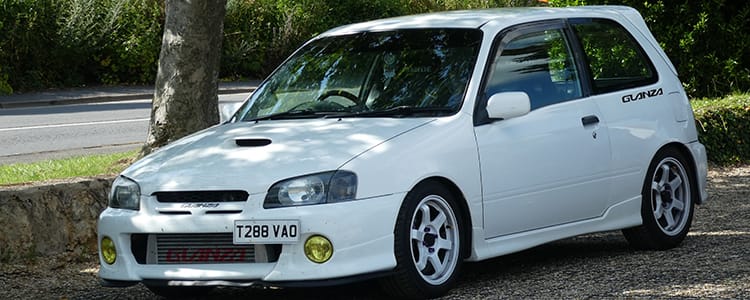
The Toyota Starlet ran from 1973 to 1999, shifting from a rear-wheel-drive economy car (KP60/KP70) to the front-wheel-drive EP-platform hot hatch that most buyers are after today. The enthusiast case rests on two trims: the EP82 GT Turbo (1989–1995) and the EP91 Glanza V (1996–1999), both using the 1.3-litre 4E-FTE with a CT9 turbocharger and a curb weight near 900 kg. Every turbocharged Starlet was JDM-only; the only cars ever sold through US Toyota dealers were third-generation KP61 base models between the 1981 and 1984 model years.
Both the EP82 GT Turbo (1989–1995) and the EP91 Glanza V (1996–1999) use the 4E-FTE — a 1.3-litre DOHC 16-valve four with a CT9 turbocharger, factory-cooled by an air-to-air intercooler.
The EP82 arrived with optional all-wheel drive, ABS, a limited-slip differential, a rear strut tower bar, and Toyota's Electronic Modulated Suspension (TEMS). The EP91 Glanza V revised the ECU mapping and sharpened turbo response, while keeping curb weight near 900 kg — good for high-7-second to low-8-second 0-60 mph times in stock form.
Toyota never offered either car in North America. The 25-year import window opened for 1996 EP91 cars in 2021 and closes out the generation in 2024.
Owner communities and period coverage align on the dominant 4E-FTE failure modes: carbon buildup, turbo cracking between the port and wastegate, and intercooler degradation. The block handles 180-220 hp on stock internals with proper fueling, conservative tuning, and an upgraded intercooler; past that, rotating-assembly work becomes the limiting factor.
The cooling system is the highest-risk subsystem on any high-mileage car. A stuck thermostat, a tired radiator cap, or a clogged turbo oil-feed line all converge on the same outcome — a cooked head gasket or a seized turbo.
Pre-purchase, auction inspection sheets give a useful starting-point read on condition; verify coolant, cap pressure, turbo shaft play, and any oil mist in the boost piping before committing.
Editorial notes
Quick read
Constants
Chassis history
The Starlet ran for six generations from 1973 until 1999. The first three are rear-wheel drive economy cars and the last three switch to front-wheel drive. The EP82 and EP91 are the ones almost every Starlet buyer ends up looking at, because that's where the 4E-FTE turbo lives.
Third generation — P70 (1984–1989)
Fourth generation — P80 (EP82, GT Turbo; 1989–1996)
Buyer's call
The Starlet is a small car that gives you a lot of fun for the money, and the trade-offs are pretty obvious. You get lightweight performance and Toyota reliability. You give up rear seat space, modern safety, and the kind of parts availability you'd get on a Civic.
Reliability
Most Starlet problems trace back to two things. Rust on the older cars, and abuse on the turbo cars. A 4E-FTE that's been beaten on with a cheap boost controller and no fuel system work will eat itself. A rust-free Starlet that's been maintained is still happy at 200,000 miles.
| Issue | Cause | Solution | Est. cost |
|---|---|---|---|
| Severe rust in sills/arches | Thin steel, trapped moisture, old repairs | Cut/weld proper panels; treat cavities; undercoat | $1500-6000 |
| Front frame rail corrosion | Road salt, poor underseal, age | Structural weld repair; avoid filler-only fixes | $2000-7000 |
| Rear beam mount rust/cracks | Rust at mounts, impacts, fatigue | Weld reinforcement; replace beam if needed | $800-2500 |
| Overheating in traffic | Aged radiator, stuck thermostat, weak fan circuit | New rad/thermostat/cap; fix fan relay/switch | $300-900 |
| Head gasket failure (abuse) | Overheating, detonation, old coolant | Machine head, gasket set, bolts; fix root cause | $900-2200 |
| Timing belt overdue | Neglected maintenance; unknown history | Belt, tensioner, idlers; water pump while there | $450-1100 |
| Cam cover oil leak | Hardened gasket, overtightened cover | Replace gasket/grommets; check PCV | $60-250 |
| Distributor O-ring leak | Aged O-ring; heat cycles | Replace O-ring; clean oil off timing area | $50-200 |
| Rear main seal leak | Age, crankcase pressure, worn seal lip | Seal replacement; inspect clutch contamination | $600-1400 |
| Idle hunting/stalling | Vacuum leaks, dirty IAC/TB, bad TPS | Smoke test; clean TB/IAC; set TPS; replace hoses | $150-600 |
| Heater core leak | Corrosion, old coolant, electrolysis | Replace core; flush system; new coolant | $500-1200 |
| Radiator plastic tank crack | Age/heat cycling; old cap overpressure | Replace radiator and cap; inspect hoses | $250-650 |
| Alternator weak/charging drop | Worn brushes/diodes; oil contamination | Rebuild/replace alternator; fix oil leaks | $200-600 |
| Starter slow crank | Worn contacts, tired battery, bad grounds | Replace contacts/starter; clean grounds | $120-450 |
| Fuel pump weak (GT worse) | Age, varnish, running low fuel often | Replace pump/filter; verify pressure under load | $250-700 |
| Injector clog/misfire | Old fuel, clogged filters, heat soak | Ultrasonic clean/flow test; replace seals | $150-600 |
| 2nd gear synchro grind | Wear from hard shifts; old gear oil | Rebuild gearbox; quality fluid may reduce symptoms | $900-2500 |
| Clutch slip/chatter | Worn disc, oil contamination, weak pressure plate | Clutch kit; resurface flywheel; fix oil leaks | $700-1600 |
| CV joint clicking | Torn boots; grease loss; age | Replace axle or reboot early; align after | $200-600 |
| Wheel bearing hum | Age, impacts, water ingress | Replace bearing/hub; check torque and seals | $250-650 |
| Rear beam bush failure | Rubber deterioration; harsh springs | Replace bushes; consider OEM rubber for street | $350-1000 |
| Front ball joint failure | Boot tears; lack of grease; impacts | Replace ball joints/control arms; align | $250-800 |
| Seized front calipers | Corrosion, old fluid, torn dust boots | Rebuild/replace calipers; flush fluid | $250-900 |
| Rear wheel cylinder leak | Corrosion in drum cylinders; old fluid | Replace cylinders/shoes; flush; adjust drums | $200-600 |
| Rusty brake hard lines | Salt exposure; aged coatings | Replace lines with NiCopp; inspect flex hoses | $400-1200 |
| Power steering leaks (if eq) | Aged seals/hoses; pump wear | Replace hoses/seals; rebuild pump if whining | $250-900 |
| A/C weak or inop | Leaks, old compressor, R12-to-R134a hacks | Leak test; replace drier; proper conversion service | $400-1400 |
| Water leaks into trunk | Hatch seal, tail light seals, body vents | Replace seals; reseal lights; clear drains | $80-400 |
| Odometer not counting | Worn plastic gear in cluster (varies by year) | Replace gear/cluster; document mileage correction | $120-500 |
| GT turbo smoking | Worn turbo seals; poor oiling; coked oil | Rebuild/replace turbo; add proper oil feed/return checks | $700-2000 |
| GT detonation/knock | Lean fuel, bad tune, heat soak, low octane | Fuel system refresh; intercooler; conservative tune | $500-2500 |
| Cracked turbo manifold | Heat cycling; missing support; overboost | Replace manifold; new studs; check downpipe stress | $400-1200 |
| Boost leaks (GT) | Old couplers, cracked vacuum lines, loose clamps | Pressure test; replace silicone/couplers; new clamps | $150-600 |
| PCV system clogged | Sludge, short trips, neglected oil changes | Replace PCV/hoses; clean breather; fix oil leaks | $80-300 |
Market
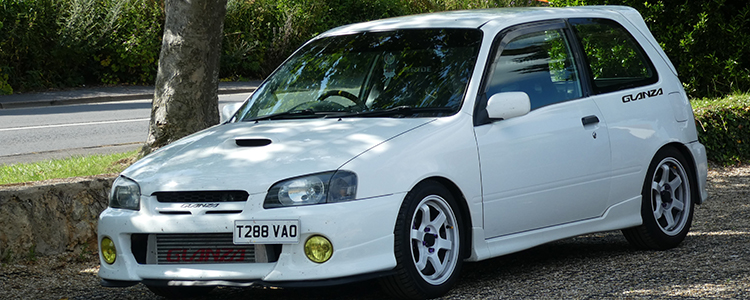
Toyota only sold the Starlet in the United States during the third generation (KP61/KP62, 1981-1984 model years) as a rear-wheel-drive economy hatch with the 1.3-litre 4K-E engine. No turbocharged Starlet was ever offered through US Toyota dealers. The EP71 1.3 Turbo (1986-1989), the EP82 GT Turbo (1989-1995), and the EP91 Glanza V (1996-1999) were all JDM-only with limited grey-market exports to the UK, Ireland, Cyprus, and Australasia. The 25-year FMVSS exemption opened EP82 GT Turbo eligibility in 2014 and EP91 Glanza V eligibility in 2021; the final 1999 cars become US-legal in 2024. Identification cues to confirm a real Glanza V on import: 4E-FTE engine code on the block, CT9 turbocharger, twin-pot front calipers, factory rear spoiler, and the 'Glanza V' badge on the tailgate. The naturally aspirated Glanza S shares the body but uses the 4E-FE and is the cheaper, slower variant.
Specs
The Starlet engine lineup goes from the old K-series 1.0 and 1.2 carbs on the early RWD cars to the twin cam 4E-FE and turbocharged 4E-FTE on the EP82 and EP91. The 4E-FTE is the one that matters. It's a 1.3 liter DOHC 16 valve turbo with a CT9 turbocharger, and it's the reason the Starlet gets imported.
| Chassis | Engine | Displacement | Power | Boost | Notes |
|---|---|---|---|---|---|
| KP40/KP47 | 2K | 1.0L | estimated | N/A | Carb I4; exact JIS output varies by year |
| KP60 | 2K | 1.0L | estimated | N/A | Carb I4; market/year dependent ratings |
| KP60 | 3K | 1.2L | estimated | N/A | Carb I4; exact JIS output varies |
| KP70 | 2K | 1.0L | estimated | N/A | Carb I4; early RWD Starlet |
| KP70 | 3K | 1.2L | estimated | N/A | Carb I4; output varies by market |
| KP70 | 4K | 1.3L | estimated | N/A | Carb I4; higher output RWD variant |
| EP80 | 1E | 1.0L | estimated | N/A | SOHC I4; carb/EFI varies by market |
| EP80 | 2E | 1.3L | estimated | N/A | SOHC I4; carb/EFI varies by market |
| EP80 | 2E-E | 1.3L | estimated | N/A | EFI SOHC I4; exact JIS varies |
| EP82 | 3E-TE | 1.5L | estimated | estimated | Turbo I4; exact boost/output market dependent |
| EP90 | 1E/1E-E | 1.0L | estimated | N/A | SOHC I4; carb/EFI varies by market |
| EP91 | 4E-FE | 1.3L | estimated | N/A | DOHC 16V; output varies by market/year |
| EP91 | 4E-FTE | 1.3L | estimated | estimated | CT9 turbo; JDM rated ~135 PS (varies) |
| EP95 | 4E-FE | 1.3L | estimated | N/A | 4WD variant in some markets; output varies |
| Type | Ratios | Availability | Notes |
|---|---|---|---|
| 4-speed Manual | estimated | P40/P50, P60, early P70 | Early K-series applications; market dependent |
| 5-speed Manual | estimated | P70, P80, P90, P100 | Common fitment; exact ratios vary by gearbox |
| 3-speed Automatic | estimated | P70/P80 (some markets) | Market dependent automatic option |
| 4-speed Automatic | estimated | P90/P100 (some markets) | Aisin 4AT variants; ratios vary by model |
Lineup
Starlet trim names are scattered across the generations and the markets. The ones worth knowing are the GT Turbo on the EP82 and the Glanza V on the EP91. Both use the 4E-FTE. The Glanza S looks like a Glanza V but uses the non-turbo 4E-FE, so check the engine code on the block before you pay Glanza V money.
| Generation | Trim | Engine | Key features |
|---|---|---|---|
| P40/P50 (1st gen, 2-door sedan) | Starlet (base) | 1.0L 2K I4 | 2-door sedan, basic trim, steel wheels |
| P40/P50 (1st gen, 2-door sedan) | Starlet Deluxe | 1.0L 2K I4 | upgraded interior, brightwork, higher equipment |
| P60 (2nd gen, 3-door hatch) | Starlet Standard | 1.0L 2K I4 | 3-door hatch, basic trim, steel wheels |
| P60 (2nd gen, 3-door hatch) | Starlet Deluxe | 1.0L 2K I4 | upgraded interior, brightwork, higher equipment |
| P60 (2nd gen, 3-door hatch) | Starlet (1.2) | 1.2L 3K I4 | larger engine, improved drivability, higher spec |
| P70 (3rd gen, RWD hatch) | Starlet Standard | 1.0L 2K I4 | RWD, 3-door hatch, basic trim |
| P70 (3rd gen, RWD hatch) | Starlet Deluxe | 1.0L 2K I4 | RWD, upgraded interior, brightwork |
| P70 (3rd gen, RWD hatch) | Starlet (1.2) | 1.2L 3K I4 | RWD, 1.2L, higher equipment |
| P70 (3rd gen, RWD hatch) | Starlet (1.3) | 1.3L 4K I4 | RWD, 1.3L, improved performance |
| P80 (4th gen, FWD) | Starlet Base | 1.0L 1E I4 | FWD, 3/5-door, basic trim |
| P80 (4th gen, FWD) | Starlet XL | 1.0L 1E I4 | higher equipment, improved interior, trim upgrades |
| P80 (4th gen, FWD) | Starlet (1.3) | 1.3L 2E/2E-E I4 | 1.3L option, improved torque, higher spec |
| P80 (4th gen, FWD) | Starlet Si | 1.3L 2E-E I4 | sport trim, tachometer, firmer suspension |
| P80 (4th gen, FWD) | Starlet Turbo S | 1.5L 3E-TE I4 Turbo | turbo, sport seats, body kit, uprated brakes |
| P90 (5th gen, FWD) | Starlet 1.0 | 1.0L 1E/1E-E I4 | FWD, 3/5-door, base equipment |
| P90 (5th gen, FWD) | Starlet 1.3 | 1.3L 2E/2E-E I4 | 1.3L, improved drivability, higher spec |
| P90 (5th gen, FWD) | Starlet Si | 1.3L 4E-FE I4 | DOHC, sport trim, tach, firmer suspension |
| P90 (5th gen, FWD) | Starlet GT Turbo | 1.3L 4E-FTE I4 Turbo | turbo, hood scoop, sport seats, rear spoiler |
| P90 (5th gen, FWD) | Starlet GT Turbo (EP91 late) | 1.3L 4E-FTE I4 Turbo | CT9 turbo, revised ECU, improved response |
| P100 (6th gen, FWD) | Starlet 1.0 | 1.0L 4E-FE I4 | FWD, 3/5-door, base equipment |
| P100 (6th gen, FWD) | Starlet 1.3 | 1.3L 4E-FE I4 | 1.3L, improved torque, higher spec |
| P100 (6th gen, FWD) | Starlet Sportif | 1.3L 4E-FE I4 | sport appearance, alloy wheels, firmer suspension |
| P100 (6th gen, FWD) | Starlet Glanza V | 1.3L 4E-FTE I4 Turbo | turbo, CT9, optional LSD, sport interior |
| P100 (6th gen, FWD) | Starlet Glanza S | 1.3L 4E-FE I4 | NA Glanza, sport trim, aero options |
| P100 (6th gen, FWD) | Starlet Carat | 1.3L 4E-FE I4 | lux trim, upgraded interior, higher equipment |
| P100 (6th gen, FWD) | Starlet Reflet | 1.3L 4E-FE I4 | special edition, unique trim, equipment package |
Pricing
Today's market range: $3,500 to $35,000 (median ~$14,500). Source: JDMBUYSELL / USS Auction.
Turbo EP82/EP91 prices remain firm with premiums for stock, rust-free cars; modified examples lag. NA cars are slowly appreciating. As 1999 EP91 becomes import-eligible, demand should lift entry and mid-tier prices, while top cars stay scarce.
Inspect
Walk the Starlet checklist with the car cold and the seller on the other side of the garage. Rust is the deal breaker on any pre-1996 car. Cooling system condition is the deal breaker on any GT Turbo or Glanza V. A 30 minute drive that includes some boost and some highway will tell you most of what you need to know.
Cross-shop
If the Starlet doesn't work out, the natural cross shops are the Honda Civic EG6 if you want more space and a bigger aftermarket, the Suzuki Swift GTi if you want something even lighter and quirkier, or the Daihatsu Charade GTti if you like the tiny turbo hatch idea but want something rarer. The Civic is the sensible choice. The Starlet is the one you buy because you actually want a Starlet.
Light FWD Toyota; 4A-GE revs; more space
Iconic 90s hot hatch; B16 VTEC; huge support
Small, light, fun; cheaper entry; simple upkeep
Lightweight 1.3 DOHC; analog feel; rising cult
Tiny turbo hot hatch; rare; similar sleeper vibe
Compare
The Starlet's competition is basically the Civic EG6 for cross shopping and the Nissan Pulsar GTI-R for raw performance. The Civic is easier to live with. The GTI-R is faster but heavier and more complicated. The Starlet sits in the middle. It's the light, simple, turbocharged Toyota hot hatch, and that combination doesn't really exist anywhere else.
| Feature | Toyota Starlet | Honda Civic EG6 SiR | Nissan Pulsar GTI-R N14 |
|---|---|---|---|
| Power (factory) | EP91 Glanza V: ~135hp | Civic EG6: ~160hp | Pulsar GTI-R: ~227hp |
| Torque (factory) | 4E-FTE: ~116 lb-ft | B16A: ~111 lb-ft | SR20DET: ~210 lb-ft |
| Curb weight | EP91: ~900-950kg | EG6: ~1050-1100kg | GTI-R: ~1290kg |
| Drivetrain | FWD; some LSD-equipped | FWD; LSD common in SiR | AWD; viscous center diff |
| Engine layout | 1.3L I4 turbo (4E-FTE) | 1.6L NA I4 (B16A VTEC) | 2.0L I4 turbo (SR20DET) |
| 0-60 mph (typical) | EP91 turbo: ~7.0-8.0s | EG6: ~7.0-7.5s | GTI-R: ~5.5-6.0s |
| Tuning headroom | 180-220hp common on stock block | NA gains modest; swap-friendly | Big power possible; costly AWD upkeep |
| Reliability baseline | Strong if stock boost & cooling OK | Very strong; watch oil use on B16 | More complex; AWD/boost heat issues |
| Rust risk | High on EP/KP in salted climates | Moderate; rear arches/sills | Moderate; underbody & rear quarters |
| Parts availability | Good aftermarket; some OEM scarce | Excellent OEM/aftermarket support | Specialist parts; pricier supply |
| Cabin practicality | Small; usable hatch, tight rear seat | More space; better ergonomics | More room; heavier, taller stance |
| Collector demand | High for Glanza V/GT Turbo, stock | High for clean EG6/Type R lineage | Niche; rally icon but fewer buyers |
| Insurance/attention | Often flagged due to theft/mods | Also flagged; high theft risk | Less theft; higher repair costs |
Gallery
Editorial
For most buyers the real question is not which Starlet to buy — it's which condition of which Starlet to accept. A clean, unmodified EP91 Glanza V is what most enthusiasts end up wanting. It is also the hardest to find, and the gap between asking price and actual condition is wider on these than on almost any comparable JDM compact.
Start with rust. Any car from a salt-climate country without documented sill, arch, and floor pan repair is a project rather than a driver. The thin steel rots from inside out, and visible surface rust means the repair bill is already in the thousands.
A Japanese auction car with a clean inspection sheet is a more reliable starting point than a UK or Irish example at the same price, given the climate difference. Grading sheets for structure and interior condition matter more on these than mileage does.
Next, assess the mods. A stock GT Turbo or Glanza V commands more than a fast one — ask for receipts and a tune log if the car has a piggyback ECU, a larger turbo, or a front-mount intercooler. A 4E-FTE runs cleanly at 180–220 hp with proper fueling, cooling, and a conservative ECU; a worn pump and a cheap boost controller are a faster path to failure at 250 hp.
Budget $15,000–$25,000 for a documented EP91 Glanza V with its original turbo, a proven timing belt history, and a clean cooling system. Anything cheaper will need work. Anything more expensive needs a build sheet and service history to justify it.
FAQ
Citations
Sources last verified:
New site! Spotted a bug? We're listening.