Import guide
How to Verify a JDM Car's Mileage Before You Buy
What Japanese inspection certificates, auction mileage records and JEVIC odometer certificates show, what each leaves out, and how to compare them.
Sources checked October 12, 2026. Rules and fees change, so confirm with the agency before you buy or ship.

On this page
- What the Japanese records show
- The auction industry mileage database
- Mileage notes and replacement records
- JEVIC odometer certificates
- Physical and paper checks
- Records kept after import: UK, Australia and New Zealand
- When readings do not match
- United States odometer disclosure and tampering rules
- Frequently asked questions
- Related topics
- Sources
Quick answer
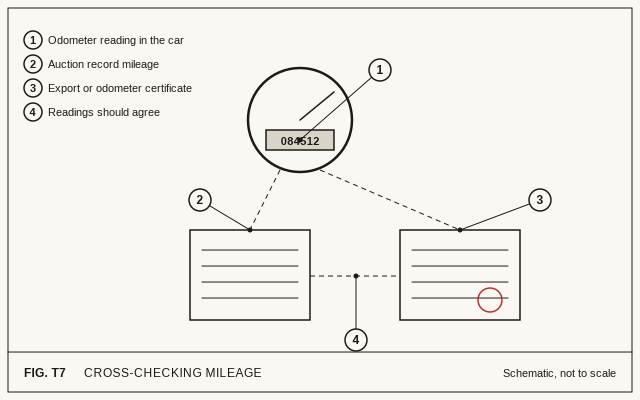
No single record proves a JDM car's lifetime mileage. Japan's inspection certificate can carry dated odometer readings, the auction industry keeps its own mileage database, and JEVIC compares odometer readings with historical ones. Collect several dated records, convert them to one unit, and treat an unexplained decrease as unresolved.
What the Japanese records show
Inspection certificate readings
A Japanese inspection certificate (shaken) can record a dated odometer reading. In the sample electronic record that MLIT, Japan's transport ministry, publishes, the remarks list an odometer indicated value (走行距離計表示値) with a date and a previous odometer indicated value (旧走行距離計表示値) with its own date. Take each reading together with its own date, and keep the certificate's registration and expiry dates separate from them.
A reading is entered at an inspection. MLIT's notice on recording odometer values says the certificate remarks carry the odometer value at the time of the vehicle's inspection. NALTEC, Japan's vehicle inspection agency, describes a renewal inspection as the inspection to undergo when operating a vehicle after its certificate's valid term has expired (checked 12 October 2026).
NALTEC lists the valid term as three years at the first inspection and two years after that for private passenger and mini-sized passenger vehicles. For mini-sized trucks it lists two years at the first inspection and two years after that.
Electronic certificates and the recorded-matters PDF
MLIT's FAQ says electronic inspection certificates have been issued since 4 January 2023 to vehicles that went through new registration, renewal inspection or a similar procedure that would previously have produced a paper certificate.
MLIT's viewer app can export the recorded matters (自動車検査証記録事項) as a PDF. MLIT says that PDF contains all the certificate information, including the IC tag contents, and that it carries an electronic signature. The signature can confirm the authenticity of the electronic data only, and MLIT says the authenticity of a printed copy cannot be confirmed. Ask the seller for the original PDF file.
Start dates, precision and the maximum-recorded value
The ministry notice that introduced the recording took effect on 1 January 2004. It covers ordinary and small vehicles, and excludes vehicles with a maximum speed under 20 km/h and towed vehicles. The Japan Automobile Manufacturers Association (JAMA) gave July 2003 as the start of recording in an October 2014 history. The two sources give different start dates.
The same notice says that a meter judged to display miles is recorded in miles. It also says the digits at the 10 km place and below are entered as 00 km on the workshop's conformity certificate, so older readings can be less precise than a dashboard figure.
From January 2017, an MLIT regional office says, a reading that becomes smaller because of a meter replacement or similar circumstances is accompanied by a 走行距離記録最大値 (maximum recorded distance) in the certificate remarks.
The auction industry mileage database
The used-car industry keeps its own mileage database, separate from MLIT's certificate records. The Automobile Fair Trade Council (AFTC) says the 走行メーター管理システム (mileage meter management system) is operated by the Japan Auto Auction Council. It accumulates the mileage data of cars entered at auto auctions.
AFTC says the check compares a car's mileage with that accumulated data, and that a car with no auction listing history has no data in the system and cannot be checked by it.
AFTC says dealers enrolled in the system can search it when sourcing a car. A buyer can have a purchased car checked at the listed association offices, and AFTC requires the car itself to be brought in. AFTC also says a buyer can compare a car's mileage with documents such as the auction listing sheet and the maintenance record book (点検整備記録簿).
Mileage notes and replacement records
AFTC's rules for four-wheel used-car listings sort cars into four groups. AFTC's current FAQ (checked 12 October 2026) sets out the display rule for each group. These rules govern how dealers display mileage in listings.
- Actual distance: the kilometres shown on the meter are displayed.
- Documented meter replacement: the listing states that the meter was replaced and shows the readings before and after. AFTC defines such a car as one with a record, such as a maintenance record book or warranty, giving the before and after kilometres, the replacement date and the business that did the work.
- Confirmed tampering: the listing states that the meter was tampered with, and the meter's kilometres may not be displayed. AFTC bases this on a previous user's records or the mileage database showing that the meter figure is not the actual distance.
- Doubtful distance: there is no evidence of tampering or replacement, but the meter figure may not be the actual distance. The listing shows a question mark, with an estimated distance if there is a basis for one, or 不明 (not known) if there is none.
Replacement and tampering stickers
AFTC says cars with a replaced or tampered meter carry a sticker on the driver's-side centre pillar. A replacement sticker lists the kilometres before and after the replacement. Photograph the sticker and ask for the workshop paperwork that matches it.
JEVIC odometer certificates
JEVIC Company Limited describes its odometer inspection as verifying the actual odometer mileage against the historical readings of the vehicle. JEVIC's page adds that Transport Malta requires vehicles exported from Japan to Malta to undergo this inspection.
JEVIC presents odometer, structural, function and quarantine inspections as separate services. Its customer page links to separate E-Certificate (Odometer) and E-Certificate (Inspections) pages. Confirm that the certificate you are shown is the odometer one.
Physical and paper checks
Government buyer guides from New South Wales (Australia) and New Zealand list the checks below as clues to weigh against the displayed figure.
Wear and the instrument cluster
- New South Wales: look at the wear on the accelerator, brake and clutch pedals to assess whether it seems appropriate for the kilometres displayed.
- New Zealand Consumer Protection: a low-mileage car whose brake or accelerator pedals are badly worn, or whose driver's seat looks well used, may have had its odometer rolled back.
- New South Wales: look for scratches around the odometer screws and for fingerprints or dust on the inside of the glass over the display.
Paperwork and stickers
Both guides recommend an independent inspection. New South Wales advises seeking an independent vehicle inspection to check for odometer discrepancies in the vehicle's history, and New Zealand Consumer Protection says its basic checks are not a substitute for a pre-purchase inspection by a professional.
- New South Wales: compare the odometer reading with the maintenance records, and make sure the VIN and engine number match the logbook and manual.
- New South Wales: look for oil change and maintenance stickers on windscreens, door frames, in the glove box or under the bonnet, and check that they are consistent with the odometer.
- New South Wales: search the VIN online for previous advertisements or auction records, including earlier condition reports and odometer history.
- Japan: MLIT says the inspection sticker on the windscreen shows when the certificate's valid term expires. Read mileage from the certificate remarks or the recorded-matters PDF instead.
Units and the trip meter
One mile is exactly 1.609344 km, according to the US National Institute of Standards and Technology (NIST). A reading of 100,000 km is about 62,137 miles. Keep the unit with every reading.
The same MLIT notice tells inspectors to confirm that a meter switchable between odometer and trip meter is showing the total distance. Check the same on any photo you are sent.
Records kept after import: UK, Australia and New Zealand
United Kingdom
GOV.UK's MOT history service shows the mileage recorded at each test. For cars, motorcycles and vans it holds results for tests done since 2005, and for Northern Ireland since 2017. You need the vehicle's number plate.
GOV.UK says a wrong MOT mileage tested within the last 28 days is corrected by the MOT centre, which must see the vehicle again. After 28 days you report the mistake online with evidence that gives the correct mileage and a date within one day of the test.
New South Wales, Australia
Service NSW's vehicle registration check includes the three most recent yearly odometer readings, if available. Transport for NSW's sample history report says it makes no warranty or guarantee as to the accuracy of odometer readings, and recommends viewing the logbook and service history.
New Zealand
NZTA's border inspection records the vehicle's odometer reading. When no reading can be recorded, the manual tells inspectors to write zeros in the odometer field, so a zero on that checksheet can mean that no reading was possible.
NZTA says it amends a reading that was incorrectly keyed. If an entry certifier suspects tampering, for example because the entry reading is lower than the border reading, the certifier notes the reading as suspect, gives the owner written notice and forwards the details to the New Zealand Police.
New Zealand Customs says the Customs Import Prohibition (Motor Vehicles) Order 2021 prohibits importing any motor vehicle whose odometer reading does not correctly record the distance driven.
When readings do not match
MLIT's Tohoku Transport Bureau reports that certificate mileage has been recorded wrongly. It says the errors were found, for example, when a reading at a renewal inspection was lower than at the previous inspection. It says a reading in the certificate remarks can be corrected only with a document showing the correct reading at the previous inspection, such as a workshop record or work instruction.
MLIT names meter replacement as one reason a reading becomes smaller, and AFTC's rules separate documented replacement from confirmed tampering and from doubtful distance. Put every reading in the same unit and date order, then ask for the replacement or correction paperwork before drawing a conclusion. Until a decrease is explained by documents, treat the car's mileage as unresolved.
United States odometer disclosure and tampering rules
49 CFR 580.17 (odometer disclosure regulation, National Highway Traffic Safety Administration, eCFR checked 12 October 2026) says a transferor need not disclose odometer mileage for a vehicle manufactured in or before the 2010 model year that is transferred at least 10 years after January 1 of the calendar year matching its model year. For a vehicle manufactured in or after the 2011 model year the period is at least 20 years.
That exemption concerns disclosure on transfer. 49 USC 32703 separately prohibits disconnecting, resetting or altering an odometer intending to change the mileage it registers.
FAQ
Frequently asked questions
- How can I check a Japanese import's mileage before buying it?
- Collect dated records and compare them. These include the inspection certificate remarks or the recorded-matters PDF, the auction sheet and maintenance record book, any replacement paperwork, and a JEVIC odometer certificate if the seller has one. Put every reading in one unit, in date order, and look for decreases.
- What mileage is recorded on a shaken certificate?
- MLIT's sample electronic record shows an odometer indicated value with a date and a previous odometer indicated value with its own date, in the remarks. A reading is entered at an inspection. Since January 2017, a reading made smaller by meter replacement or similar circumstances is accompanied by a maximum recorded distance.
- Can I verify a JEVIC certificate online, and what does it show?
- JEVIC's customer page links to an E-Certificate (Odometer) page, separate from its E-Certificate (Inspections) page. JEVIC describes the odometer inspection as verifying the actual odometer mileage against the vehicle's historical readings. Use JEVIC's own site to check the certificate you were given, and confirm it is the odometer certificate.
- Does an asterisk or circle on an auction sheet mean the odometer was rolled back?
- Not by itself. AFTC's listing rules separate documented meter replacement, confirmed tampering and doubtful distance, and treat them differently. Ask which auction issued the sheet, and for a translation of that auction's legend and the inspector's notes. A replacement should come with before and after readings.
- What if the instrument cluster has been replaced?
- AFTC says a documented replacement needs records giving the kilometres before and after, the replacement date and the business that did the work. A replacement sticker on the driver's-side centre pillar lists the before and after kilometres. Ask for the matching workshop paperwork and keep both readings.
- Why is a later mileage record lower than an earlier one?
- MLIT names meter replacement as one reason a certificate reading becomes smaller, and its Tohoku bureau reports recording errors found when a reading was lower than at the last inspection. New Zealand's process also treats a lower entry reading as possible tampering. Convert units, check dates, and ask for documents before concluding.
- Does a US title marked mileage exempt mean the mileage is accurate?
- No. Under 49 CFR 580.17, as checked on 12 October 2026, an exemption applies to disclosure on transfer, after 10 years for model year 2010 or older and after 20 years for model year 2011 or newer. 49 USC 32703 separately prohibits altering an odometer intending to change the mileage it registers.
- Can pedal or seat wear prove the real mileage?
- No. New South Wales and New Zealand guidance treats wear as a clue. New South Wales says to assess whether pedal wear seems appropriate for the kilometres displayed, and New Zealand says badly worn pedals on a low-mileage car could mean tampering. Both point to a professional inspection.
See also
Related topics
Sources
Agency pages and publications below were checked on October 12, 2026.
- NALTEC, Vehicle inspection categories and valid terms
- MLIT, Electronic vehicle inspection certificate recorded matters sample
- MLIT, Electronic vehicle inspection certificate viewer app
- MLIT, Electronic vehicle inspection certificate FAQ
- MLIT, Notice on recording odometer values on inspection certificates
- JAMA, JAMAGAZINE October 2014
- MLIT Hokkaido Transport Bureau, Maximum recorded distance on inspection certificates
- MLIT Tohoku Transport Bureau, Confirming total distance at inspection
- MLIT, Inspection sticker (kensa hyosho) explanation
- AFTC, Mileage meter management system
- AFTC, Meter replacement and tampering stickers
- AFTC, Used-car FAQ on displaying mileage
- JEVIC, Vehicle inspection services
- JEVIC, Customer portal
- NSW Government, Buying a used vehicle
- New Zealand Consumer Protection, Pre-purchase inspections and checks
- NIST, Revised unit conversion factors
- GOV.UK, Check the MOT history of a vehicle
- GOV.UK, Correcting MOT certificate mistakes
- Service NSW, Check a vehicle's registration
- Transport for NSW, Sample vehicle history report
- NZTA, Border inspection manual
- NZTA, Entry certification vehicle attributes
- New Zealand Customs Service, Vehicles, vessels and aircraft
- eCFR, 49 CFR 580.17 Exemptions
- US Code, 49 USC 32703 Preventing tampering